Nov 25, 2026
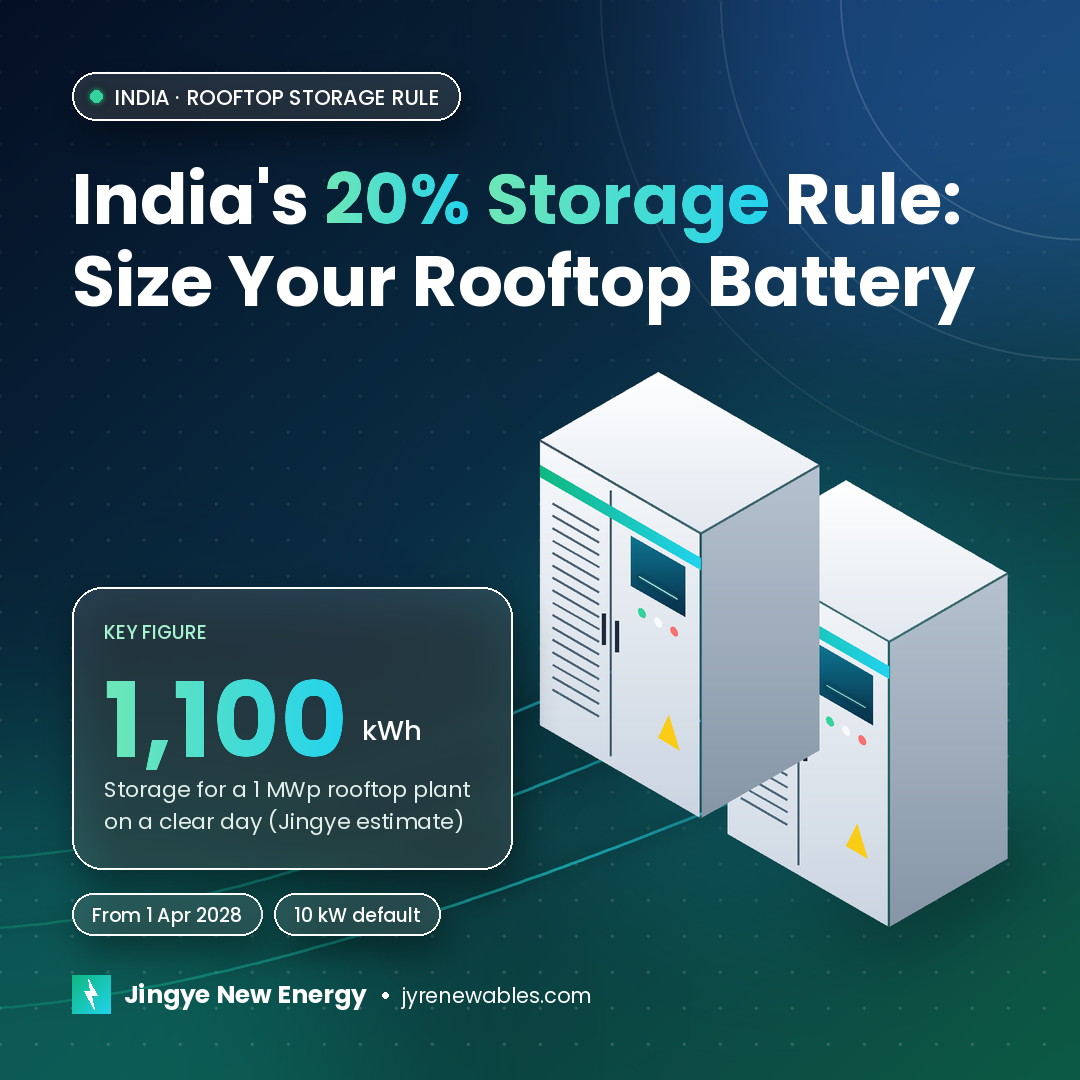
India's revised draft consumer rules, issued on 23 November 2026, would let state regulators require rooftop and on-site solar owners to install battery storage equal to at least 20% of the energy their plant generates in a day, from 1 April 2028. Where a state sets no threshold, the rule would apply above 10 kW. In practice, a 1 MWp rooftop plant would need roughly 800 to 1,100 kWh of storage, depending on how much it generates on its best days.
India's Ministry of Power has put out a revised draft of the Electricity (Rights of Consumers) Amendment Rules, 2026. It was issued on 23 November 2026 and is open for comments from state governments, regulators, discoms and industry until 23 December 2026, according to SolarQuarter. Most amendments would take effect from 1 April 2027.
For factories, warehouses, malls, hospitals and other C&I sites with rooftop solar, the headline is the rooftop solar storage mandate. The ministry's reasoning, as reported by Business Standard, is that storage can shift surplus solar to the evening and ease the strain on discoms. This guide explains what the draft says, who it would cover, and how to size a battery for it. It is written for plant owners, EPCs and rooftop installers who need to plan projects that will still be running in 2028.
It gives each State Electricity Regulatory Commission (SERC) the power to make storage mandatory above a capacity threshold, and it sets a minimum size: storage equal to at least 20% of the energy the renewable system generates in a day. If a state does not set its own threshold, the requirement applies to systems above 10 kW, starting 1 April 2028 (Power Peak Digest).
This is a big change from the first draft published in March 2026. That version said storage might be required for renewable installations above 500 kW, and gave no minimum size (Energetica India; Mercom India).
| Provision | March 2026 draft | November 2026 revised draft |
|---|---|---|
| Who may need storage | Renewable installations above 500 kW | Systems above a threshold set by each SERC; 10 kW if none is set |
| Minimum storage size | Not specified ("appropriate capacity") | At least 20% of daily renewable generation |
| Storage start date | Not specified | 1 April 2028 |
| ToD tariffs, demand above 10 kW | 1 April 2027 | 1 April 2028 |
| ToD tariffs, other non-agricultural consumers | 1 April 2028 | 1 April 2029 |
| Rules take effect | 1 October 2026 | 1 April 2027 |
| Comment deadline | 11 April 2026 | 23 December 2026 |
Table 1. How the storage and tariff provisions changed between the two drafts. Sources: Energetica India and Mercom India (March draft); Business Standard, Power Peak Digest and SolarQuarter (November draft).
On the draft as reported, any prosumer above their state's threshold would need storage from 1 April 2028. If a state stays silent, that means almost every C&I rooftop system, since 10 kW is small for a factory or commercial building.
Some points are still open. Business Standard notes the draft gives no method for net metering charges and does not say whether existing systems would be protected. Each state will also set its own threshold, so the rules may end up different in Maharashtra, Gujarat or Tamil Nadu.
The numbers and dates above come from the revised draft as reported on 24 November 2026. They can change after consultation, and each SERC will write its own regulations. Check the final notified rules and your state's regulations before you sign a contract.
Multiply your plant size by its daily yield, then take 20%. The draft ties storage to "total energy generated during a day", so the yield you pick matters. MNRE's rooftop FAQ says one kWp can generate 4 to 5.5 units on a clear sunny day. Sizing to the top of that range is the safe choice, because a battery sized only for an average day could fall short of the rule on the brightest days.
Formula: required storage (kWh) = plant size (kWp) × daily yield (kWh per kWp) × 0.20. At 5.5 kWh/kWp, that works out to 1.1 kWh of storage for every kWp of solar.
| Rooftop plant | Clear-day generation | 20% storage needed | LFP-261kWh cabinets | Installed energy |
|---|---|---|---|---|
| 100 kWp | 550 kWh | 110 kWh | 1 | 261 kWh |
| 250 kWp | 1,375 kWh | 275 kWh | 2 | 522 kWh |
| 500 kWp | 2,750 kWh | 550 kWh | 3 | 783 kWh |
| 1 MWp | 5,500 kWh | 1,100 kWh | 5 | 1,305 kWh |
| 2 MWp | 11,000 kWh | 2,200 kWh | 9 | 2,349 kWh |
Table 2. Storage needed under the proposed 20% rule at 5.5 kWh/kWp per day (MNRE clear-day upper value), and the smallest number of LFP-261kWh cabinets (261 kWh each) that covers it. Jingye estimate; not a quotation.
Two practical points. First, the 100 kWp plant needs only 110 kWh, so a 261 kWh cabinet is more than the rule asks for. That extra capacity can be used for ToD shifting or backup, or you can choose a smaller system. Second, at 1 MWp and above, the LFP-417kWh cabinet with an external PCS can reach the target with fewer units. For example, three 417 kWh cabinets give 1,251 kWh against the 1,100 kWh needed at 1 MWp.
The draft, as reported, does not say whether the 20% refers to nameplate or usable energy, or how capacity fade will be treated over the system's life. Until the state rules are out, leave some margin above the minimum.
Quite a lot. Using the MNRE range of 4 to 5.5 units per kWp, the storage needed for a 1 MWp plant runs from 800 kWh to 1,100 kWh. Sunny, dry sites tend to sit near the top of that range, and cloudier or hazier sites near the bottom. Use your plant's monitoring data for its best days, not the annual average.
Figure 1. Required storage = 1,000 kWp × daily yield × 20%. Yield range from the MNRE rooftop solar FAQ. Jingye estimate.
Very likely, though the details are up to each state. The revised draft lets SERCs set net metering limits and charges. No charges would apply below a threshold the Commission sets, but above it charges could reflect "the imputed cost of energy storage and network losses" (Business Standard). Where no limit is prescribed, the current rules allow net metering up to 500 kW.
Put simply, exporting midday solar to the grid is likely to earn less, and using it on site in the evening is likely to be worth more. The battery the rule requires can do more than tick a compliance box.
We have not put a payback figure here on purpose. Payback depends on your state's ToD rates, how the net metering charge is set and your load profile, and none of those are final yet. Once your SERC publishes its tariff periods, run the numbers on your own 15-minute load data.
Start now, in four steps. Systems being designed today will still be running when the rule starts, and adding a battery later usually costs more than planning space and connections for it from the start.
Before you ask any supplier for a quote, have this information ready:
Jingye New Energy builds C&I storage cabinets in sizes that fit this rule. The LFP-261kWh all-in-one cabinet has a built-in 125 kW PCS, 314Ah LFP cells, liquid cooling, an IP54 rating and a listed cycle life of 6,000 cycles at 90% depth of discharge. For larger rooftops, the LFP-417kWh cabinet works with an external PCS and lists more than 8,000 cycles. Our factory runs a 15 GWh module and PACK line and an in-house CNAS-accredited test lab, and holds ISO quality, environmental and occupational health and safety certification. We have also delivered user-side storage stations for energy-intensive factories, including Huaxi Special Steel (15 MW / 30.09 MWh) and Jiangsu Jingye Iron and Steel (50 MW / 100.32 MWh).
Check any Indian certification, testing or local-content requirements that apply to your project with your discom and EPC early. For publicly funded utility projects, see our earlier guide to India's 40% local content rule under the VGF scheme. For another example of how time-of-use pricing changes battery economics, read our post on Brazil's Tarifa Hora Certa.
No. It is in the revised draft Electricity (Rights of Consumers) Amendment Rules, 2026, issued on 23 November 2026 for comments until 23 December 2026. It may change before it is notified, and each SERC will set its own threshold.
Daily energy. As reported, storage must equal at least 20% of the total energy the renewable system generates in a day, so it is measured in kWh, not kW.
The draft, as reported by Business Standard, does not say whether existing systems are protected. Watch your state's regulations for any grandfathering clause.
Each SERC sets its own capacity threshold. If a state does not set one, the draft applies the requirement to systems above 10 kW.
At MNRE's clear-day figure of 5.5 kWh per kWp, a 500 kWp plant generates about 2,750 kWh, so 20% is about 550 kWh. Three LFP-261kWh cabinets (783 kWh) would cover it with margin. This is a Jingye estimate; your own peak-day data will give the exact figure.
Under the revised draft, ToD tariffs would apply from 1 April 2028 for consumers above 10 kW, and from 1 April 2029 for other non-agricultural consumers.
Send us your plant size, peak-day generation and site load profile. We will propose a cabinet configuration that meets the draft 20% rule and suits your peak hours.
Share your project detailsHebei Jingye New Energy Technology Co., Ltd, part of Jingye Group, makes LFP energy storage cabinets and containers, cell contact systems, EV chargers and commercial vehicle batteries for customers worldwide.
Nov. 25, 2026
India's 20% Rooftop Solar Storage Rule: How to Size Your Battery Before 2028
India's revised draft consumer rules would require rooftop solar owners above a state threshold (10 kW by default) to install storage equal to at least 20% of daily generation from 1 April 2028. For a 1 MWp plant, that means roughly 800 to 1,100 kWh of battery storage.
Nov. 23, 2026
NTPC 40 GWh BESS Tender: How to Qualify and Size Your Block Bid (2026)
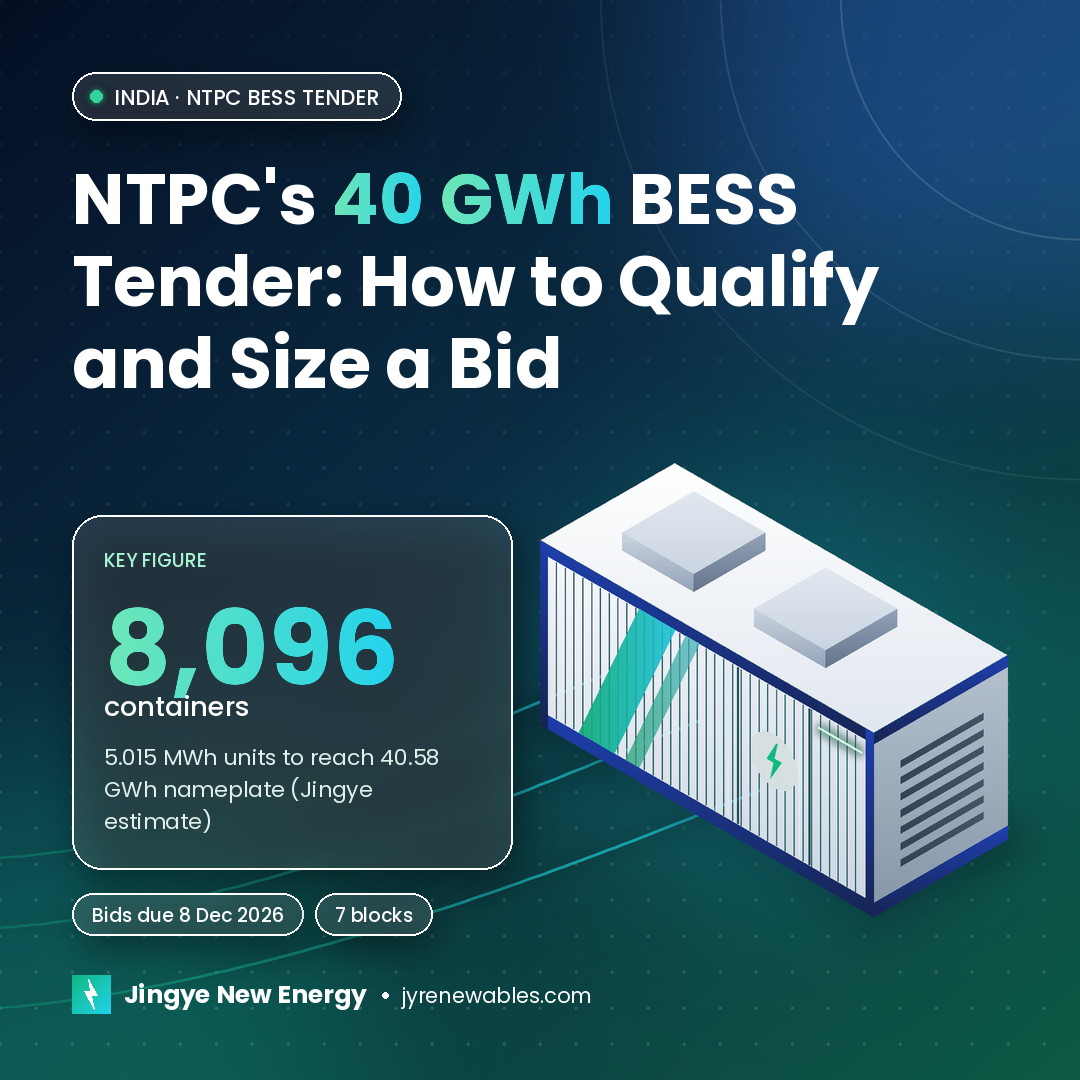
NTPC Green Energy's tender buys LFP battery containers and grid-forming PCS for 40.58 GWh in seven full blocks of 4.56–6.80 GWh, with bids due 8 December 2026. Direct suppliers need 4,000 MWh of containers delivered in the last three years.
Nov. 20, 2026
Gujarat's 550 MWh BESS Agreement: What EPCs Must Specify in 2026
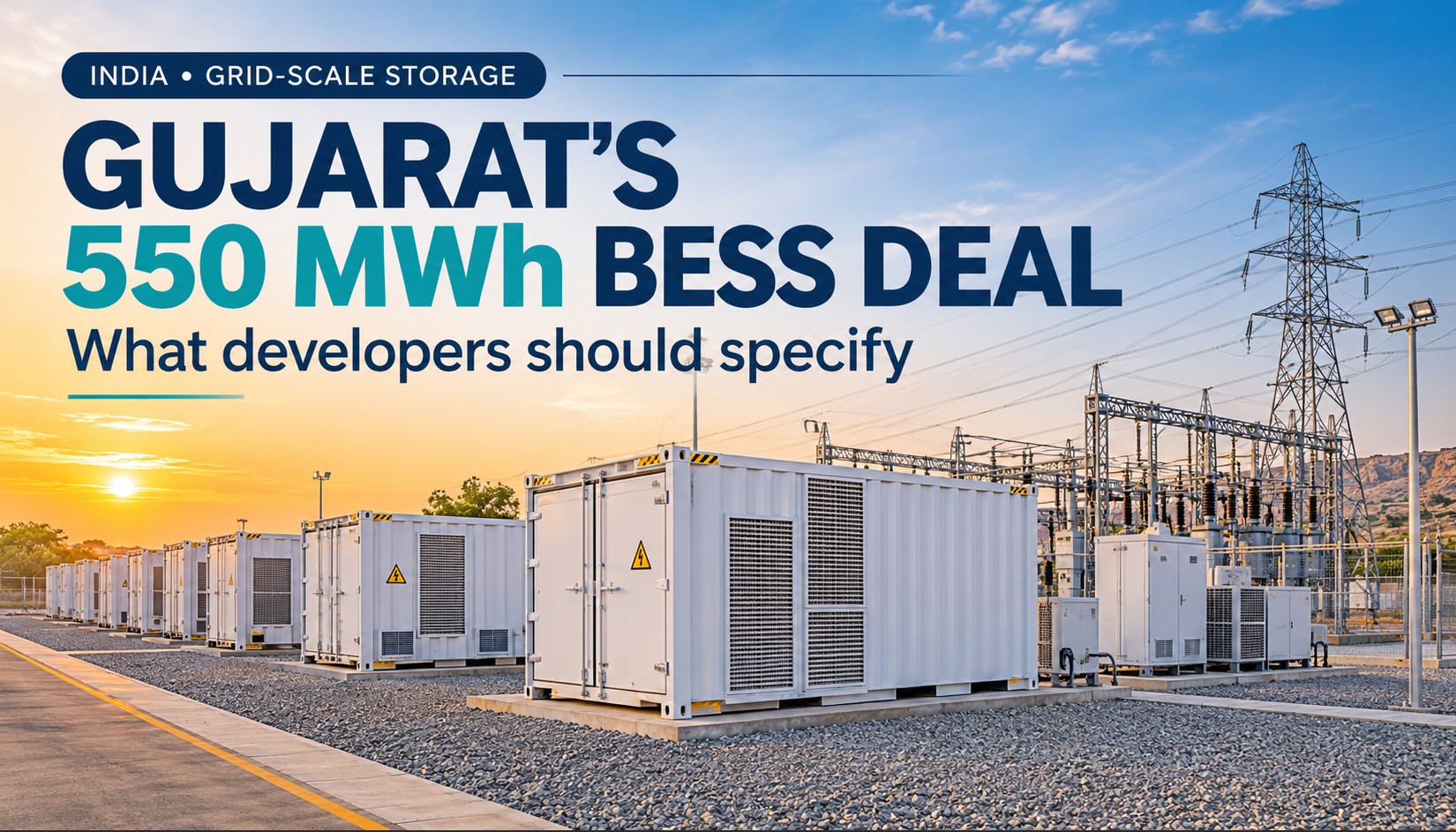
NLC India has signed a 275 MW / 550 MWh battery energy storage agreement with Gujarat Urja Vikas Nigam Limited (GUVNL), strengthening India's growing grid-scale storage market. This article explains the key capacity, system design, safety and integration requirements that EPCs and project developers should evaluate when planning large-scale BESS projects.
Let’s Get Started on Your New Energy Journey.