Nov 11, 2026
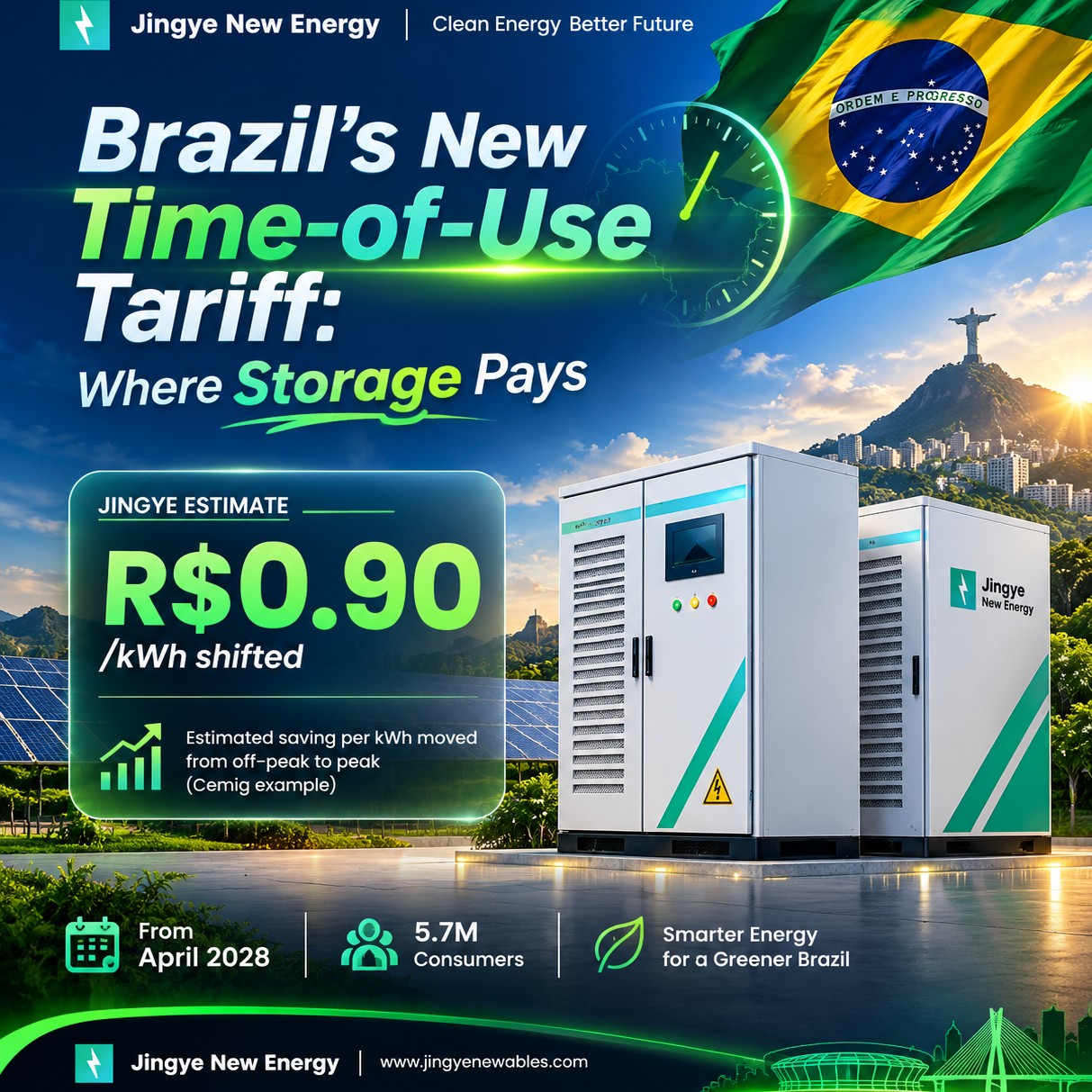
ANEEL's technical team has proposed the Tarifa Hora Certa, a time-of-use tariff that would automatically cover about 5.7 million low-voltage homes, farms and businesses from April 2028. In ANEEL's Cemig example, peak energy costs R$1.73/kWh against R$0.75/kWh off-peak. A battery that charges off-peak and discharges at peak would save about R$0.90 per kWh shifted (Jingye estimate), which is why storage, solar and EV charging businesses should plan now.
On 9 November 2026, ANEEL's technical areas presented a plan to replace Brazil's optional tarifa branca with the Tarifa Hora Certa. Low-voltage consumers in groups B1 (residential), B2 (rural) and B3 (commercial, industrial and other activities) that use 500 kWh or more per month would move to time-of-use billing automatically, in three stages up to 2031, according to ANEEL. The proposal still needs a vote by ANEEL's board, which Canal Solar reports is expected by December.
For shops, small factories, farms, solar owners and EV charging operators, this changes the value of every kilowatt-hour used in the evening. This guide explains the new rules, puts numbers on the peak-price gap and shows where a battery pays back.
It is a time-of-use tariff with three price periods on weekdays and one cheap price at weekends. Peak lasts three consecutive hours, usually in the early evening.
Exact hours and prices will differ by distribution company. ANEEL plans to review each distributor's tariff design, and its notice says some areas could get a cheaper period during the hours of strongest solar generation.
The biggest low-voltage users move first. Each stage starts in April, after at least three "informative" bills that show what the customer would have paid.
Figure 1. Proposed rollout. Sources: ANEEL, Canal Solar.
Customers who don't want time-of-use can switch to a temporary flat tariff, but it costs more than today's conventional tariff. Canal Solar reports ANEEL's estimate of 3% to 5% above the conventional price, and the option lasts only two years from the start of each stage.
Under the proposal, solar (micro and mini distributed generation) units that apply to connect to the net-metering system from 90 days after the rule is published go straight onto the Tarifa Hora Certa with no exit option, whatever their consumption. New commercial EV charging stations follow the same rule from day one.
In ANEEL's example using Cemig data, peak energy costs more than twice the off-peak price. That gap is what a battery earns from.
Figure 2. Source: ANEEL survey based on Cemig Distribuidora data, as reported by Primeira Hora. Prices vary by distributor.
In this example, off-peak energy is about 17% cheaper than today's conventional price, while peak energy is about 92% more expensive. A business that can't move its evening load will pay more. A business that moves it, or covers it from a battery, will pay less.
About R$0.90 for every kWh moved from off-peak to peak, using the Cemig prices and a 90% efficiency assumption. That adds up to roughly R$224 per kWh of usable battery capacity each year.
| Step | Assumption or result | Value |
|---|---|---|
| Charge price | Off-peak, Cemig example | R$0.75/kWh |
| Grid energy needed per kWh delivered | 90% efficiency (1 ÷ 0.9) | 1.11 kWh |
| Cost of 1 kWh delivered from the battery | 1.11 × R$0.75 | R$0.83 |
| Price avoided | Peak, Cemig example | R$1.73/kWh |
| Net saving per kWh shifted | R$1.73 − R$0.83 | ≈ R$0.90 |
| Cycles per year | One full cycle per weekday, about 250 days | 250 |
| Annual saving per kWh of usable capacity | R$0.90 × 250 | ≈ R$224 |
Table 1. Energy arbitrage under the Tarifa Hora Certa. Jingye estimate, before O&M, taxes and degradation. Prices from the ANEEL/Cemig example above.
Our LFP-261kWh all-in-one cabinet has 261 kWh of usable capacity and a built-in 125 kW PCS. Over a three-hour peak it could deliver up to 375 kWh at full power, so energy, not power, is the limit: it covers 261 kWh of peak load each weekday.
This counts only peak-to-off-peak arbitrage at Cemig prices. Charging from your own midday solar instead of the grid, avoiding demand charges, backup during outages and lower installed prices would all shorten it. Peak hours and prices in your area will be different, so run the numbers on your own distributor's Hora Certa tariff once it is published.
Solar produces at midday, but the expensive hours are in the early evening. Under time-of-use billing, solar alone no longer covers the most costly part of the bill.
ANEEL's proposal brings distributed-generation units into the Tarifa Hora Certa when they consume or inject 500 kWh/month or more on average over 12 months. Existing systems keep an exit option during the transition, but from 2033 the rule becomes mandatory for existing units too, including GD1 systems, Canal Solar reports. New net-metering connections filed 90 days after publication have no exit at all.
A battery lets a solar owner store midday output and use it during the three peak hours. For installers and EPCs, that means quoting solar + storage as one package for any client above the thresholds, starting with the 1,800 kWh/month group in 2028.
New commercial charging stations would be on the Tarifa Hora Certa from day one, so evening charging sessions would cost the operator the peak price.
Figure 3. ANEEL's illustrative example, as reported by Canal Solar.
ANEEL treats EV charging as a flexible load that can move to cheaper hours. That works for fleets parked overnight. It doesn't work for a public fast-charging site where drivers arrive after work. A battery at the site can charge off-peak and supply the evening sessions, so the operator sells peak-hour charging without buying peak-hour energy.
Jingye New Energy makes the LFP-261kWh all-in-one cabinet (314Ah LFP cells, liquid cooling, built-in 125 kW PCS, IP54) and the LFP-417kWh cabinet for larger sites with an external PCS. For charging sites we build 60–240 kW DC fast chargers for 400 V and 800 V vehicles. Products are tested in our CNAS-accredited lab, and our factory runs ISO 9001, ISO 14001 and ISO 45001 management systems.
Not sure whether your site needs a built-in or a separate PCS? See our guide to all-in-one vs separate PCS energy storage systems. For grid-scale projects, read our analysis of Brazil's LRCAP 2026 battery auction.
It is ANEEL's proposed replacement for the optional tarifa branca. Low-voltage consumers using 500 kWh/month or more would pay different energy prices for peak, intermediate and off-peak hours.
Not yet. ANEEL's technical areas presented the proposal on 9 November 2026, and the board still has to vote on it. Canal Solar reports a decision is expected by December 2026.
In April 2028 for units using 1,800 kWh/month or more, April 2029 for 1,000 kWh/month or more, and April 2031 for 500 kWh/month or more.
Peak is three consecutive hours, usually in the early evening, with one intermediate hour on each side. The exact hours are set for each distributor. Weekends and national holidays are billed at the off-peak price.
Only temporarily. A flat tariff, estimated at 3% to 5% above the conventional price, is available for two years from the start of each stage, and the option ends in 2033. New solar connections and new commercial EV charging stations get no exit option.
With the Cemig example prices and 90% efficiency, about R$0.90 per kWh shifted from off-peak to peak, or about R$224 per kWh of usable capacity per year with one cycle each weekday. This is a Jingye estimate; your distributor's prices will differ.
No. The proposal covers low-voltage groups B1, B2 and B3. Medium- and high-voltage (Group A) customers already have their own time-of-use tariffs.
Send us your monthly consumption, your distributor and your evening load. We'll size a cabinet and estimate the payback under the Tarifa Hora Certa.
Request a sizingHebei Jingye New Energy Technology Co., Ltd, part of Jingye Group, makes LFP energy storage cabinets, battery storage containers, DC fast EV chargers, commercial vehicle batteries and cell contact systems for customers worldwide.
Nov. 12, 2026
NGEL 40 GWh BESS Tender: Container Sizing, Qualification Rules and Bid Deadline (2026)
NTPC Green Energy's 10 GW / 40.58 GWh BESS tender closes on 8 December 2026 and needs at least 8,092 battery containers of 5.015 MWh. Here are the block sizes, qualification routes, turnover rules and bid steps.
Nov. 11, 2026
Brazil Tarifa Hora Certa: How Battery Storage Cuts Peak Electricity Costs from 2028
ANEEL's proposed Tarifa Hora Certa would move about 5.7 million low-voltage consumers in Brazil to time-of-use pricing from April 2028. With peak energy at R$1.73/kWh vs R$0.75 off-peak in ANEEL's Cemig example, a battery saves about R$0.90 per kWh shifted.
Nov. 10, 2026
India's new ₹14,500 crore VGF scheme backs 30 GWh of battery storage, and BESS projects must now meet a 40% domestic content rule, double the earlier 20%. Here's what it means for developers, EPCs and equipment buyers.
Let’s Get Started on Your New Energy Journey.