Nov 04, 2026
By Daniyal, Jingye New Energy. Published 4 November 2026.
Quick answer: Brazil buys its first standalone battery capacity on 2 December (domestic-content round) and 4 December 2026 (open round), under 15-year contracts that pay a fixed annual revenue from 1 August 2028. The price caps are R$1.76 million and R$1.58 million per MW per year, or about R$440 and R$395 per kWh of storage per year on a 4-hour basis. By our estimate, the 30 MW minimum project needs about 27 of our 5.015 MWh containers, or 34 if 15 years of degradation is built in on day one.
Brazil's electricity regulator ANEEL approved the tender documents for the country's first battery capacity auctions on 27 October 2026 (eixos). Interest is enormous. The energy research office EPE registered 6,091 projects with 296.8 GW of capacity (TaiyangNews), while the storage association Absae puts the 2028 power shortfall at about 4.5 GW, or 18 GWh if it is met with four-hour batteries (ESS News).
With about four weeks to auction day, developers are fixing equipment quotes now. This guide turns the rules into the numbers a bidder needs: what the price caps are worth per kWh, how many containers a bid needs, how many cycles the batteries must survive, and where imported systems can compete.
It is a capacity reserve auction (LRCAP) that pays standalone battery projects a fixed annual revenue for keeping power available to the grid. It is split into two rounds by equipment origin.
The rules come from the Ministry of Mines and Energy's Portaria 136/2026 and ANEEL tender notices 05/2026 and 06/2026. Winners are paid in 12 monthly instalments, adjusted for inflation (IPCA), and the payment can be cut if the plant underperforms (TaiyangNews, Comerc). Energy used for charging and energy sent to the grid is settled separately at the hourly spot price (PLD).
| Rule | Product 2028 A (2 Dec) | Product 2028 B (4 Dec) |
|---|---|---|
| Equipment origin | Must meet BNDES minimum domestic content | No domestic-content requirement |
| Price cap | R$1,760,000 per MW per year | R$1,580,000 per MW per year |
| Contract | 15 years from 1 August 2028 | 15 years from 1 August 2028 |
| Duration | 4 hours at full contracted power | 4 hours at full contracted power |
| Cycling | Up to 2 cycles a day, max 366 a year | Up to 2 cycles a day, max 366 a year |
| Recharge | Full recharge within 6 hours | Full recharge within 6 hours |
| Minimum size | 30 MW | 30 MW |
| Round-trip efficiency | At least 85% | At least 85% |
Sources: price caps from eixos; contract, duration, cycling and recharge from TaiyangNews; minimum size and efficiency from Comerc.
ANEEL also lowered the reference investment used to set bid guarantees from R$9.8 million to R$6 million per MW, to cut the entry barrier. The volume the government will buy has not been published yet (EnergyNews.biz).
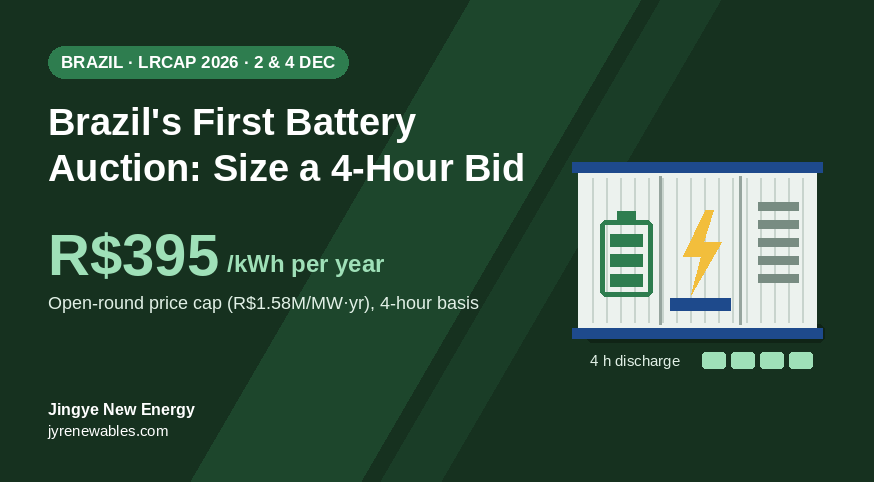
On a 4-hour basis, the open-round cap equals about R$395 per kWh of storage per year, and the domestic-content cap about R$440.
Each contracted MW must deliver 4 MWh, or 4,000 kWh. R$1,580,000 divided by 4,000 is R$395 per kWh per year, and R$1,760,000 divided by 4,000 is R$440. Over 15 years, before inflation indexation, that is R$23.7 million per MW at the open-round cap and R$26.4 million at the domestic-content cap.
For scale: ANEEL's reference investment for guarantees is R$6 million per MW. At the open-round cap, fixed revenue would equal that figure in about 3.8 years. That is our gross estimate, before O&M, taxes, financing, grid connection and charging costs, and real bids will clear below the cap.
The domestic-content cap is only 11.4% higher than the open one. Watt Capital estimates a locally qualifying system could cost up to about 25% more than an imported one and still come close to parity once cheaper Climate Fund financing is counted (ESS News).
About 0.8 containers per MW on nameplate, or 0.9 per MW after losses. A 30 MW minimum project needs 24 to 34 containers, depending on how degradation is handled.
Each Jingye 5.015 MWh container covers about 1.25 MW for four hours on nameplate, well inside its 2.5 MW rating. So power and the six-hour recharge window are not the constraint; usable energy is. The table below is our own estimate. It assumes about 90% of nameplate energy reaches the grid after depth-of-discharge and conversion losses, and, in the fourth column, that 80% of initial capacity remains at year 15 with all oversizing built on day one.
| Contracted power | Energy needed (4 h) | Containers, nameplate | Containers, after losses | Containers, with 15-yr degradation | Revenue/yr at B cap | Revenue/yr at A cap |
|---|---|---|---|---|---|---|
| 30 MW | 120 MWh | 24 | 27 | 34 | R$47.4 m | R$52.8 m |
| 100 MW | 400 MWh | 80 | 89 | 111 | R$158 m | R$176 m |
| 250 MW | 1,000 MWh | 200 | 222 | 277 | R$395 m | R$440 m |
Jingye estimate. Container counts rounded up. Revenue is the price cap times contracted MW, before IPCA indexation and performance deductions.
At market level, Absae's 18 GWh need equals about 3,590 of these containers on nameplate (18,000 MWh divided by 5.015 MWh).
Many developers will add containers in later years (augmentation) instead of building all the margin on day one. That lowers upfront cost but needs spare space, a supply agreement and grid capacity. Our sizing guide for Saudi Arabia's 12 GWh BESS tender walks through the same trade-off.
The PCS ratio also changes. Our Jiangsu Jingye Iron and Steel station pairs two 5 MWh battery cabins with each 5 MW PCS cabin, a 2-hour design. Brazil's 4-hour product needs roughly twice the battery behind each MW of PCS.
It means up to 5,490 full cycles over the 15-year contract (366 times 15). The battery's warranted cycle life and degradation curve must cover that, and the plant must still deliver four hours of contracted power every year.
Two cycles a day is the peak duty, but the 366-cycle annual cap means average use is about one cycle a day. Because payments can be cut for poor performance, a plant that falls below its 4-hour capacity loses revenue. Before you bid, ask every supplier for:
For more on how cycling depth affects lifetime, see our guide to battery depth of discharge and energy storage life.
Product B on 4 December is open to imported systems. Product A on 2 December needs BNDES domestic content, but the rules still allow imported battery containers if enough other components are made in Brazil.
Until 31 December 2027, BNDES splits a storage system into eight components, four of them classed as strategic. A system qualifies with at least three components, including one strategic one, and a national-content index of at least 15% of total value (ESS News). The simplest route pairs a Brazilian PCS and EMS with imported battery containers.
Early quotes for localized systems ran 40% to 50% above fully imported ones, though prices are falling. Absae's July survey found about 12 GWh (3 GW) of expected domestic production, below the 18 GWh need. BNDES currently accredits BYD, Gotion, Moura, TBEA, Trina, SecPower, WEG and You.On as storage system suppliers.
For a DC-block supplier such as Jingye New Energy, that leaves two practical routes. Supply containers directly into Product B bids, or supply containers to a Product A bidder that localizes the PCS and EMS. In the second case, the developer must confirm the complete system qualifies under BNDES rules.
Tight. Technical qualification results are due on 18 November, the auctions run on 2 and 4 December, and supply must start on 1 August 2028, with grid-connection risk sitting on the developer.
Watt Capital says an imported container can arrive in about six months (ESS News). That leaves room, but factory slots, shipping, transformers and substation work should be locked in early. See our note on transformer requirements for utility-scale battery storage.
Product 2028 A, restricted to systems that meet BNDES domestic-content rules, runs on 2 December 2026. Product 2028 B, with no equipment-origin requirement, runs on 4 December 2026.
ANEEL approved caps of R$1.76 million per MW per year for the domestic-content round and R$1.58 million per MW per year for the open round on 27 October 2026. On a 4-hour basis that is about R$440 and R$395 per kWh of storage per year.
15 years, with supply starting on 1 August 2028. Winners receive a fixed annual revenue paid in 12 monthly instalments and adjusted for inflation (IPCA), which can be reduced for poor performance.
At least 30 MW, four hours of full contracted power, up to two cycles a day and 366 a year, a full recharge within six hours, and round-trip efficiency of at least 85%.
Yes. Product B is open to imported systems. Product A accepts imported battery containers only inside a system that meets BNDES domestic content: at least three of eight components, one of them strategic, and at least 15% national content by value.
By our estimate, about 80 Jingye 5.015 MWh containers on nameplate, about 89 after depth-of-discharge and conversion losses, and about 111 if 15 years of degradation is built in on day one.
The Ministry of Mines and Energy has not yet published the volume. The storage association Absae estimates a shortfall of about 4.5 GW in 2028, equal to 18 GWh of four-hour batteries.
Send us your contracted MW, site temperature range and target supply date. We will send back a container count, a layout and a budget quote for your Product A or Product B bid.
Send your project detailsHebei Jingye New Energy Technology Co., Ltd, part of Jingye Group, makes LFP battery energy storage containers, commercial and industrial energy storage cabinets, CCS cell contact systems and DC fast EV chargers.
Nov. 05, 2026
All-in-One vs Separate PCS Energy Storage Systems
Energy Storage Cabinets are no longer selected only by battery capacity. Buyers also need to evaluate power conversion, safety controls, thermal management, installation time, maintenance access, expansion options, and long-term operating cost. The central purchasing decision is whether to choose an All-in-One energy storage system or a Separate PCS architecture.
Nov. 05, 2026
AI Data Center Battery Storage: How to Size the BESS in 2026
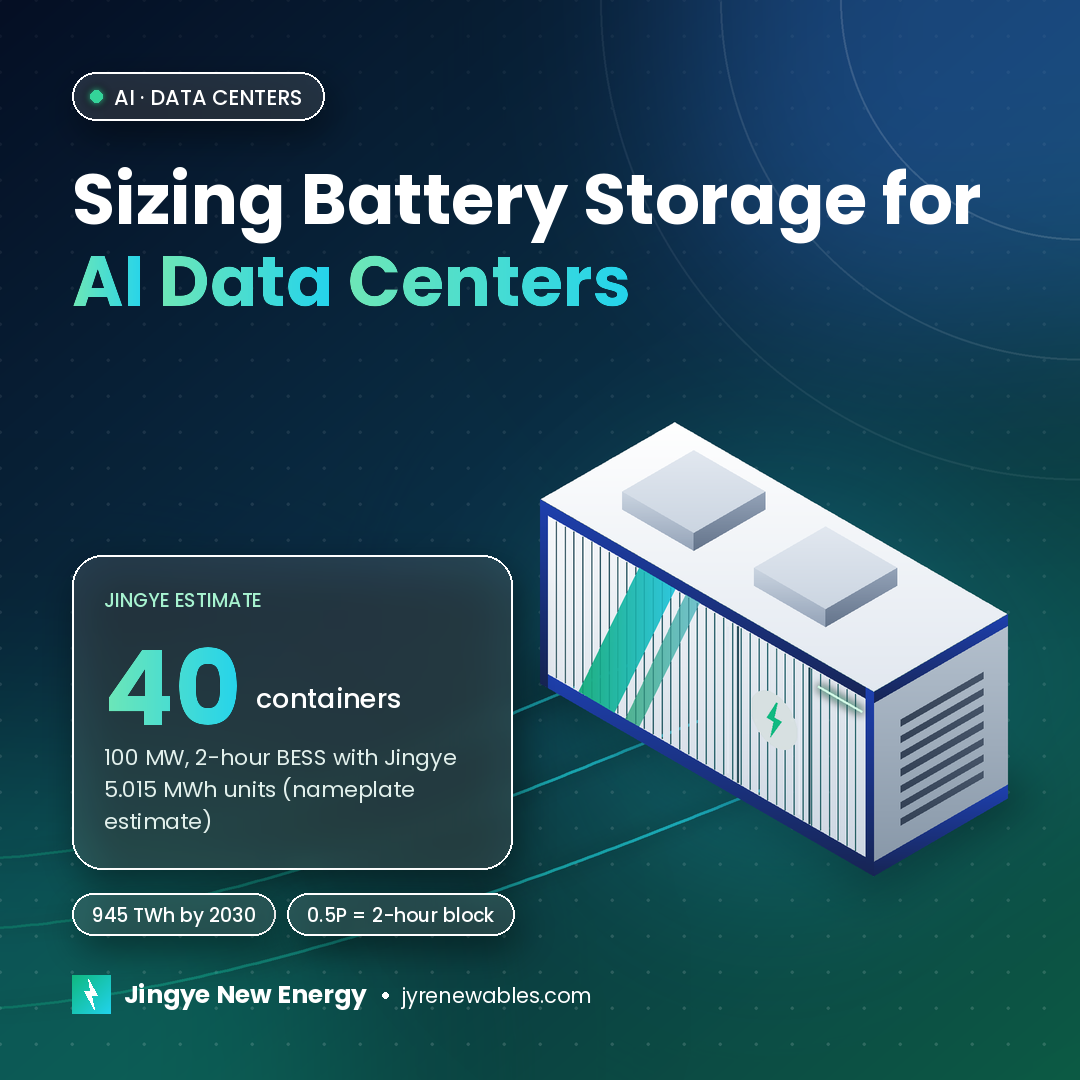
AI data centers use battery storage to smooth GPU load swings, ride through outages and manage grid limits. By our estimate, a 100 MW, 2-hour BESS needs 40 Jingye 5.015 MWh containers, and a 4-hour system needs 80.
Nov. 04, 2026
Brazil Battery Storage Auction LRCAP 2026: How to Size a 4-Hour Bid
Brazil's first battery capacity auctions on 2 and 4 December 2026 cap prices at R$1.58–1.76 million per MW per year, about R$395–440 per kWh of 4-hour storage. By our estimate, a 100 MW bid needs 80–111 Jingye 5.015 MWh containers.
Let’s Get Started on Your New Energy Journey.