Nov 05, 2026
Energy Storage Cabinets are no longer selected only by battery capacity. Buyers also need to evaluate power conversion, safety controls, thermal management, installation time, maintenance access, expansion options, and long-term operating cost. The central purchasing decision is whether to choose an All-in-One energy storage system or a Separate PCS architecture.
Across the leading Google SERP blog topics for this subject, readers usually want more than a basic definition. They want a direct comparison, realistic operating expectations, transparent advantages and disadvantages, and guidance for selecting the right architecture for a specific site. This article addresses those needs from the perspective of commercial users, system integrators, facility owners, and energy storage purchasers.
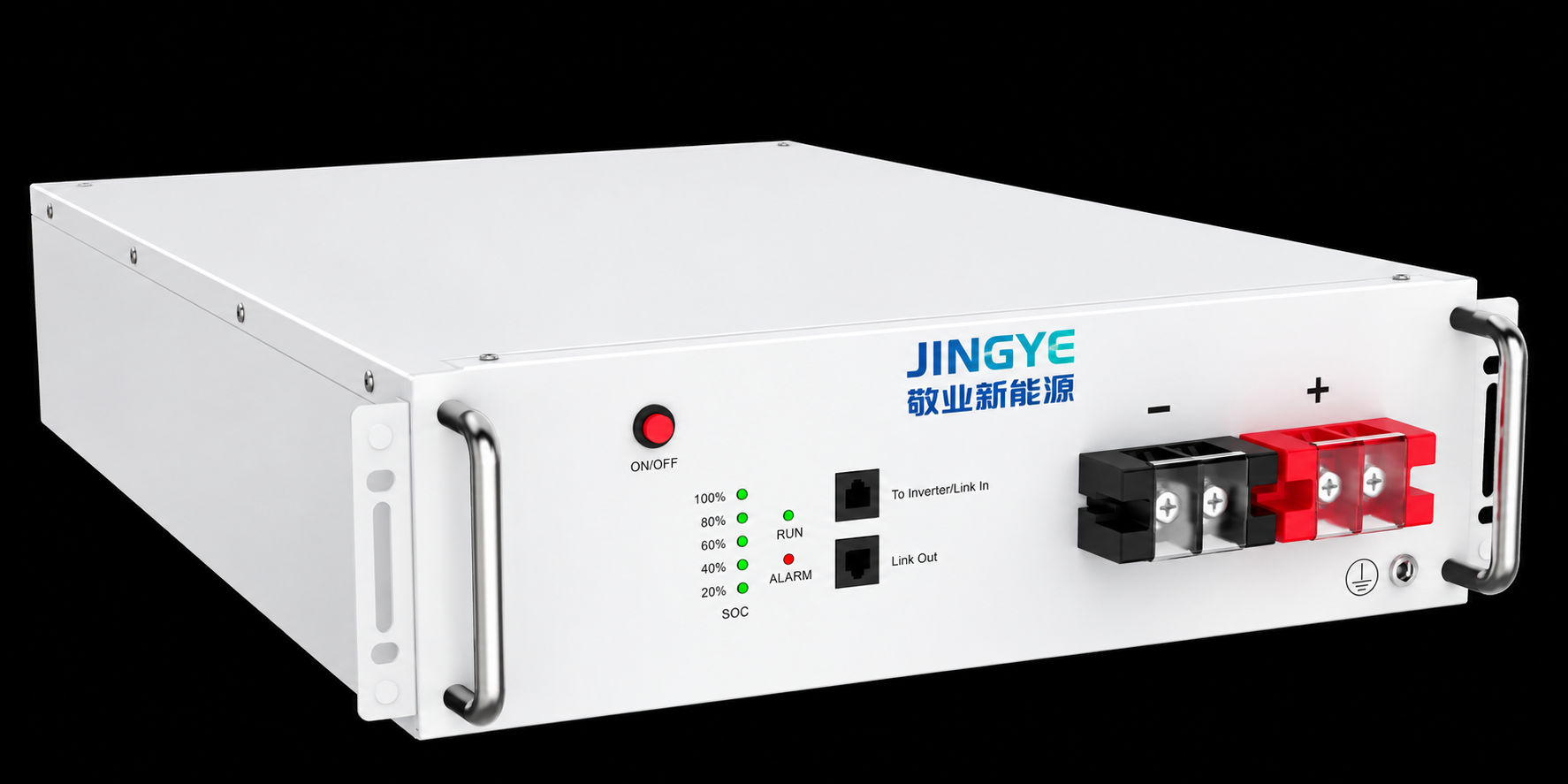
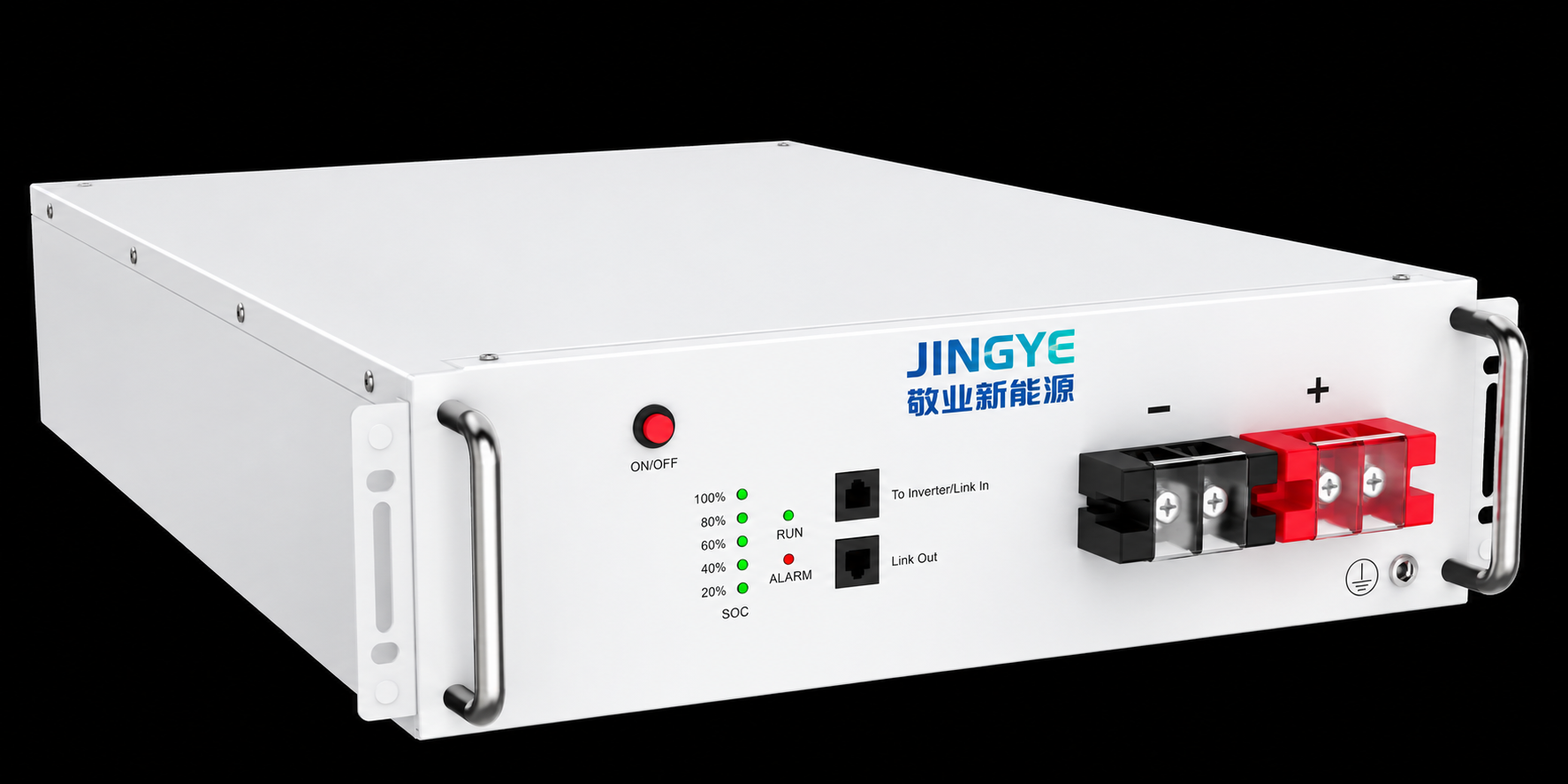
An All-in-One system integrates major components into one cabinet or coordinated enclosure. Depending on the product design, it may include battery modules, a battery management system, a PCS, an energy management system, thermal management, fire protection, distribution equipment, and communication interfaces.
A Separate PCS system places the battery cabinet and PCS in separate enclosures or treats them as independent equipment packages. The battery system may be connected to one or more PCS units through a DC bus, AC bus, or site-level power distribution design.
The difference is not simply physical packaging. It affects procurement responsibility, installation labor, fault isolation, system efficiency, expansion planning, maintenance procedures, and the number of suppliers involved in the project.
An All-in-One design usually reduces the number of decisions required before installation. A Separate PCS design usually provides greater control over system sizing and future modifications. Therefore, the better choice depends on whether the project prioritizes simplicity or flexibility.
| Parameter | All-in-One energy storage system | Separate PCS energy storage system | Purchasing implication |
|---|---|---|---|
| Typical integration | Battery, PCS, BMS, EMS, cooling, and safety equipment are coordinated in one package | Battery system, PCS, EMS, transformer, and protection equipment are selected separately | All-in-One reduces integration work; Separate PCS provides more design freedom |
| Installation time | Usually shorter because internal wiring and controls are completed before delivery | Usually longer because equipment positioning, cabling, testing, and control integration occur on site | All-in-One is attractive when project schedules are tight |
| Power flexibility | Power rating is normally linked to the selected cabinet configuration | PCS power can be selected or expanded independently from battery capacity | Separate PCS is better for changing load profiles and future power upgrades |
| Energy flexibility | Battery capacity is usually defined as a complete cabinet or cluster | Battery cabinets can be added or changed without replacing the entire PCS configuration | Separate PCS supports phased capacity expansion |
| Space utilization | Compact for many commercial and industrial sites | Requires planning for separate battery and PCS locations | All-in-One can reduce layout complexity where space is limited |
| Cooling design | Thermal management is designed around the integrated cabinet | Battery and PCS cooling can be optimized independently | Separate PCS can be advantageous in high-power or high-temperature applications |
| Maintenance access | One cabinet can simplify inspection but may create denser internal access | Separate equipment can make component replacement and fault isolation easier | Service requirements should be reviewed before purchase |
| Redundancy | Depends on the internal modular design of the product | Multiple PCS units can provide independent power paths and staged redundancy | Separate PCS often offers more options for critical facilities |
| Control integration | Usually delivered with a preconfigured control and communication structure | Requires coordination among the battery BMS, PCS controller, EMS, and site system | All-in-One reduces compatibility risk for standard applications |
| Initial engineering effort | Lower for standard projects | Higher because electrical and communication interfaces require detailed design | Engineering labor can change the total project cost significantly |
| Lifecycle flexibility | Best when the expected operating profile remains stable | Best when power, capacity, or control requirements may change | Long-term planning should influence the architecture choice |
Battery energy is normally expressed in kilowatt-hours or megawatt-hours, while PCS power is expressed in kilowatts or megawatts. A system with high energy capacity does not automatically provide high output power.
Buyers should calculate both requirements:
An All-in-One system is often suitable when power and energy are purchased as a predictable package. A Separate PCS system is more useful when a project needs a large battery bank with moderate power, high power with limited duration, or staged power expansion.
Manufacturers may publish a cycle life under specific temperature, charge rate, depth of discharge, and end-of-life conditions. Actual battery life can be shorter or longer depending on how the system is operated.
In practical use, an All-in-One system may achieve more consistent battery behavior because the BMS, PCS, cooling system, and operating limits are factory coordinated. A Separate PCS system can achieve equally strong or better results, but only when the system integrator correctly matches the PCS control strategy, battery voltage range, current limits, and thermal design.
Stable operation requires the battery and PCS to exchange accurate information about voltage, current, state of charge, state of health, temperature, alarms, and shutdown commands. A communication fault can cause nuisance trips even when the battery cells are healthy.
All-in-One systems generally reduce compatibility risk because the main control interfaces are tested as a package. Separate PCS systems may involve equipment from different suppliers, which increases the need for protocol testing and commissioning.
Before purchase, request confirmation of the following points:
Round-trip efficiency is affected by the battery, PCS, transformers, cables, cooling equipment, control system, and auxiliary loads. A value measured at one operating point should not be treated as the efficiency for every condition.
Actual operating efficiency is usually lower when:
An integrated cabinet can reduce some internal connection losses and simplify auxiliary power management. A Separate PCS design can achieve strong efficiency when the PCS is accurately sized for the load profile and installed with short, properly rated electrical connections.
All-in-One systems usually provide a cleaner service process because one supplier may manage the battery, PCS, controls, and cabinet. However, the equipment is densely packaged, so access to an individual component may be more restricted.
Separate PCS systems can make it easier to isolate a failed PCS or replace a power module without opening the battery cabinet. On the other hand, troubleshooting may require coordination among several suppliers and service teams.
Ask for the following maintenance information before signing the purchase order:
Facility owners are usually concerned with energy savings, backup reliability, equipment life, safety, and the total cost of ownership. They may prefer an All-in-One system when the application is well defined and the facility team has limited energy storage experience.
A Separate PCS system may be more appropriate when the owner expects major load growth, requires multiple operating modes, or wants to preserve the option of replacing the PCS independently from the battery.
Integrators focus on electrical compatibility, communication protocols, installation sequence, testing procedures, and warranty boundaries. A packaged system can reduce integration labor, but it must still provide sufficient access to settings, alarms, and operating data.
For Separate PCS projects, the integrator should establish a documented responsibility matrix covering:
The lowest equipment quotation is not always the lowest project cost. Procurement teams should compare the complete delivered system rather than only the battery or PCS nameplate price.
Energy storage revenue may come from peak shaving, time-of-use arbitrage, demand charge reduction, backup power, renewable energy integration, frequency regulation, or other grid services. Each revenue stream creates a different power and energy requirement.
A financial evaluation should include:
Battery safety depends on cell quality, module construction, rack protection, current interruption, temperature monitoring, ventilation, fire detection, and emergency response. A cabinet should be evaluated as a complete system rather than by battery chemistry alone.
In an All-in-One cabinet, battery cells and power electronics share a coordinated enclosure. This can simplify protection design, but the internal layout must provide adequate separation, thermal control, and service access.
In a Separate PCS system, physical separation can reduce heat concentration around the battery cabinet and simplify replacement of power electronics. However, the external DC or AC connections require careful protection, insulation, grounding, and cable routing.
Buyers should request project-specific safety documentation, test records, emergency procedures, and installation requirements rather than relying only on general product claims.
An All-in-One system is generally a strong choice for the following users:
This architecture is particularly attractive when standardization, installation speed, and straightforward operation are more important than maximum customization.
A Separate PCS system is generally a strong choice for the following users:
This architecture is more suitable when long-term flexibility, modular power expansion, and component-level serviceability justify the additional engineering work.
A practical evaluation model can assign different weights to the factors that matter most for the project.
The exact weights should be adjusted to the application. A data center may assign more importance to redundancy and response time. A solar farm may prioritize efficiency and expansion. A commercial building may emphasize compact design and installation speed.
Purchasers should ask suppliers to connect each advertised specification with a test condition or contractual guarantee.
Jingye approaches the All-in-One versus Separate PCS decision by starting with the operating profile rather than selecting a cabinet only by nominal capacity. Power demand, discharge duration, site limitations, thermal conditions, safety requirements, expansion plans, and service expectations should be reviewed together.
For a compact project with a standard load profile, an integrated Energy Storage Cabinet can reduce engineering effort and accelerate deployment. For a larger or more customized project, a Separate PCS arrangement can provide stronger control over power conversion, redundancy, and future expansion.
A complete purchase specification should define the equipment scope, installation boundary, communication interfaces, acceptance tests, warranty conditions, performance guarantees, maintenance schedule, and spare parts strategy. This prevents the common problem of buying a low-cost system that later requires unplanned integration work.
In the end, the right Energy Storage Cabinets are the ones that deliver the required power and usable energy safely, consistently, and economically throughout the project life. By comparing actual operating conditions, lifecycle costs, battery aging, stability, serviceability, and expansion needs, buyers can select the architecture that best fits their site. Jingye can be evaluated as a solution partner when the project requires a practical balance between integrated deployment, reliable operation, and long-term Energy Storage Cabinet value.
Nov. 05, 2026
All-in-One vs Separate PCS Energy Storage Systems
Energy Storage Cabinets are no longer selected only by battery capacity. Buyers also need to evaluate power conversion, safety controls, thermal management, installation time, maintenance access, expansion options, and long-term operating cost. The central purchasing decision is whether to choose an All-in-One energy storage system or a Separate PCS architecture.
Nov. 05, 2026
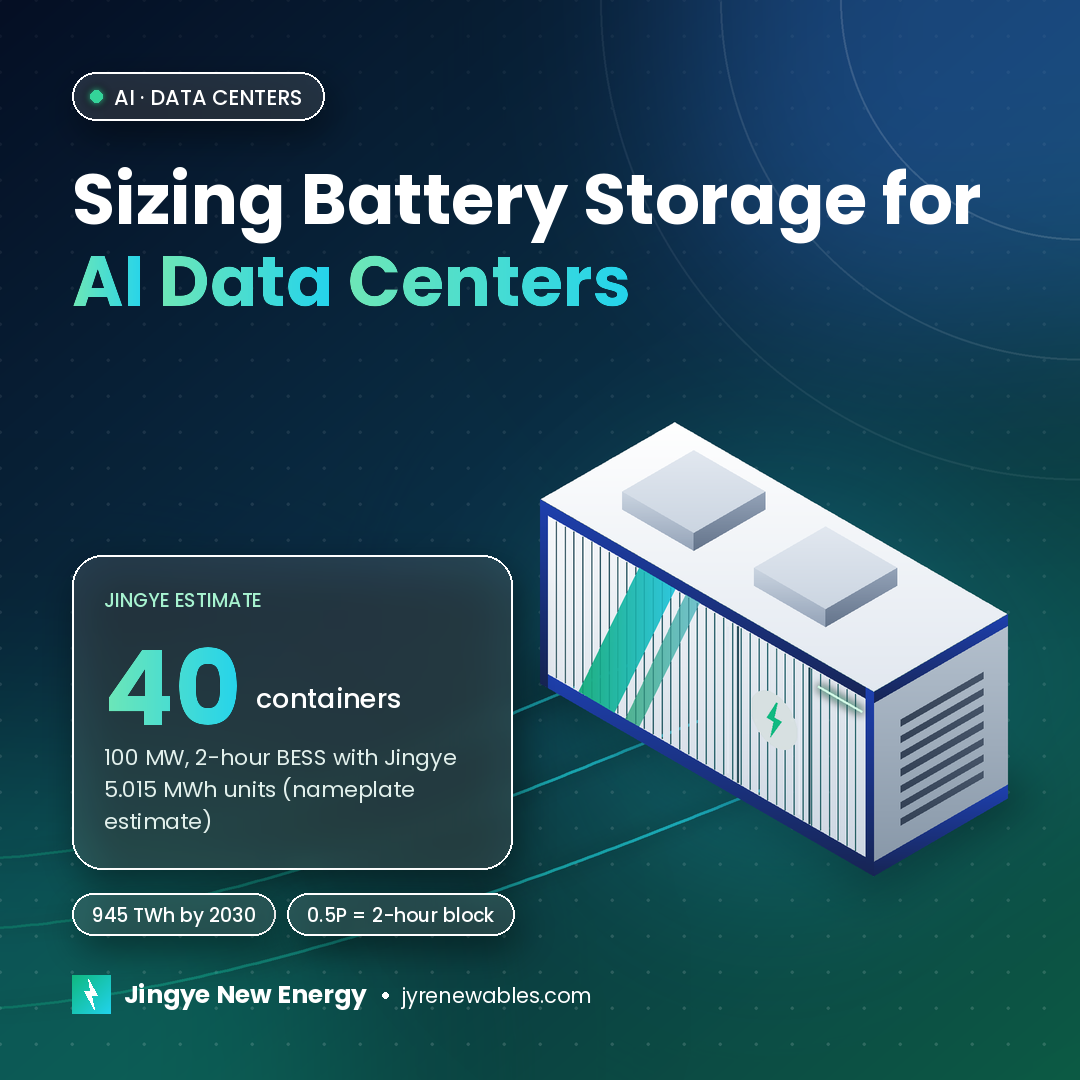
AI Data Center Battery Storage: How to Size the BESS in 2026
AI data centers use battery storage to smooth GPU load swings, ride through outages and manage grid limits. By our estimate, a 100 MW, 2-hour BESS needs 40 Jingye 5.015 MWh containers, and a 4-hour system needs 80.
Nov. 04, 2026
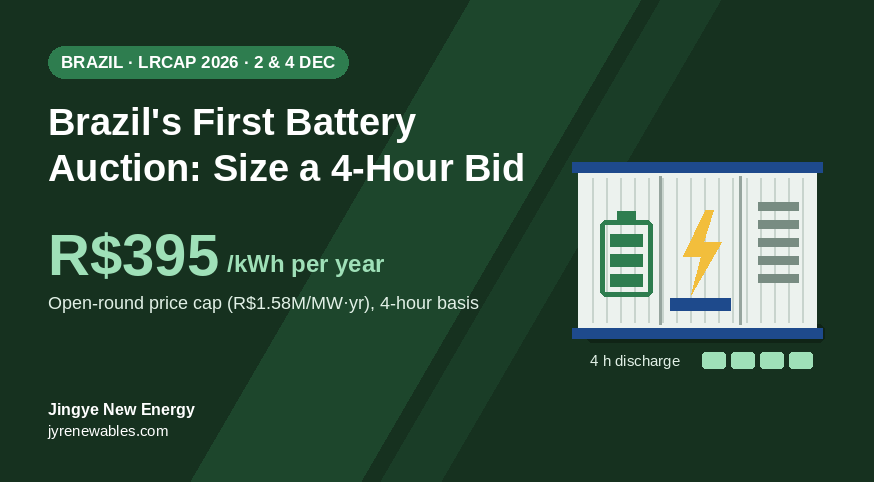
Brazil Battery Storage Auction LRCAP 2026: How to Size a 4-Hour Bid
Brazil's first battery capacity auctions on 2 and 4 December 2026 cap prices at R$1.58–1.76 million per MW per year, about R$395–440 per kWh of 4-hour storage. By our estimate, a 100 MW bid needs 80–111 Jingye 5.015 MWh containers.
Let’s Get Started on Your New Energy Journey.