Nov 10, 2026
By Daniyal, Jingye New Energy. Published November 10, 2026.
Quick answer: On 4 November 2026, India approved ₹14,500 crore of viability gap funding (VGF) for 92 GWh of grid-scale storage, including 30 GWh of battery storage, to be built between FY2027 and FY2031. Battery projects must now meet a 40% domestic content requirement, double the 20% applied to VGF battery projects since December 2025. Cells are the hard part: by our estimate they make up about 63% of a Chinese 2-hour container's price, so developers need a clear localisation plan before they bid.
India's Union Cabinet approved the Viability Gap Funding scheme for grid-scale energy storage on 4 November 2026 (Prime Minister's Office). The 92 GWh target equals about 170% of the country's present grid-scale storage capacity, and it is one step towards the 411 GWh the government says India needs by 2031-32.
The money is not the only headline. For the first time, the scheme sets a 40% minimum domestic content requirement (DCR) for battery projects. That matters because India still has a big gap between awarded and built storage: IEEFA and JMK Research count 10.2 GWh of BESS commissioned so far, with only about 1.9% of the 50 GW utility-awarded pipeline in operation (IEEFA-JMK, October 2026). This post explains what the 40% rule means for developers, EPCs and equipment buyers, and how to plan for it.
A five-year VGF programme that pays part of the cost of new storage projects, with capacity awarded through tariff-based competitive bidding. Here is how the 92 GWh splits.
| Item | Detail |
|---|---|
| Total VGF support | ₹14,500 crore (FY2026-27 to FY2030-31) |
| Estimated total investment | ₹97,600 crore |
| Pumped hydro storage | 60 GWh |
| Battery energy storage (BESS) | 30 GWh |
| Alternative storage technologies | 2 GWh |
| Who can receive VGF (BESS and pumped hydro) | Public and private distribution companies |
| Allocation method | Tariff-based competitive bidding |
| Domestic content for BESS | Minimum 40% |
Sources: Prime Minister's Office release, 4 Nov 2026; Renewable Watch, 5 Nov 2026.
Two numbers help put it in context. The VGF covers about 14.9% of the estimated ₹97,600 crore investment (our calculation), so developers still finance most of each project. And batteries are about a third of the target (30 of 92 GWh), with pumped hydro taking the largest share.
It is the biggest of the three, and the first to set the battery local-content bar at 40% from day one.
| Scheme | VGF budget | Capacity | Domestic content for BESS |
|---|---|---|---|
| 2023 BESS VGF | ₹3,760 crore | 4,000 MWh at launch, later 13,220 MWh | Not stated in the launch announcement |
| June 2025 BESS VGF (PSDF) | ₹5,400 crore | 30 GWh BESS (25 GWh states, 5 GWh NTPC) | 20% of total project cost (from Dec 2025) |
| November 2026 storage VGF | ₹14,500 crore | 92 GWh (incl. 30 GWh BESS) | 40% minimum |
Sources: News On AIR, Sept 2023; ESS News, Dec 2025; Energy-Storage.news; PMO, Nov 2026. The 2023 scheme covered up to 40% of capital cost, paid in five tranches.
Other VGF rules already apply to battery projects. Since August 2025, EMS application software must be developed in India, and refurbished cells are not allowed (Energetica India). Expect those rules to carry over unless the new guidelines say otherwise.
It means a big share of each project's value has to be made in India, and cells are the item that decides how hard that is. The exact calculation method has not been published, so treat the numbers below as a planning guide, not a compliance test.
Under the December 2025 rule, the 20% was measured against total project cost, and Indian-developed EMS software counted towards it (ESS News). If the 40% works the same way, everything in the project budget matters: cells, modules, containers, PCS, transformers, EMS, civil works, grid connection and installation.
To see why cells matter so much, we split a Chinese 2-hour AC container price into cells and everything else, using IEEFA-JMK's September 2026 prices.
| Item (China after-tax price basis) | US$ per kWh | Share of container price |
|---|---|---|
| LFP 314Ah cells | 54.4 | 63% |
| Everything else in the container (PCS, enclosure, cooling, fire protection, BMS, assembly) | 32.0 | 37% |
| 2-hour AC container, total | 86.4 | 100% |
| For reference: Indian landed LFP cell price | 62–67 | n/a |
Prices from IEEFA-JMK Research, October 2026. Split and shares are Jingye New Energy estimates. Real project costs vary by duration, site, grid connection and contract terms.
What this tells developers:
About 5,982 containers of our 5.015 MWh size, at nameplate energy. That is our own estimate, based on the 5,015 kWh rating on our 5.015 MWh BESS container page, and it does not include any overbuild for degradation or losses.
Prices are also moving. The latest Indian standalone BESS tariffs are rising: MSEDCL's 2,000 MW / 4,000 MWh tender cleared at ₹2.38 lakh per MW per month and SJVN's 265 MW / 530 MWh at ₹2.35 lakh, and about 57% of September's tendered capacity was re-tendered because the lowest bids were off benchmark (IEEFA-JMK). Higher DCR may push costs up further, which is one reason the VGF exists.
The per-MWh VGF rate for batteries has not been announced. Spread across all 92 GWh, the ₹14,500 crore works out to about ₹15.8 lakh per MWh (our estimate). For comparison, recent state tenders under earlier VGF tranches, such as KREDL's and UPCL's, offered ₹18 lakh per MWh (IEEFA-JMK).
For more on India's tender pipeline and the earlier 20% rule, see our guide to India's 50 GWh GEC-III battery plan.
Start the localisation plan now, because the bid deadline will be too late. These are the steps we suggest:
Most BESS problems start in integration and commissioning rather than in cells. Our BESS safety buyer checklist covers what to check.
We can't make imported equipment count as Indian content. What we can do is supply the parts that fit your localisation plan and make them easy to integrate with Indian partners.
Behind the products are a 15 GWh module/PACK production line with MES traceability from materials to finished product, a CNAS-accredited testing laboratory, and ISO quality, environmental and occupational health and safety certification (company profile).
We also run large systems ourselves. The Jiangsu Jingye Iron and Steel 50 MW / 100.32 MWh station uses 20 of our 5 MWh battery cabins with 10 sets of 5 MW PCS, and at Huaxi Special Steel (15 MW / 30.09 MWh) Jingye New Energy designed, funded, built and operates the station. See our full energy storage system range.
A ₹14,500 crore Viability Gap Funding scheme for 92 GWh of grid-scale energy storage between FY2026-27 and FY2030-31: 60 GWh pumped hydro, 30 GWh battery storage and 2 GWh other technologies, with an estimated ₹97,600 crore of total investment.
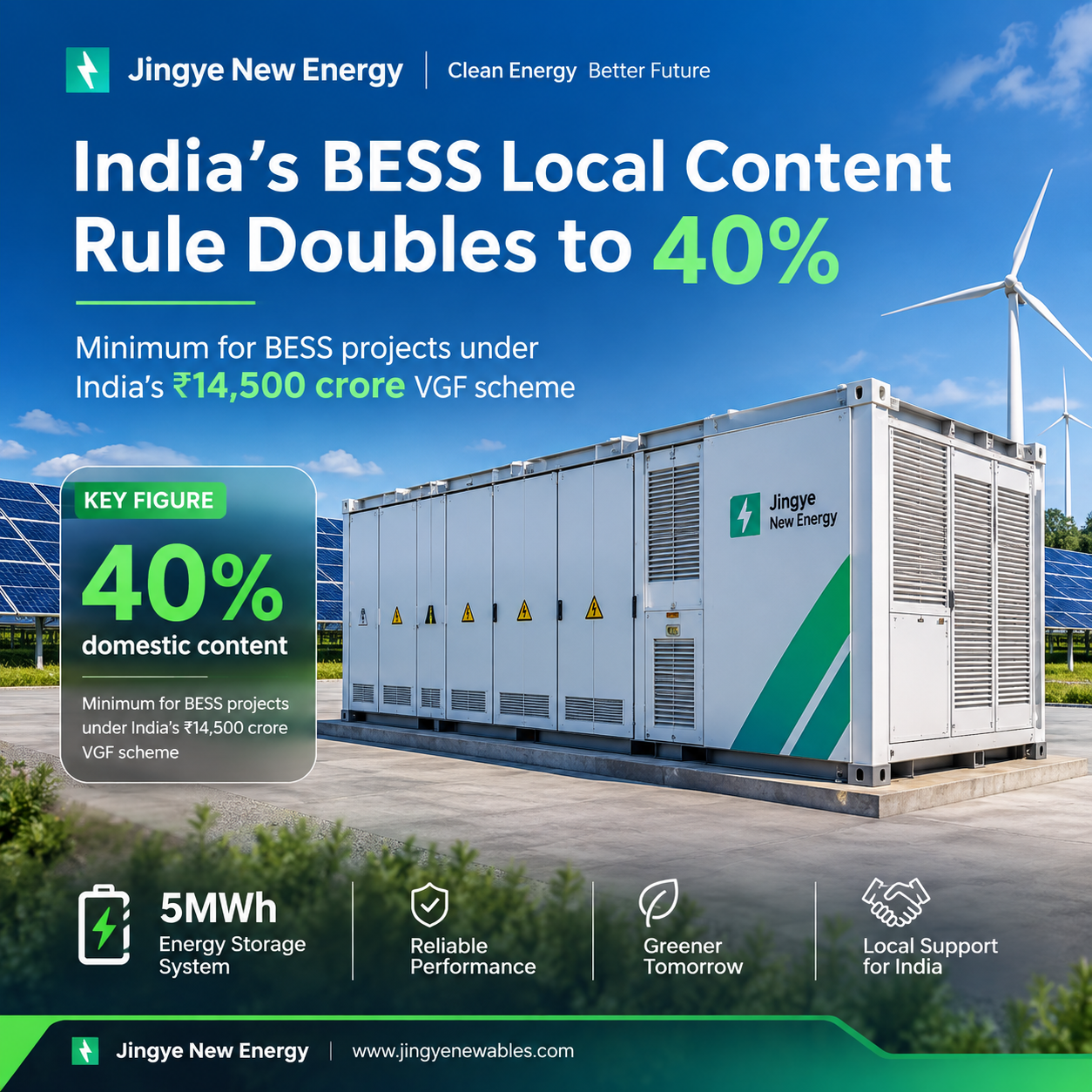
Battery storage projects must meet a minimum domestic content requirement of 40%. Since December 2025, VGF-supported battery projects have needed 20%.
The calculation method has not been published yet. Under the December 2025 rule, the 20% was measured against total project cost, and indigenously developed EMS software counted towards it. Check the bidding documents when they are released.
Nothing published so far bans imported cells, but cells are the largest single cost item. Using IEEFA-JMK price data, we estimate cells make up about 63% of a Chinese 2-hour AC container's price, so projects using imported cells will need most of their local content to come from other parts of the project.
The per-technology rate has not been announced. Across all 92 GWh, the scheme averages about ₹15.8 lakh per MWh (our estimate), while recent state tenders under earlier VGF tranches offered ₹18 lakh per MWh.
The bidding procedures have not been published yet. Capacity will be allocated through tariff-based competitive bidding, and both public and private distribution companies can receive VGF for battery projects.
Send us the tender's capacity, duration and domestic content clause. Our engineers will reply with a container or CCS supply proposal built around your localisation plan.
Send your tender detailsHebei Jingye New Energy Technology Co., Ltd, part of Jingye Group, makes utility-scale BESS containers, C&I energy storage cabinets, CCS cell contact systems, commercial vehicle batteries and DC fast EV chargers.
Nov. 12, 2026
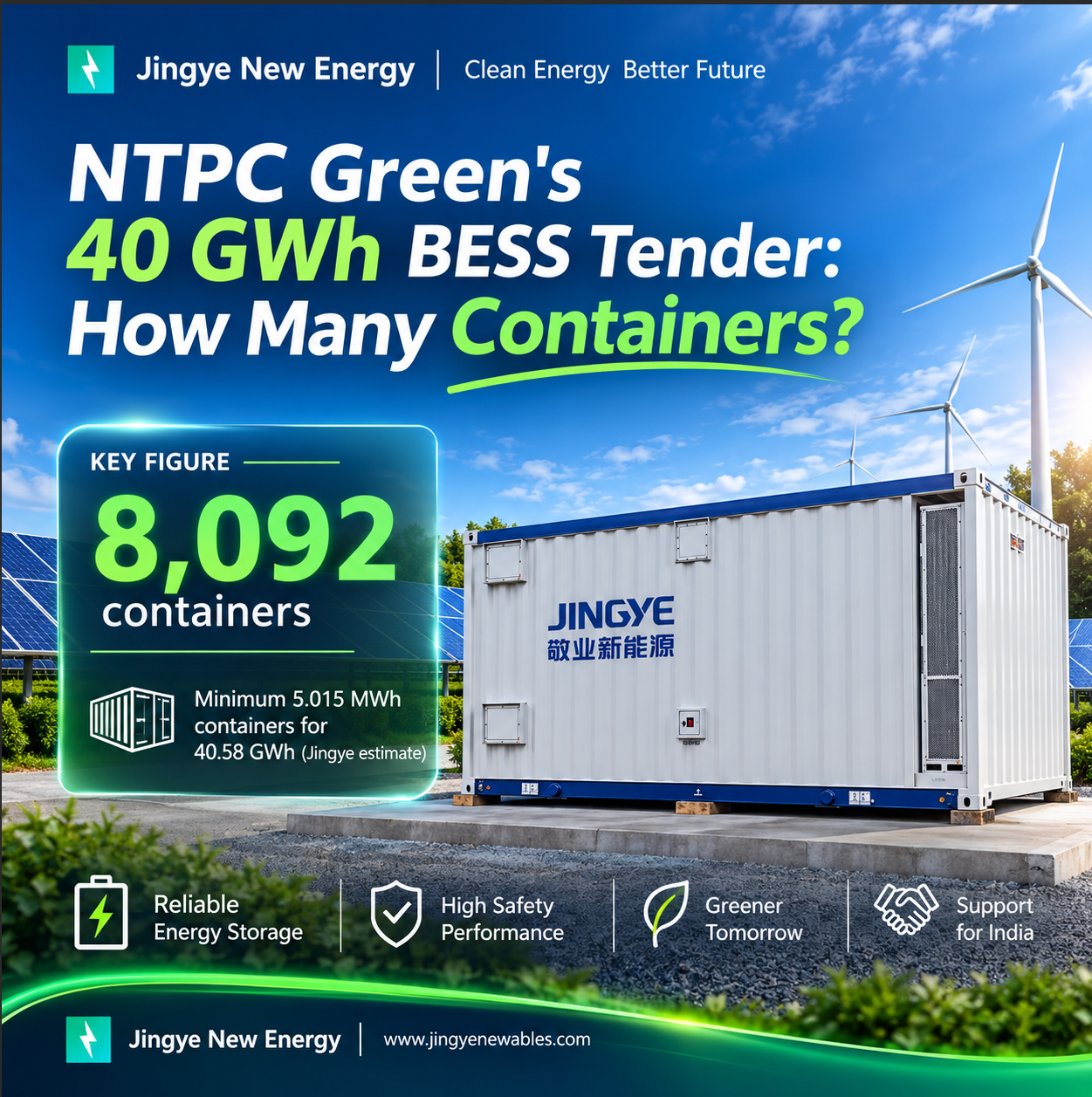
NGEL 40 GWh BESS Tender: Container Sizing, Qualification Rules and Bid Deadline (2026)
NTPC Green Energy's 10 GW / 40.58 GWh BESS tender closes on 8 December 2026 and needs at least 8,092 battery containers of 5.015 MWh. Here are the block sizes, qualification routes, turnover rules and bid steps.
Nov. 11, 2026
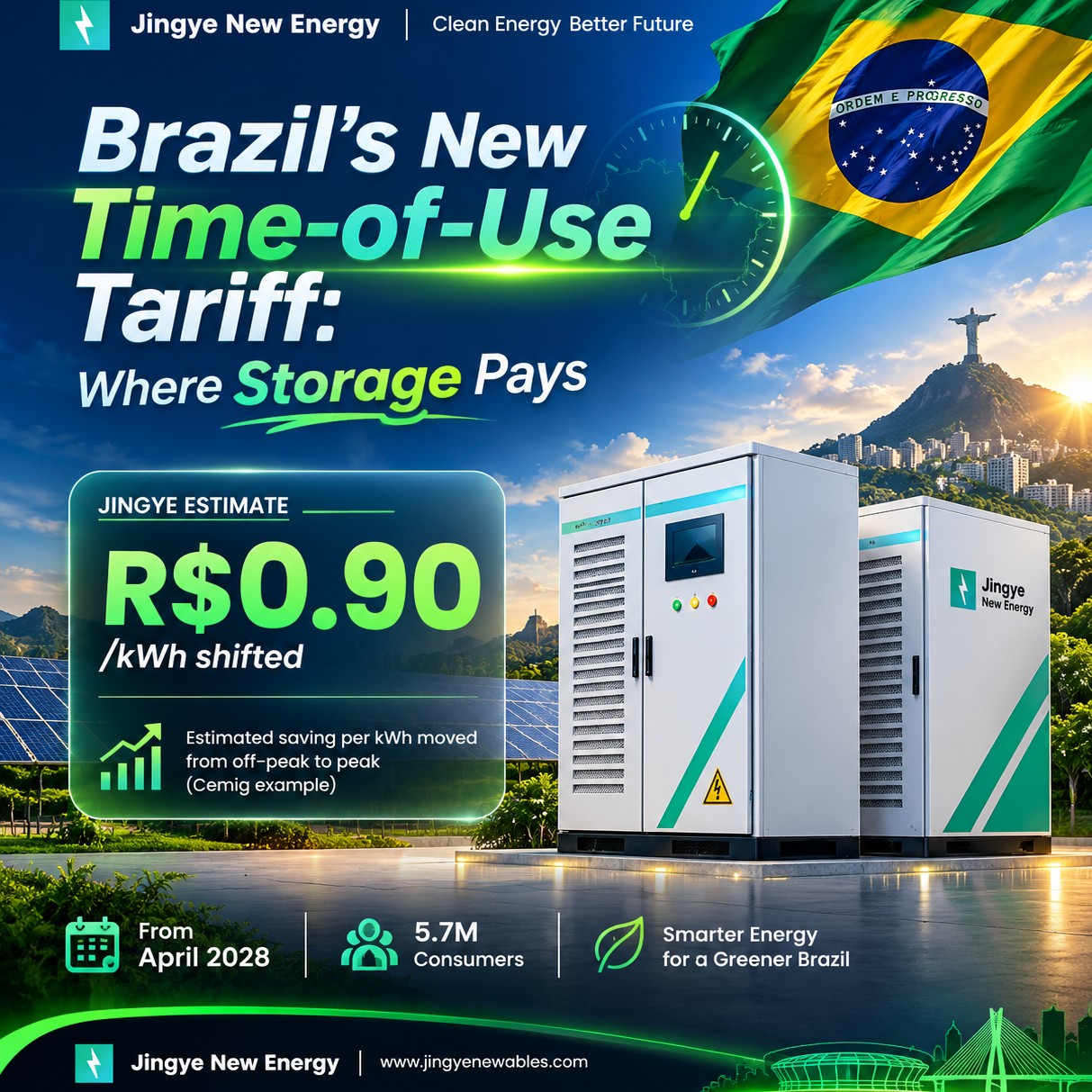
Brazil Tarifa Hora Certa: How Battery Storage Cuts Peak Electricity Costs from 2028
ANEEL's proposed Tarifa Hora Certa would move about 5.7 million low-voltage consumers in Brazil to time-of-use pricing from April 2028. With peak energy at R$1.73/kWh vs R$0.75 off-peak in ANEEL's Cemig example, a battery saves about R$0.90 per kWh shifted.
Nov. 10, 2026
India's new ₹14,500 crore VGF scheme backs 30 GWh of battery storage, and BESS projects must now meet a 40% domestic content rule, double the earlier 20%. Here's what it means for developers, EPCs and equipment buyers.
Let’s Get Started on Your New Energy Journey.