Oct 13, 2026
By Daniyal, Jingye New Energy. Published October 10, 2026.
Quick answer: Yes, battery energy storage has become much safer. EPRI's October 2026 report finds that BESS failures per GWh deployed fell 98% between 2018 and 2025, to a rate comparable with large oil-filled transformers. Most failures now start in integration, controls and commissioning rather than in the cells, so the supplier's system design and site support matter more than the cell brand.
Safety is still the first question most buyers ask about battery storage. Planning boards ask it, insurers ask it and factory owners ask it before they put a battery next to a production line. On 5 October 2026, the US Electric Power Research Institute (EPRI) gave the clearest data-based answer so far: annual BESS failures per deployed GWh dropped 98% worldwide between 2018 and 2025, while installed capacity grew exponentially.
That decline happened while the industry got far bigger. Global deployments passed 300GWh of new installations in 2025, and cumulative capacity is expected to exceed 7,000GWh by 2035. This guide explains what the report found, what it means if you are buying a 5MWh container or a C&I cabinet, and the questions to ask any supplier, including us.
The short answer is that failures are now rare and rarely leave the site. The report, Risk Factors and Failure Statistics of Lithium-Ion BESS, uses EPRI's BESS Failure Incident Database of real-world events. EPRI's report page has the full document. The main findings, as reported by Energy-Storage.News:
Very fast, and the trend held across two separate EPRI studies. An earlier EPRI, PNNL and TWAICE study found the failure rate fell from about 9.2 per GW deployed in 2018 to about 0.2 in 2023. The 2026 report extends the data to 2025 and puts the drop at 98%.
| Study | Period | Finding |
|---|---|---|
| EPRI / PNNL / TWAICE (May 2024) | 2018 → 2023 | About 9.2 → 0.2 failures per GW deployed (−97%) |
| EPRI (October 2026) | 2018 → 2025 | Failures per deployed GWh down 98% |
| EPRI (October 2026) | 2025 | Over 300GWh of new BESS installed worldwide |
Newer system designs and lessons shared after early incidents both play a part. For example, there have been no reported BESS-related injuries or deaths in the US since lessons from the 2019 Surprise, Arizona fire were spread through the industry.
No. The data points to integration, controls and operation far more than to the cells. The 2024 study found that 65% of incidents were linked to the operation and integration of batteries, and only 11% to cell or module failures. Balance-of-system parts (PCS, thermal management and other non-battery hardware) and controls were the most common failing elements.
The 2026 report goes further. EPRI could not show that cell chemistry on its own is a risk factor for system-level failures, because chemistry is hard to separate from better unit design and better manufacturing and operating practice. For buyers, this changes what to look at. A famous cell brand does not make a safe system. How the cells are monitored, cooled, separated, protected and commissioned does.
Mostly early in the project's life. In the 2024 data, 72% of incidents happened during construction, commissioning or the first two years of operation. That matches the 2026 finding that failure rates drop as systems age past their early years.
So the most important safety work happens before and just after energisation: factory testing, correct installation, careful commissioning and close monitoring in year one. A supplier that ships the container and disappears leaves you exposed in exactly the period when risk is highest.
Each EPRI finding points to a concrete question. The table below is our own mapping of the report's findings to supplier checks, with how Jingye New Energy answers each one.
| EPRI finding | What to ask your supplier | How Jingye answers |
|---|---|---|
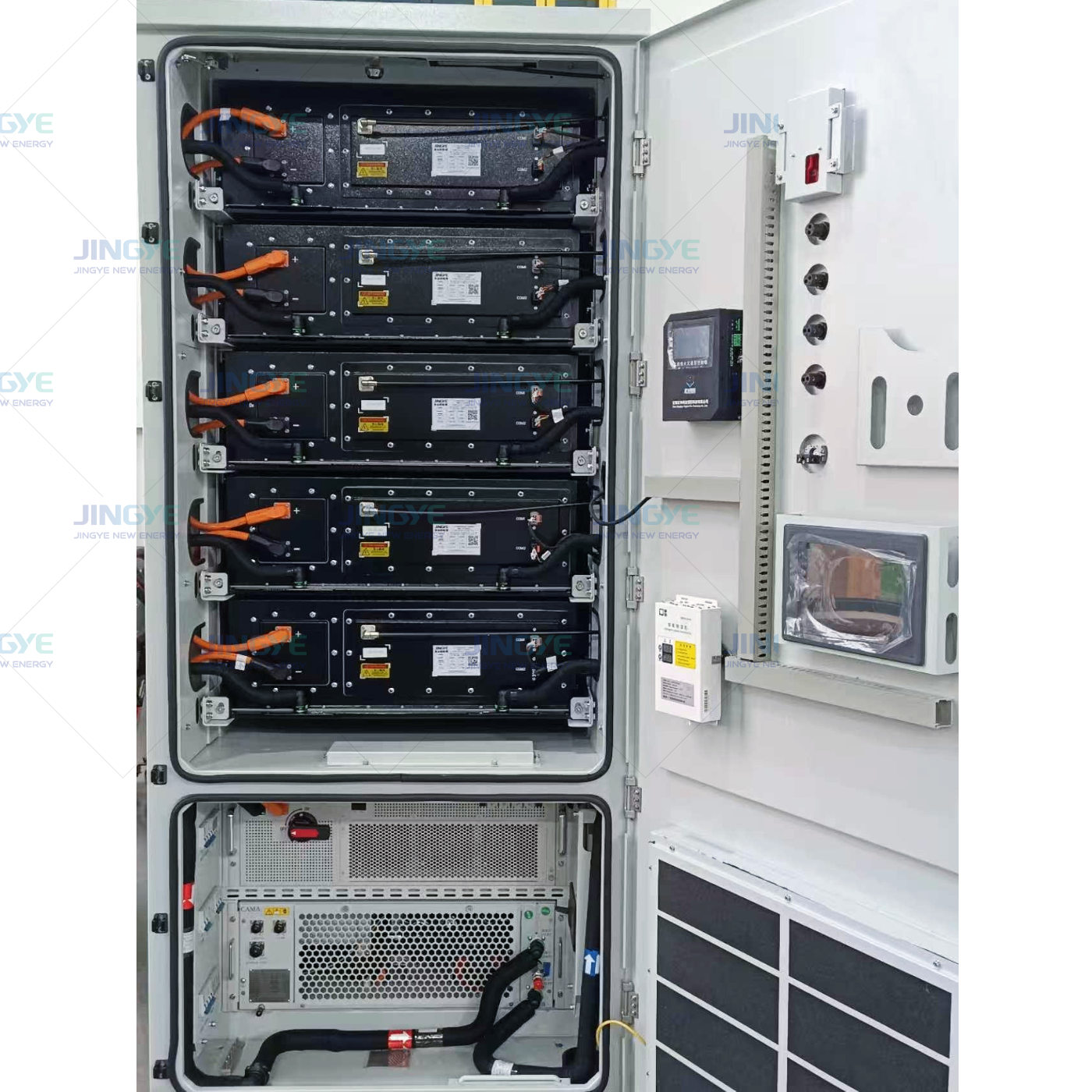
| Most failures start in integration and controls, not cells | Who designs and integrates the full system, and how many levels does the BMS monitor? | We integrate in-house. The 5.015MWh container's BMS monitors cell, pack, cluster and system levels, with automatic protection and disconnection. |
| Stopping propagation is critical | Is fire detection and suppression zoned, or one system for the whole enclosure? | The container has three-level automatic alarm and fire extinguishing: pack, cluster and compartment. C&I cabinets use cell, module, cluster and cabinet protection. |
| Indoor facilities are overrepresented | Is the product built as a standalone outdoor enclosure? | Both product lines are self-contained enclosures: a 20-ft container (IP54/IP55 with salt-fog protection) and IP54 or IP55 cabinets. |
| 72% of incidents occur in construction, commissioning or years 1–2 | Do you support installation and commissioning, and what warranty applies? | Installation guidance, commissioning support and a 3-year warranty on the container. |
| Newer designs and practices are safer | Which standards does the product meet, and what is tested in your own lab? | The container page lists GB/T 36276, IEC/EN 62619, IEC/EN 62477, UN 38.3 and IEC/EN 63056. Finished packs go through charge-discharge and cooling tests in our CNAS-accredited lab. |
| Transparency drives improvement | Can you trace every part back to its batch? | Our MES system traces each product from raw material to finished system. |
Oct. 20, 2026
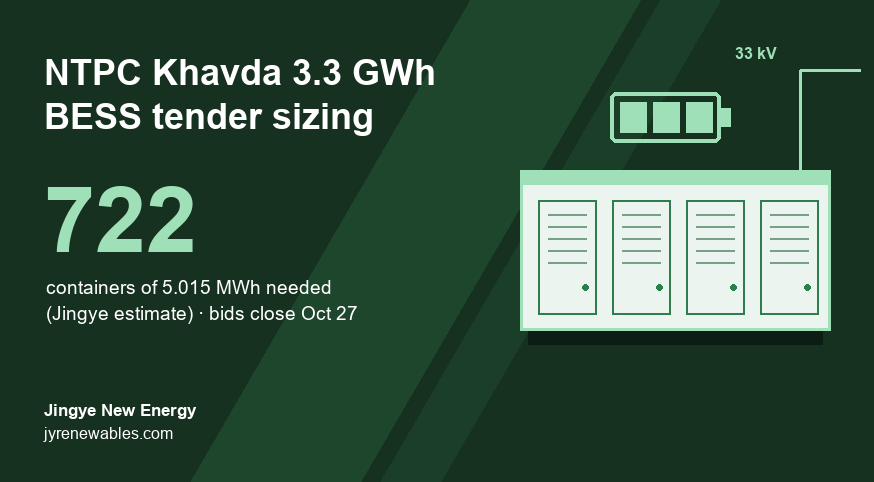
NTPC Khavda 3,300 MWh BESS Tender: How Many Containers You Really Need (2026)
NTPC Green Energy's 1,100 MW / 3,300 MWh Khavda battery tender closes on October 27, 2026. Because capacity is counted as AC energy at the grid point, we estimate it needs about 722 containers of 5.015 MWh, roughly 10% more installed battery than the headline figure.
Oct. 20, 2026
Battery Energy Storage System Architecture: Key Components Explained
A battery energy storage system architecture determines how safely and efficiently a BESS stores, controls, and delivers electricity. The main challenge for overseas buyers is choosing the right structure without creating avoidable cost, safety, or integration problems.
Oct. 19, 2026
Battery Capacity Fade in Commercial Energy Storage Systems
Battery capacity fade in commercial energy storage systems reduces the amount of energy a site can store and deliver. This battery degradation can increase demand charges, reduce backup time, and change the return on investment.
Let’s Get Started on Your New Energy Journey.