Oct 09, 2026
By Daniyal, Jingye New Energy. Published 9 October 2026.
Quick answer: On 30 September 2026, India's Cabinet approved Green Energy Corridor Phase III (GEC-III), including ₹50,000 crore (about US$5.2 billion) for 50 GWh of battery energy storage by FY2032-33. That is roughly ₹10,000 per kWh, which is close to what a 2-hour BESS container costs landed in India today. With tender tariffs rising and local-content rules tightening, choosing the right supplier will decide which developers deliver these projects profitably.
India's storage market is moving from tenders to construction. As of 31 August 2026, the country had only 9.08 GWh of battery storage operating, but a pipeline of 176.66 GWh across 187 projects, and a projected need of 236 GWh by FY2031-32 (TaiyangNews, citing Rubix Data Sciences).
GEC-III adds another 50 GWh on top. This guide explains what the scheme includes, what its budget means per kWh, how tender prices are moving, and what developers and EPCs should check before choosing a BESS supplier.
GEC-III is India's programme to strengthen state-level transmission so up to 135 GW of renewable energy can reach the grid, and for the first time it includes a dedicated battery storage component. The key facts from the official Cabinet release:
The government has not yet published project-level details on technology, storage duration or procurement structure for the 50 GWh (Energy-Storage.News). Expect those to arrive state by state through tenders.
To put the scale in perspective: 50 GWh equals about 9,970 of our 5.015 MWh twenty-foot containers.
₹50,000 crore for 50 GWh works out to ₹10,000 per kWh, or about US$105/kWh. That is almost exactly today's landed price of a 2-hour BESS container in India, before land, grid connection and installation.
| Benchmark (August 2026 prices) | ₹ per kWh | US$ per kWh |
|---|---|---|
| 314Ah LFP cell, China price | 5,114 | 53.6 |
| LFP cell, landed in India | 5,824–6,301 | 61–66 |
| 2-hour AC container system, China average | 8,239 | 86.3 |
| 2-hour AC container, landed in India (our estimate: China price + 14–23% import premium) | ≈ 9,390–10,130 | ≈ 98–106 |
| GEC-III BESS budget (₹50,000 crore ÷ 50 GWh) | 10,000 | ≈ 105 |
Market prices from the IEEFA–JMK Research EnergyWatts report, September 2026, which puts India's landed cell and container prices 14–23% above China prices. Exchange rate: ₹95.47 per US$. The GEC-III figure is a simple average; the government has not said what it covers.
What this means: if the budget has to cover equipment, installation and grid connection, there is very little room for error. Every rupee saved on the container, and every percentage point of efficiency gained over 15 years, goes straight to the project's margin.
Yes. After record lows in 2025, recent repeat tenders from the same buyers are clearing 10–25% higher, and buyers are shifting to longer 4-hour systems.
| Tender (comparable pair) | Earlier tariff | August 2026 tariff | Change |
|---|---|---|---|
| WBSEDCL, West Bengal (4-hour) | ₹3.47 lakh/MW/month (Jan 2026) | ₹4.35–4.39 lakh/MW/month | ≈ +25% |
| GUVNL, Gujarat (2-hour) | ₹2.10 lakh/MW/month (Feb 2026) | ₹2.32 lakh/MW/month | ≈ +10.5% |
Source: IEEFA–JMK Research, September 2026.
Yes, with conditions. Projects funded under India's Viability Gap Funding (VGF) scheme must have at least 20% local content, and that threshold is low enough that imported cells can still be used (Energy-Storage.News, citing Wood Mackenzie).
The practical model: import proven cells and battery systems, and add local value in EMS, installation, civil works and assembly to meet each tender's content rule. Always check the specific local-content and certification clauses in each RfS before you bid.
A 50 MW / 200 MWh project needs about 40 of our 5.015 MWh containers at nameplate, each running at 1.25 MW for four hours. Here are common Indian tender sizes:
| Project size (example tender) | Duration | 5.015 MWh containers (nameplate) | Power per container |
|---|---|---|---|
| 50 MW / 200 MWh (SECI ESS-IV minimum) | 4 hours | 40 | 1.25 MW |
| 250 MW / 500 MWh | 2 hours | 100 | 2.5 MW |
| 1,000 MW / 4,000 MWh (GUVNL, Aug 2026) | 4 hours | 798 | ≈ 1.25 MW |
| 1,500 MW / 6,000 MWh (RVUNL, Aug 2026) | 4 hours | 1,197 | ≈ 1.25 MW |
Nameplate counts only. Real designs add containers for usable energy at the grid connection point, conversion losses and degradation over the contract life. Send us your tender's RfS for an exact layout.
A live opportunity: SECI's ESS-IV tender, issued on 1 October 2026, seeks 800 MW / 3,200 MWh of standalone 4-hour storage anywhere in India, with a 50 MW / 200 MWh minimum project size. At least 51% of charging power must be renewable, and online bids close on 30 October 2026 (TaiyangNews).
With thin budgets and rising tariffs, the supplier decides whether a project makes money. Check these six points:
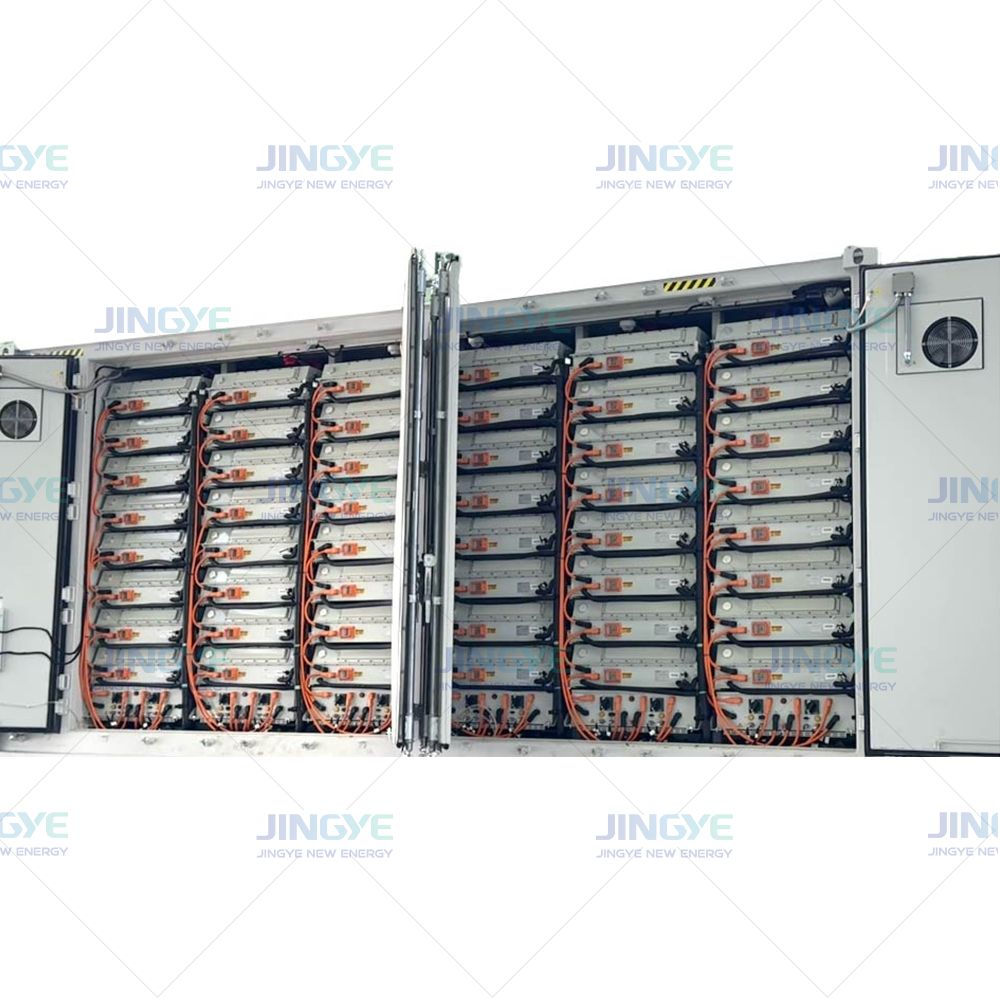
Our 5.015 MWh liquid-cooled BESS container is built for exactly this kind of utility-scale project:
The same platform runs at scale today. It powers the 50 MW / 100.32 MWh Jiangsu Jingye Iron and Steel station (20 battery containers with 10 integrated 5 MW PCS units), and we built and operate a 15 MW / 30.09 MWh station for Huaxi Special Steel running two cycles a day.
Our systems are made on an automated 15 GWh module and pack line with full MES traceability, backed by ISO 9001, ISO 14001 and ISO 45001 management systems, SGS testing and an in-house CNAS-accredited laboratory (company profile).
For Indian integrators assembling battery packs locally, we also supply IATF 16949-certified Cell Contact Systems (CCS). For more background, read our guides on 5 MWh containerized BESS specifications and cost and what a BESS is.
It is a ₹1,86,405 crore scheme, approved on 30 September 2026, to strengthen state transmission networks for up to 135 GW of renewable energy. It is the first phase to include a dedicated battery storage component: 50 GWh by FY2032-33.
₹50,000 crore (about US$5.2 billion) for 50 GWh, which averages ₹10,000 or roughly US$105 per kWh.
Yes. Comparable tenders awarded in August 2026 cleared about 25% higher in West Bengal (4-hour) and about 10.5% higher in Gujarat (2-hour) than earlier in the year.
Yes. VGF-supported projects need at least 20% local content, which still allows imported cells. Each tender sets its own rules, so check the RfS.
About 40 containers of 5.015 MWh at nameplate, each discharging at 1.25 MW for four hours. The final number is higher once usable energy, losses and degradation are included.
SECI's ESS-IV tender for 800 MW / 3,200 MWh of standalone 4-hour storage, with online bids due on 30 October 2026.
Mostly lithium iron phosphate (LFP), with 314Ah cells now widely used in utility-scale systems for their cycle life, safety and cost.
Send us the tender's RfS or your MW/MWh target. Our engineers will propose a container layout, PCS pairing and price for your bid.
Request a BESS proposalHebei Jingye New Energy Technology Co., Ltd, part of Jingye Group, makes 5 MWh BESS containers, C&I energy storage cabinets (261 and 417 kWh), Cell Contact Systems and related storage hardware for developers, EPCs and distributors worldwide.
Oct. 09, 2026
India's 50 GWh BESS Plan (GEC-III): What It Means for Battery Storage Buyers in 2026
India's Green Energy Corridor Phase III sets aside ₹50,000 crore for 50 GWh of battery storage by FY2032-33, about ₹10,000 per kWh. Here's what that budget, rising tender tariffs and the 20% local-content rule mean for developers choosing a BESS supplier.
Oct. 09, 2026
EV Charger Load Management for Commercial Charging Stations
Commercial charging sites often face high electricity bills, limited grid capacity, and slow charging during busy periods. Dynamic load balancing helps distribute available power between several chargers without exceeding the site's electrical limit. This guide explains EV charger load management in clear steps for fleet operators, property owners, and overseas EV charging distributors. Smart
Oct. 09, 2026
Battery Storage for Commercial Buildings: Key Applications
Commercial buildings face high electricity bills, power interruptions, solar energy waste, and limited grid capacity. Commercial battery storage supports peak shaving, demand charge management, and load shifting in one energy system. The best battery storage project matches the building's load profile, tariff rules, safety needs, and backup power goals.
Let’s Get Started on Your New Energy Journey.