Nov 05, 2026
By Daniyal, Jingye New Energy. Published 5 November 2026.
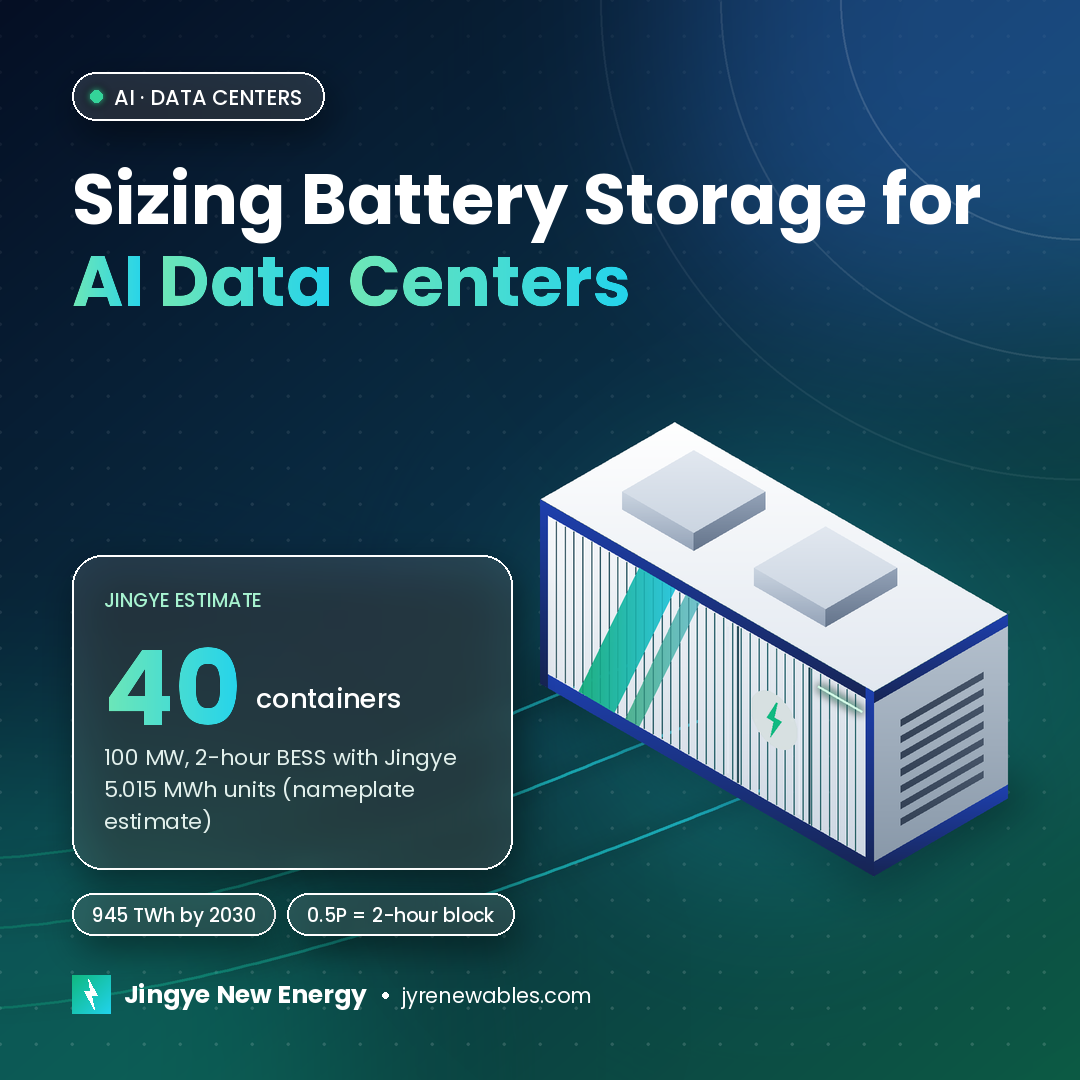
Quick answer: AI data centers use battery storage for three jobs on three timescales: smoothing GPU load swings (seconds to minutes), backup and ride-through (minutes to about an hour), and managing grid limits or storing renewable power (two to four hours). The duration decides the hardware. By our estimate, a 100 MW system needs 40 of our 5.015 MWh containers for one or two hours, because each is rated up to 2.5 MW, and 80 for four hours.
Data centers used about 415 TWh of electricity in 2024, roughly 1.5% of the world total, and the IEA's Base Case has that doubling to around 945 TWh by 2030, growing about 15% a year (IEA). Much of the new load comes from AI training and inference, which draws power in large, fast-changing blocks.
Batteries are moving into that picture fast. On 4 November 2026, Scana's PSW Power & Automation signed a framework agreement to deliver a 240 MVA / 250 MWh battery energy storage system to a Norwegian AI and high-performance computing data center operator, with deliveries expected from Q1 2027 (Scana release). This guide explains what those batteries do, how long they need to run, and how many containers a project actually needs.
Because AI load is large and spiky, grid connections are limited, and data centers cannot afford interruptions. A battery can respond in milliseconds, hold power for minutes, and shift energy for hours, depending on how it is designed.
Synchronized GPU training cycles make power demand jump up and down, and those swings can excite grid frequencies. A study published on 2 November 2026 simulated a hybrid system of a battery and a supercapacitor that reshaped 75–160 MW demand swings to fit largely within a 10 MW band, and cut a critical 20 MW oscillation below 1 MW (arXiv).
Power architecture is changing too. Envision says its Galaxy AI campus in Ulanqab, China, now runs an 800 V DC system that pairs solid-state transformers with battery storage. The batteries provide minute-scale backup, while millisecond-level control absorbs GPU load swings. The campus is planned for 3 GW, with more than 80% of its power expected from renewables (IndexBox).
It depends on the job. Fast smoothing needs power more than energy, while peak management and renewable shifting need two to four hours of energy.
| Job | Timescale | What the battery does | Typical hardware |
|---|---|---|---|
| Smooth GPU load swings | Milliseconds to minutes | Absorbs and injects fast power changes so grid draw stays within limits | High-power battery, often paired with supercapacitors |
| Backup and ride-through | Seconds to about 1 hour | Carries critical load until backup generation or the grid takes over | UPS batteries and high-power BESS |
| Grid limit and peak management | 1 to 4 hours | Caps grid import and covers demand peaks | Containerized LFP BESS |
| Renewable shifting | 2 to 4 hours or more | Stores solar or wind power for use later | Containerized LFP BESS |
Timescales are typical ranges, not rules. Each project should be designed around its own load profile and grid agreement.
Scana's system shows where the market is today. 250 MWh behind 240 MVA is roughly a one-hour system at full rating (our calculation, assuming full output as real power). That is a power-heavy design, built to support the site rather than to shift energy for many hours. Scana expects NOK 250–350 million of revenue from the agreement, which works out to about NOK 1,000–1,400 per kWh for the complete integrated system (our calculation; it covers far more than the batteries).
Take the larger of two numbers: the energy needed divided by 5.015 MWh, and the power needed divided by 2.5 MW. For a 100 MW system that means 40 containers for one or two hours and 80 for four hours.
Our 5.015 MWh container is rated up to 2.5 MW, which is 0.5P. That makes it a natural two-hour block: at full power it runs for about two hours. For shorter jobs you are limited by power, so you install more energy than the spec asks for. For longer jobs you are limited by energy, and each container runs at a gentler rate.
| System | Energy needed | Containers by energy | Containers by power | Containers needed | Installed energy |
|---|---|---|---|---|---|
| 100 MW, 1 hour | 100 MWh | 20 | 40 | 40 | 200.6 MWh |
| 100 MW, 2 hours | 200 MWh | 40 | 40 | 40 | 200.6 MWh |
| 100 MW, 4 hours | 400 MWh | 80 | 40 | 80 | 401.2 MWh |
| 240 MW, ~1 hour (250 MWh) | 250 MWh | 50 | 96 | 96 | 481.4 MWh |
Jingye estimate on nameplate ratings, rounded up. Add margin for depth of discharge, conversion losses and degradation. The 240 MW row applies our container to the size in Scana's announcement as an illustration only; it is not their design.
The last row is the useful lesson. With 0.5P containers, a one-hour, 240 MW specification needs 96 units and about 481 MWh of installed energy, almost twice the 250 MWh on paper. If the job truly is one hour, ask for a higher-rate design. If the site can also use the extra energy for peak management, the 0.5P route gives you a two-hour asset that earns in more ways.
Our Jiangsu Jingye Iron and Steel station shows the two-hour block in practice: 20 of our 5 MWh battery cabins and 10 PCS cabins of 5 MW make 50 MW / 100.32 MWh, almost exactly two hours. For how to build degradation margin into a large tender, see our Saudi Arabia 12 GWh sizing guide.
Check the power rating per unit against the duration you need, how the system responds to fast load changes, how it cycles over its life, and how it is protected against fire.
Our containers fit the two- to four-hour layer at campus scale, and our all-in-one cabinets fit small edge sites. For the fastest smoothing, a container is one layer of a design that also uses high-power devices such as supercapacitors or UPS systems.
To smooth fast swings in GPU power demand, to carry critical load for seconds or minutes until backup generation or the grid takes over, and to cap grid import or store renewable power for a few hours when the grid connection is the limit.
It depends on the job: seconds to minutes for load smoothing, around one hour for power support such as the 240 MVA / 250 MWh system Scana announced in November 2026, and two to four hours for peak management and renewable shifting.
The IEA estimates data centers used about 415 TWh in 2024, around 1.5% of global electricity, and projects about 945 TWh by 2030 in its Base Case.
Yes. A November 2026 study simulated a battery and supercapacitor system that reshaped 75–160 MW demand swings to fit largely within a 10 MW band and cut a 20 MW oscillation below 1 MW.
By our estimate, 40 Jingye 5.015 MWh containers for a one- or two-hour system, because each container is rated up to 2.5 MW, and 80 containers for four hours. These are nameplate counts before losses and degradation margin.
A 0.5P rating means full-power discharge takes about two hours. Our 5.015 MWh container delivers up to 2.5 MW, so for one-hour duty you are limited by power, and for four-hour duty by energy.
It is a power architecture that feeds computing racks from an 800 V DC bus instead of AC. Envision says its Galaxy AI campus in China now runs one with solid-state transformers and battery storage for minute-scale backup.
Send us the power you need to support, the duration, and your grid connection limit. We will send back a container count, a layout and a budget quote.
Send your project detailsHebei Jingye New Energy Technology Co., Ltd, part of Jingye Group, makes LFP battery energy storage containers, commercial and industrial energy storage cabinets, CCS cell contact systems and DC fast EV chargers.
Nov. 05, 2026
All-in-One vs Separate PCS Energy Storage Systems
Energy Storage Cabinets are no longer selected only by battery capacity. Buyers also need to evaluate power conversion, safety controls, thermal management, installation time, maintenance access, expansion options, and long-term operating cost. The central purchasing decision is whether to choose an All-in-One energy storage system or a Separate PCS architecture.
Nov. 05, 2026
AI Data Center Battery Storage: How to Size the BESS in 2026
AI data centers use battery storage to smooth GPU load swings, ride through outages and manage grid limits. By our estimate, a 100 MW, 2-hour BESS needs 40 Jingye 5.015 MWh containers, and a 4-hour system needs 80.
Nov. 04, 2026
Brazil Battery Storage Auction LRCAP 2026: How to Size a 4-Hour Bid
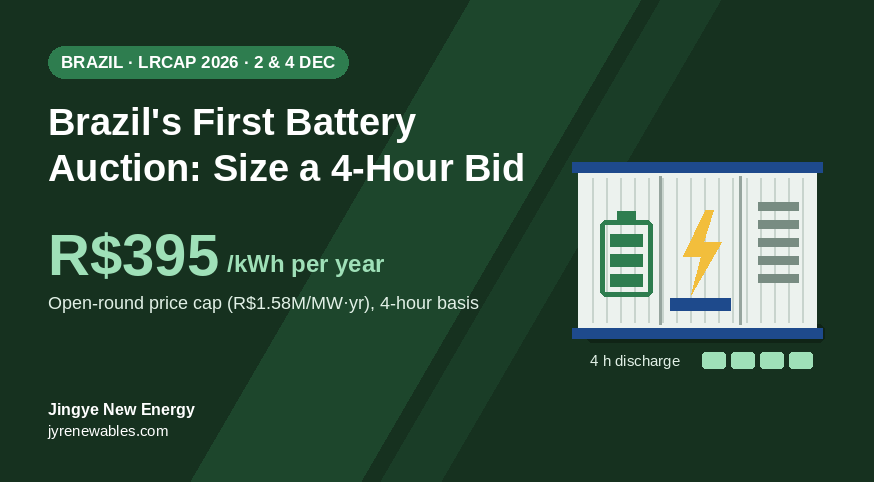
Brazil's first battery capacity auctions on 2 and 4 December 2026 cap prices at R$1.58–1.76 million per MW per year, about R$395–440 per kWh of 4-hour storage. By our estimate, a 100 MW bid needs 80–111 Jingye 5.015 MWh containers.
Let’s Get Started on Your New Energy Journey.