Nov 03, 2026
Battery energy storage for frequency regulation helps keep the power grid stable when electricity supply and demand change. A grid needs grid frequency control because most power systems must operate close to 50 Hz or 60 Hz. Solar power output can fall within seconds when clouds pass over a site. Wind output can also change as wind speed shifts. This creates a need for fast automatic generation control and reliable ancillary services. Traditional power plants can respond, but many units need several minutes to change their output. Battery systems can react in less than one second and provide both charging and discharging power. This article explains how a BESS supports grid stability, how it is sized, and how operators measure its performance.
Battery energy storage provides frequency regulation by quickly charging when grid frequency rises and discharging when frequency falls. A battery Energy Storage System receives a frequency or power-control signal from the grid operator, sends the signal to its power conversion system, and changes active power within seconds. Lithium iron phosphate batteries are widely used because they offer strong cycle life, stable thermal performance, and a high level of safety. A properly designed system must include a battery management system, suitable power capacity, enough energy capacity, thermal management, protection equipment, and performance testing.
Grid frequency shows the balance between electricity generation and electricity demand. When demand becomes higher than generation, frequency falls. When generation becomes higher than demand, frequency rises. The control system must correct this difference before it causes equipment trips or a wider outage.
| Grid condition | Frequency trend | Battery action | Power direction |
|---|---|---|---|
| Demand is higher than generation | Frequency falls | Battery discharges | Power flows from the BESS to the grid |
| Generation is higher than demand | Frequency rises | Battery charges | Power flows from the grid to the BESS |
| Supply and demand are balanced | Frequency remains near its target | Battery waits or maintains its operating point | Small corrections may continue |
A battery does not need fuel combustion, steam pressure, or mechanical ramping before it changes output. Its inverter can change active power through electronic controls. A frequency regulation battery system can often reach its requested power in about 100 milliseconds to 1 second, depending on the project design and grid rules.
Speed alone is not enough. The battery must also maintain an appropriate state of charge. If the battery is already full, it cannot absorb much extra energy. If it is nearly empty, it cannot discharge for long. Operators commonly keep the state of charge near the middle of its operating range so the system can respond in both directions.
Battery racks contain cells, modules, contactors, fuses, sensors, and mechanical supports. The battery management system monitors cell voltage, module temperature, current, insulation status, and state of charge. It can disconnect a rack when it detects an unsafe condition.
Many utility-scale projects use lithium iron phosphate battery cells. A typical LFP cell has a nominal voltage near 3.2 V. A module may contain 12 to 16 cells in series, while a rack may use several modules in series. The final voltage depends on the selected cell and rack design.
The power conversion system changes direct current from the battery into alternating current for the grid. It also changes grid AC into battery DC during charging. A PCS for frequency regulation must support fast active power changes, four-quadrant operation when required, and communication with the energy management system.
Common project ratings range from 250 kW for a commercial system to more than 100 MW for a utility installation. A 10 MW system with a 5 MWh battery can provide 10 MW for about 30 minutes at its rated output, before accounting for reserve limits and conversion losses.
The energy management system receives dispatch instructions, forecast data, market signals, and battery limits. It decides how much power the PCS should deliver. Communication may use protocols such as Modbus TCP, DNP3, or IEC 61850, depending on the grid connection requirements.
Battery temperature affects power, life, and safety. Liquid cooling can keep cell temperatures more uniform than air cooling in high-power systems. A project may set normal operating limits near 15 deg C to 35 deg C, but the final limits must follow the cell manufacturer's data.
Large systems also require smoke detection, off-gas detection, fire suppression or cooling measures, emergency stops, ventilation, and separation between containers. Design reviews should consider NFPA 855, UL 9540, UL 9540A, IEC 62933, and local fire codes where they apply.
Step 1: Grid sensors measure frequency, voltage, current, and active power.
Down
Step 2: The controller compares measured frequency with the target value.
Down
Step 3: The energy management system receives an automatic generation control or dispatch signal.
Down
Step 4: The power conversion system calculates the required charge or discharge power.
Down
Step 5: The battery management system checks voltage, temperature, current, and state of charge limits.
Down
Step 6: The PCS changes active power and sends the response to the grid.
Down
Step 7: The controller records response time, accuracy, energy use, and alarms for verification.
Assume a 20 MW BESS operates at 50 percent state of charge. The grid frequency falls because a generator trips. The controller sends a 12 MW discharge command. The PCS begins increasing output within milliseconds and reaches the requested level within the required response time. After the grid returns to its target frequency, the operator may send a charging command to restore the battery to its reserve state.
This process is different from energy arbitrage. Energy arbitrage usually schedules charging when electricity prices are low and discharging when prices are high. Frequency regulation follows a rapid control signal and may change direction many times during one hour.
Power capacity is measured in kilowatts or megawatts. It determines how quickly and how strongly the battery can correct a frequency event. A project that must provide 20 MW of regulation needs at least 20 MW of usable PCS output. Designers may add a margin to account for auxiliary loads, temperature, aging, and conversion losses.
Energy capacity is measured in kilowatt-hours or megawatt-hours. Frequency regulation often needs high power but does not always need long discharge duration. For example, a 20 MW battery with 10 MWh of usable energy has a theoretical two-hour duration at full output. In practice, the system may reserve part of this energy to support both charging and discharging.
| System size | Typical use | Example regulation profile | Main design focus |
|---|---|---|---|
| 250 kW to 2 MW | Commercial site or local feeder | 0.5 MW for 15 to 60 minutes | Demand charges, backup power, and local voltage limits |
| 2 MW to 20 MW | Industrial site or distribution network | 5 MW for 30 to 120 minutes | Fast control, thermal management, and market participation |
| 20 MW and above | Utility-scale ancillary service | 10 MW to 100 MW with reserved energy | Interconnection studies, telemetry, protection, and performance guarantees |
| Metric | What it measures | Typical project target or check |
|---|---|---|
| Response time | Time from a control command to the start of power response | About 100 milliseconds to 1 second for fast regulation designs |
| Ramp rate | How quickly output changes | Often 1 to 4 times rated power per minute, subject to PCS limits |
| Tracking accuracy | Difference between requested and delivered power | Set by the grid operator; many projects target errors below 2 percent to 5 percent |
| Availability | Time the system can provide the contracted service | Often designed above 95 percent, with contract-specific requirements |
| Round-trip efficiency | Energy delivered compared with energy used for charging | Often 85 percent to 95 percent at system level |
| State of charge accuracy | Difference between estimated and actual battery energy | Managed through calibration, current measurement, and model updates |
A professional project should use documented inspection gates. Factory tests may include cell capacity checks, module voltage checks, insulation resistance, BMS alarms, PCS power tests, communication tests, and emergency stop tests.
Site acceptance tests should verify the complete system. Test engineers can issue step commands, ramp commands, and real regulation signals. They can record the command, measured active power, frequency, voltage, current, state of charge, and alarm status at a sampling rate such as 10 milliseconds to 1 second, depending on the requirement.
Useful standards and codes may include IEC 62619 for industrial lithium battery safety, IEC 62933 for electrical energy storage systems, UL 1973 for stationary battery systems, UL 9540 for energy storage systems, UL 9540A for thermal runaway fire propagation testing, NFPA 855 for stationary energy storage installation, IEEE 1547 for distributed energy resource interconnection, and ISO 9001 for quality management. The correct list depends on the country, utility, system voltage, and project type.
| Resource | Response speed | Typical strength | Common limitation |
|---|---|---|---|
| Battery energy storage | Milliseconds to seconds | Fast two-way response and accurate control | Energy capacity, degradation, and fire safety requirements |
| Natural gas generator | Seconds to minutes | Long operating duration | Fuel use, emissions, and slower ramping |
| Hydropower | Seconds to minutes | High power and long duration | Location, water conditions, and construction cost |
| Demand response | Seconds to minutes | Can reduce demand without adding generation | Customer availability and process limits |
| Flywheel storage | Milliseconds to seconds | High cycle capability and fast response | Short energy duration and standby losses |
A hybrid system can combine a battery with solar power, wind power, a generator, or a flywheel. The battery can handle rapid changes. A generator or renewable source can support longer energy needs. The energy management system must coordinate the resources and prevent the battery from operating outside its limits.
Thermal runaway can occur when a battery cell produces more heat than it can release. Prevention begins with cell quality, correct charging limits, temperature control, mechanical protection, and early fault detection. The system should separate battery compartments and provide clear emergency procedures.
Frequency regulation depends on reliable communication. A project should use role-based access, password controls, network separation, event logging, backup communication paths, and tested recovery procedures. The BESS should move to a safe operating mode if it loses the dispatch signal or detects invalid data.
Frequency regulation can create many shallow charge and discharge cycles. The owner should track equivalent full cycles, temperature exposure, average state of charge, and available capacity. A warranty may define an end-of-life point such as 70 percent or 80 percent of the original usable capacity. The actual value depends on the supplier and contract.
Jingye can organize a frequency regulation project around four control points: application analysis, system design, factory verification, and site commissioning. The design review should confirm the required MW rating, MWh capacity, response time, state of charge reserve, cooling method, safety code, and grid communication interface. The implementation team should also prepare a test plan before equipment delivery. This reduces the risk of discovering control or protection problems after installation.
A battery may earn revenue from several services, depending on local market rules. These services can include frequency regulation, capacity availability, energy arbitrage, renewable energy smoothing, demand charge reduction, and backup power. The owner must check whether the market pays for capacity, mileage, response accuracy, energy, or a combination of these factors.
A basic project model can include the following values:
For example, a 10 MW BESS that receives a capacity payment of 50,000 currency units per MW-year would have a gross capacity payment of 500,000 currency units per year before energy costs, operating costs, taxes, and degradation. This example does not predict market revenue. It shows why both power capacity and service availability matter.
Many frequency regulation systems are designed for 15 minutes to 2 hours of rated output. The required duration depends on the market signal, reserve rule, state of charge strategy, and replacement resources.
Yes. LFP batteries are widely considered for stationary storage because they provide good thermal stability, long cycle life, and predictable operating behavior. The final selection must still consider cost, temperature, warranty terms, installation code, and available safety test data.
Frequency regulation is a fast service that follows short control signals to balance the grid. Peak shaving reduces a facility's highest demand during a longer time period. One BESS can perform both services if it has enough power, energy, and control flexibility.
No. In many cases, the battery operates near the middle of its state of charge range. This allows it to charge when frequency is high and discharge when frequency is low.
The buyer should request cell test data, battery warranty terms, usable capacity, PCS efficiency, response time, operating temperature range, fire safety test results, protection settings, communication protocols, maintenance requirements, spare parts information, and factory and site acceptance procedures.
Battery energy storage for frequency regulation gives grid operators a fast way to balance supply and demand. The battery rack provides stored energy. The battery management system protects the cells. The power conversion system changes power in milliseconds or seconds. The energy management system follows grid instructions and maintains the required state of charge. A reliable project must also meet performance targets, pass factory and site tests, follow applicable standards, and include a clear lifecycle plan. With suitable design and implementation, Jingye and other experienced system integrators can help users apply BESS technology to grid frequency control, renewable integration, and wider ancillary services.
Nov. 03, 2026
Battery Energy Storage for Frequency Regulation
Battery energy storage for frequency regulation helps keep the power grid stable when electricity supply and demand change. A grid needs grid frequency control because most power systems must operate close to 50 Hz or 60 Hz. Solar power output can fall within seconds when clouds pass over a site. Wind output can also change as wind speed shifts. This creates a need for fast automatic generation
Nov. 02, 2026
Battery Depth of Discharge and Its Impact on Energy Storage Life
Battery depth of discharge has a direct effect on energy storage life, safety, and operating cost. Thermal management helps control heat during charging and discharging. A commercial battery storage system may lose capacity faster when it operates at high discharge levels every day. Battery cycle life also depends on temperature, charging speed, operating voltage, and rest time. The battery
Oct. 30, 2026
Saudi Arabia 12 GWh BESS Tender: How to Size Group 2 Bids (2026)
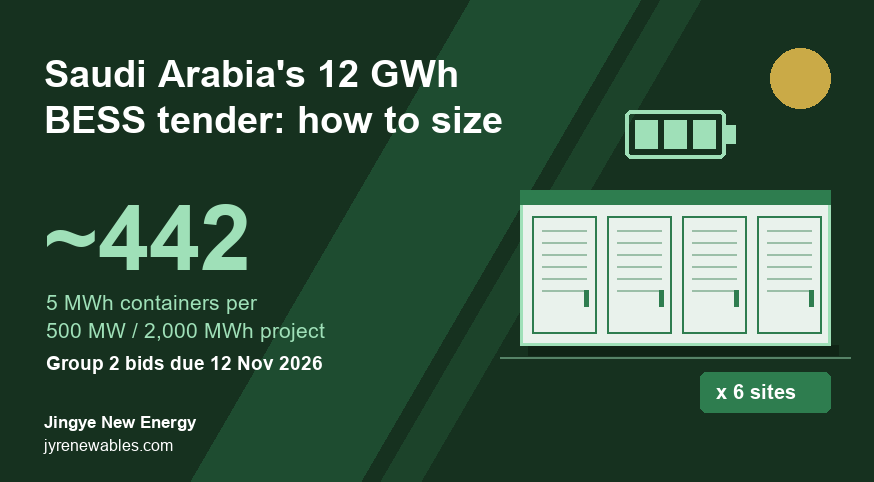
Saudi Arabia's Group 2 BESS tender (six 500 MW / 2,000 MWh sites, 12 GWh in total) now closes on 12 November 2026. By our estimate, each site needs about 442 of our 5.015 MWh containers to deliver 2,000 MWh at the grid, or up to 553 if 15-year degradation is built in upfront.
Let’s Get Started on Your New Energy Journey.