Oct 20, 2026
By Daniyal, Jingye New Energy. Published October 19, 2026.
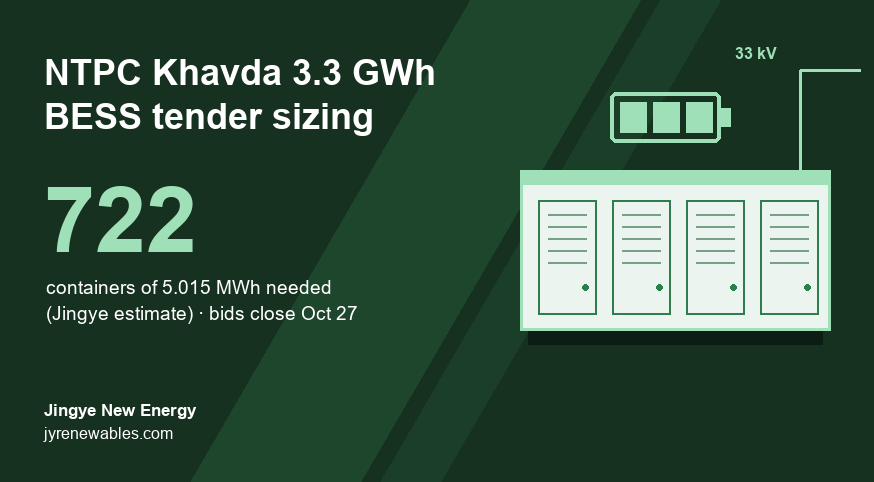
Quick answer: NTPC Green Energy's 1,100 MW / 3,300 MWh battery tender at Khavda closes on October 27, 2026. Because capacity is measured as AC energy at the grid connection, our estimate is that it needs about 722 containers of 5.015 MWh, around 3,621 MWh of installed battery, or roughly 10% more than the headline figure, before allowing for battery ageing.
NTPC Green Energy Ltd (NGEL) has invited turnkey EPC bids for a 3,300 MWh battery energy storage system (BESS) at the NTPC REL Khavda solar plant in Gujarat, reported by pv magazine India on October 9. Bids are due on October 27, 2026 at 3:00 PM, according to Energetica India.
The market behind it is huge. India had 19,798 MW / 61,013 MWh of battery storage under tendering in early 2026, per T&D India. But the headline number is not the amount of battery you buy. This guide explains how the tender defines capacity, how many containers it really takes, and what bidders should check before they price the job.
A complete, grid-connected BESS split into four blocks, delivered turnkey with 15 years of operation and maintenance (O&M).
| Item | Tender requirement |
|---|---|
| Total size | 1,100 MW / 3,300 MWh (3-hour system) |
| Blocks | 3 × 300 MW / 900 MWh, plus 1 × 200 MW / 600 MWh |
| Grid connection | Each block connects at 33 kV to a designated solar plant |
| Capacity definition | Deliverable AC capacity at the point of interconnection (POI) at commercial operation |
| Losses to include | 1% power transformer, 0.25% transmission line up to the POI |
| Operation | One full cycle per day, 25-year design life including batteries |
| Energy guarantee | 98% of contracted energy at end of year 1, 70% in year 15 |
| Availability / efficiency | 98% annual availability; at least 80% monthly round-trip efficiency including auxiliary consumption |
| O&M | Comprehensive O&M, warranty and AMC for 15 years |
| Bid deadline | October 27, 2026, 3:00 PM |
Sources: TaiyangNews, Energetica India, pv magazine India. Always confirm against the official NGEL bid document.
Because the tender counts energy delivered at the grid point, and energy is lost on the way there from the battery.
Every MWh leaving a battery cell passes through the power conversion system (PCS), the inverter-duty transformer, the power transformer and the line to the POI. Each step takes a small cut. On top of that, a lithium iron phosphate (LFP) battery is not normally run from 100% to 0%, so part of its nameplate energy is kept in reserve. The tender also states the transformer and line losses that must be built into sizing.
Put together, only about 91% of nameplate DC energy reaches the POI in our working assumptions. That gap is what bidders must cover with extra containers.
About 197 containers per 900 MWh block and 131 for the 600 MWh block, or 722 in total, based on the assumptions below.
| Step (per block) | 900 MWh block | 600 MWh block |
|---|---|---|
| Energy required at POI (start of life) | 900.0 MWh | 600.0 MWh |
| Add tender losses (1% transformer, 0.25% line) | 911.4 MWh | 607.6 MWh |
| Add PCS (98.5%) and inverter-duty transformer (99%) losses* | 934.6 MWh | 623.1 MWh |
| Divide by usable depth of discharge (95%)* | 983.8 MWh | 655.9 MWh |
| Containers of 5.015 MWh (rounded up) | 197 | 131 |
| Installed nameplate energy | 988.0 MWh | 657.0 MWh |
| Whole project (3 + 1 blocks) | 591 containers | 131 containers |
| Total | 722 containers | ≈ 3,621 MWh installed |
*Jingye New Energy estimate. PCS efficiency, transformer efficiency and usable depth of discharge are typical working assumptions, not tender values; replace them with your own equipment data. Tender loss figures from TaiyangNews.
Power is not the limit here. A 300 MW block needs about 311.5 MW on the DC side after losses, or about 1.58 MW per container. Our 5.015 MWh liquid-cooled container is rated up to 2.5 MW, so a 3-hour duty sits comfortably inside its range.
If cells fade faster than the tender's guarantee curve, you need more containers on day one or a plan to add them later.
The tender asks for 98% of contracted energy after year 1 and 70% in year 15. So the battery's state of health (SOH) at those points sets a minimum oversizing factor: the larger of 0.98 ÷ SOH in year 1 and 0.70 ÷ SOH in year 15. The table shows how this plays out under three example ageing curves.
| Example SOH (year 1 / year 15) | Oversizing factor | Containers per 900 MWh block | Total containers | Installed MWh |
|---|---|---|---|---|
| 98% / 80% | 1.000 | 197 | 722 | 3,620.8 |
| 97% / 75% | 1.010 | 199 | 730 | 3,660.9 |
| 96% / 68% | 1.029 | 202 | 741 | 3,716.1 |
Jingye New Energy estimate. SOH values are illustrative scenarios, not a warranty curve for any product. The tender lets bidders propose their own degradation; check the bid document for whether augmentation (adding batteries later) is allowed.
Note that year 1 often decides the count, not year 15. A fresh battery that loses more than 2% in its first year fails the 98% test unless it was oversized from the start.
Every kWh used by cooling, BMS and auxiliary loads counts against the 80% monthly minimum, so thermal design matters as much as cell quality.
Khavda sits in the hot, dusty Kutch region, and the rule is checked month by month, not as a yearly average. Cooling load is highest in the summer months, which is exactly when a weak thermal design can push efficiency under the limit. Ask suppliers for auxiliary power at full load and high ambient temperature, not just at 25°C.
A rough benchmark is about ₹3,700 crore, based on NTPC's recent average of ₹1.12 crore per MWh reported by T&D India.
For example, Solarworld won a 132 MW / 264 MWh package at NTPC Solapur for ₹314.26 crore excluding taxes, as Energetica India reported, which works out to about ₹1.19 crore per MWh. Treat these as reference points only: the earlier packages carried 11 years of O&M, while Khavda asks for 15, and the extra 10% of installed battery shown above also has to be priced in.
The wider trend helps bidders. Wood Mackenzie said on October 8 that four-hour battery storage is now cheaper than new open-cycle gas peakers in all 43 markets where it modelled both, in its latest cost report.
For contract wording, see our guide on the ESCA model BESS supply contract. For how large batteries support solar plants like Khavda, read grid-scale battery storage for renewable energy integration.
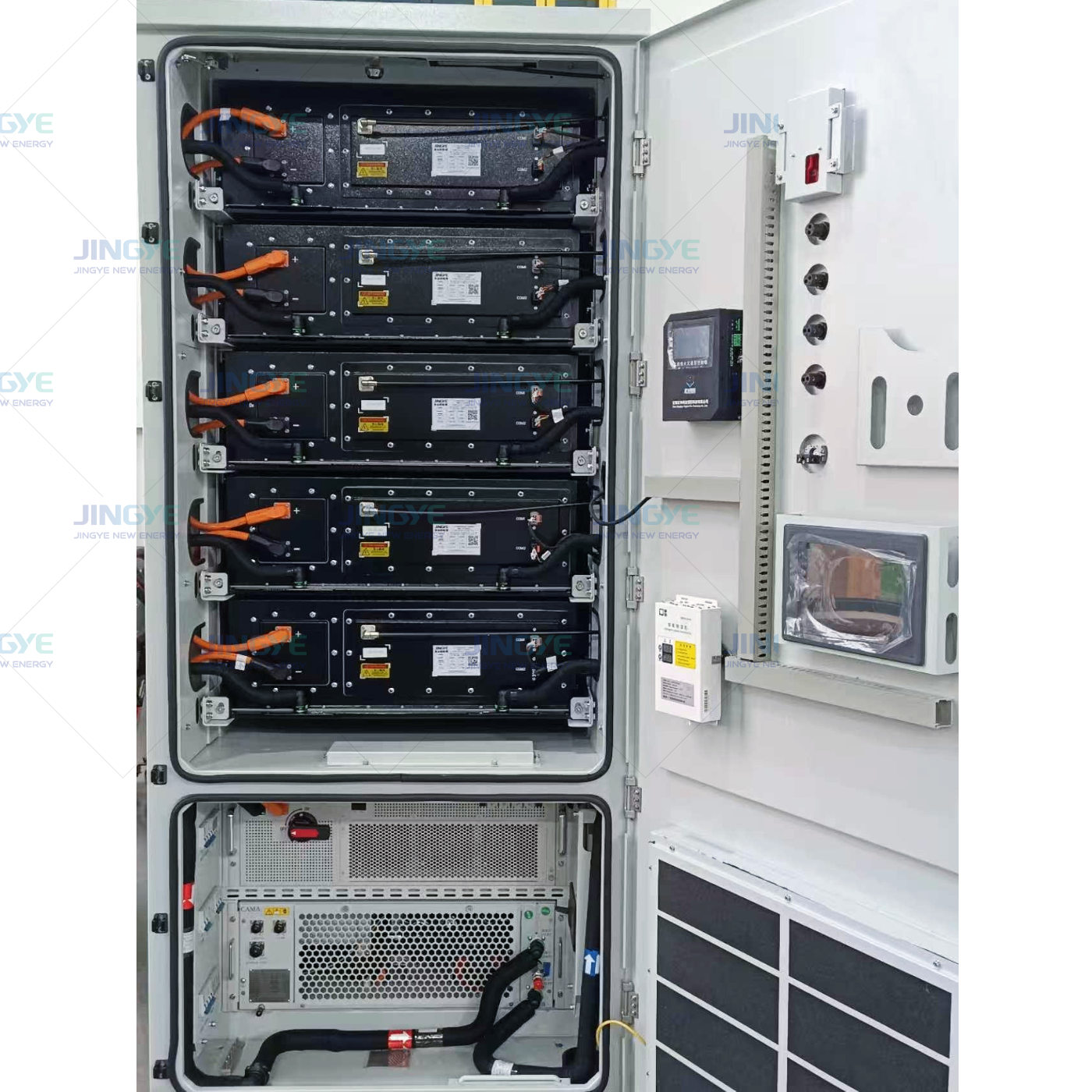
We supply the 5.015 MWh liquid-cooled BESS container used in the sizing above, built in-house on a 15 GWh module and PACK production line.
Our containers already run in large projects, including the Jiangsu Jingye Iron and Steel 50 MW / 100.32 MWh station (20 battery cabins of 5 MWh with 10 PCS cabins of 5 MW) and the Huaxi Special Steel 15 MW / 30.09 MWh station, which runs two cycles a day. See the full energy storage system range.
Bids are due on October 27, 2026 at 3:00 PM, with techno-commercial bids opened the same day.
It is a 3-hour system: 1,100 MW of power and 3,300 MWh of energy, operated on one cycle per day.
Our estimate is about 722 containers of 5.015 MWh, or around 3,621 MWh installed, before oversizing for degradation. The exact number depends on your PCS, transformer and depth-of-discharge figures.
Capacity is measured as AC energy at the grid point, so conversion losses, transformer and line losses and reserved state of charge all have to be covered by extra installed energy.
Each block must deliver at least 98% of contracted energy at the end of year 1 and 70% in year 15, with degradation proposed by the bidder.
NTPC's recent awards averaged about ₹1.12 crore per MWh, though scope, duration and O&M length differ between packages.
Share your block size, PCS choice and degradation target. We will reply with a container count, layout and supply quote for the 5.015 MWh container.
Request a container quoteHebei Jingye New Energy Technology Co., Ltd, part of Jingye Group, makes liquid-cooled BESS containers, C&I energy storage cabinets, cell contact systems, commercial vehicle batteries, DC fast EV chargers and inverters.
Oct. 20, 2026
NTPC Khavda 3,300 MWh BESS Tender: How Many Containers You Really Need (2026)
NTPC Green Energy's 1,100 MW / 3,300 MWh Khavda battery tender closes on October 27, 2026. Because capacity is counted as AC energy at the grid point, we estimate it needs about 722 containers of 5.015 MWh, roughly 10% more installed battery than the headline figure.
Oct. 20, 2026
Battery Energy Storage System Architecture: Key Components Explained
A battery energy storage system architecture determines how safely and efficiently a BESS stores, controls, and delivers electricity. The main challenge for overseas buyers is choosing the right structure without creating avoidable cost, safety, or integration problems.
Oct. 19, 2026
Battery Capacity Fade in Commercial Energy Storage Systems
Battery capacity fade in commercial energy storage systems reduces the amount of energy a site can store and deliver. This battery degradation can increase demand charges, reduce backup time, and change the return on investment.
Let’s Get Started on Your New Energy Journey.