Oct 16, 2026
By Daniyal, Jingye New Energy. Published 16 October 2026.
Quick answer: On 13 October 2026 the Energy Storage Contract Alliance (ESCA), a buyer group with more than 40 GWh of battery projects, published a free model contract for utility-scale BESS supply. It charges the supplier 0.2% of the price per day for late delivery from day 16, pays 10% on factory test approval and 90% within 30 days of delivery, and requires at least 80% usable capacity at the end of the warranty. Buyers should start using it as a checklist now, and pick suppliers who can prove cell traceability, factory and site testing, and full pack-level data.
Every utility-scale battery deal used to start from a blank page. Each developer wrote its own supply agreement, and each supplier pushed back clause by clause. That costs weeks of legal time on every project. On 13 October 2026, a group of buyers decided to fix this. Energy-Storage.News reports that ESCA launched with 22 member companies that together have delivered 40 GWh of BESS projects, with names such as Neoen, BW ESS, MN8 Energy, Fortum and Munich Re behind it.
The result is the ESCA Model BESS Supply & Purchase Agreement, version 1.2, published on escabattery.org. It is written from the buyer side. This article explains what the contract says, what it will cost a supplier who gets it wrong, and what EPCs, developers and procurement teams should check before their next tender.
It is a ready-made supply and purchase agreement for utility-scale battery storage that any buyer can download and use in full, in part, or not at all. It does not set prices. It sets the rules around price, quality, testing, data and risk.
According to the ESCA website, ESCA is a non-profit association based in Lausanne, Switzerland. Its members are utilities, IPPs, developers, insurers and asset owners. The core clauses are free to download as a Word file. More than 15 technical appendices, covering cells, racks, system specifications, warranties, monitoring, calibration and spare parts, are for members only. The technical secretariat is run by Sinovoltaics, a quality assurance firm, which drafted the first version.
Pedro Garcia Hrdy of MN8 Energy summed up the problem in the launch coverage: every project negotiates availability guarantees, augmentation, performance testing, warranty terms and risk allocation "from scratch" (Energy-Storage.News). A shared baseline removes most of that work.
Six clauses change daily procurement work the most: late delivery, payment, cell traceability, cybersecurity, monitoring data and end-of-warranty capacity. The table below lists what each one says and the question a buyer should put to every supplier.
| Clause (ESCA v1.2) | What it says | Question to ask your supplier |
|---|---|---|
| Late delivery | Liquidated damages of 0.2% per day, starting on day 16 after the scheduled delivery period ends. Total LDs are capped. | What is your real lead time from deposit to shipment, and from which factory? |
| Payment | 10% advance when the buyer's third-party inspector approves the factory acceptance test (FAT); 90% within 30 days of final delivery. | Can you finance production until FAT, with only 10% upfront? |
| Cell traceability | Seller provides traceable data on the origin of all cells and components within 14 days of the start of each manufacturing batch. | Can your factory system show cell lot, module and pack serials for every unit? |
| Cybersecurity | Seller notifies the buyer within 72 hours of a critical vulnerability and within 24 hours of a cyber incident. | Who on your team owns security alerts, and how fast do you patch? |
| Monitoring and data | Real-time monitoring of 100% of containers, racks and packs, with time-synchronised signals. If data is missing because of the supplier, guarantees are deemed failed. | Which signals does your BMS export, and over which protocols? |
| End-of-warranty capacity | At least 80% usable capacity at end of warranty, measured from commissioning and tested every year. | What capacity do you guarantee each year, and how is it tested? |
Source for the clause wording: ESCA model contract summary. Two more rules are worth knowing. A "serial defect" is defined, and all units from the same design or batch are presumed affected unless the supplier proves otherwise. And ownership only passes to the buyer after a successful site acceptance test (SAT). If you are new to site tests, our guide to BESS commissioning tests before commercial operation explains what is usually measured.
On a EUR 10 million supply contract, every day of delay after day 15 costs the supplier EUR 20,000. A two-month delay costs EUR 900,000, or 9% of the contract, before any cap applies.
The worked example below uses an illustrative EUR 10 million contract. It is our own calculation from the 0.2% per day rule, not a figure published by ESCA. The cap level sits in the full contract text, so check it there.
| Days late after scheduled delivery | Days charged (from day 16) | LD as % of contract | LD on EUR 10m contract |
|---|---|---|---|
| 15 | 0 | 0% | EUR 0 |
| 30 | 15 | 3% | EUR 300,000 |
| 45 | 30 | 6% | EUR 600,000 |
| 60 | 45 | 9% | EUR 900,000 |
For buyers, the message is simple: delivery dates now carry a clear price. Ask suppliers for a production schedule tied to named factory lines, not just a lead time in weeks.
It means every rack and every pack must report live data, not just the container. For a 100 MWh plant built from twenty 5.015 MWh containers, that is 240 racks, 960 packs and nearly 100,000 cells to trace and monitor.
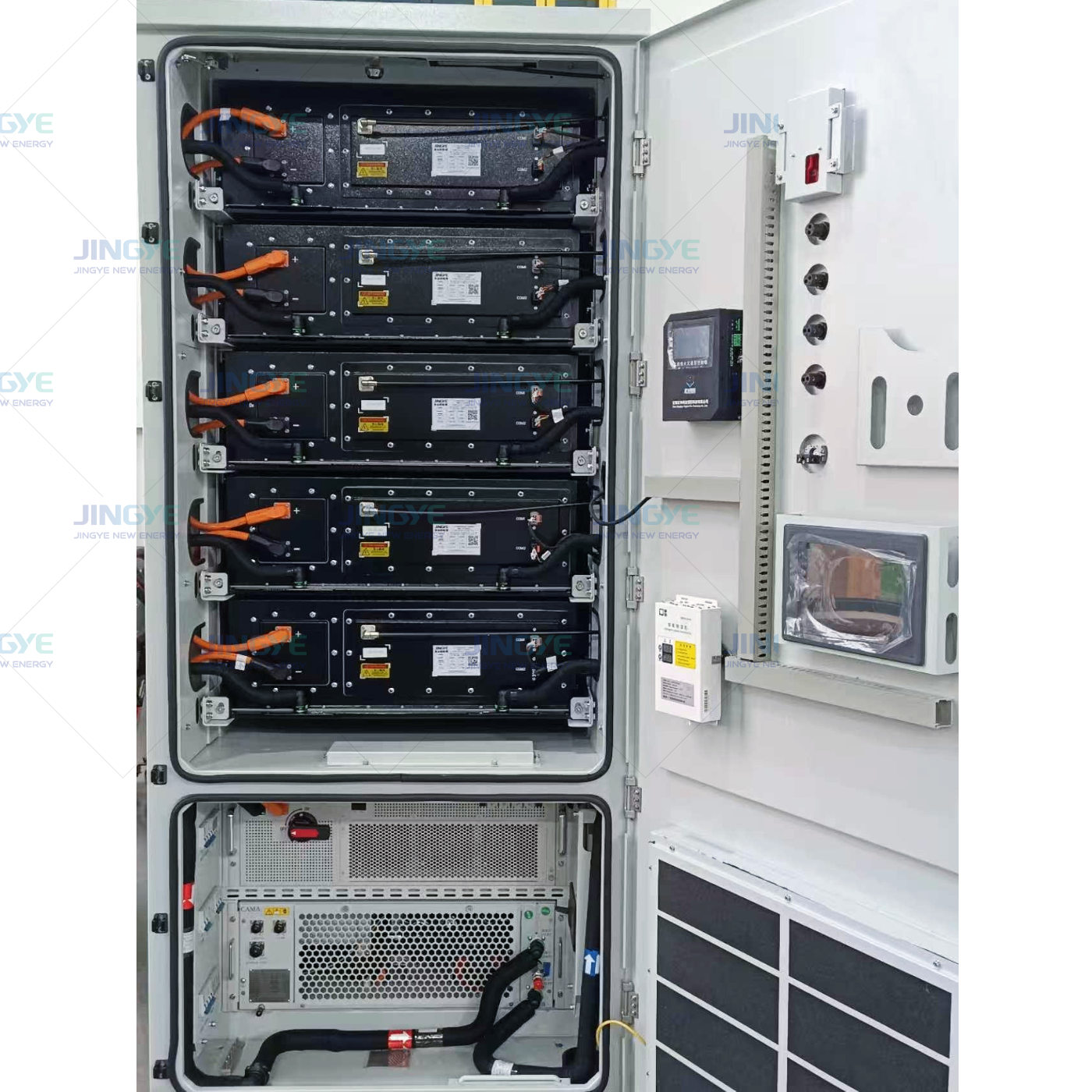
We worked this out from the published layout of our own 5.015 MWh liquid-cooled BESS container: 12 racks of four 104-cell packs each, with 314Ah LFP cells. The numbers are estimates for planning, not a project design.
| Item | One 5.015 MWh container | 20 containers (about 100 MWh) |
|---|---|---|
| Rated energy | 5.015 MWh | 100.3 MWh |
| Racks (clusters) | 12 | 240 |
| Battery packs (1P104S) | 48 | 960 |
| 314Ah LFP cells | 4,992 | 99,840 |
| ESCA 80% end-of-warranty floor | 4.012 MWh | 80.24 MWh |
This is why traceability is turning into a buying criterion. A supplier needs a factory system that links every cell lot to a pack serial number, or it cannot meet the 14-day data rule. We covered this trend earlier in why battery traceability is becoming a procurement KPI.
ESCA includes price-adjustment mechanisms but leaves the numbers to each deal. With storage cell prices moving by as much as 8% in a single month this year, an agreed adjustment rule protects both sides.
Benchmark Mineral Intelligence reports these prices for 314Ah LFP storage cells in Q3 2026:
| Month (2026) | EXW China (USD/kWh) | Change vs prior month |
|---|---|---|
| July | 57.75 | +4.6% |
| August | 53.15 | -8.0% |
| September | 54.21 | +2.0% |
In September the CIF Europe price was USD 62.97 per kWh and the CIF North America price was USD 64.78 per kWh. Benchmark notes that lithium carbonate fell sharply on 16 September, too late for the September assessment, and expects lagged downward pressure on cell quotes into Q4.
To put that in context: at the September EXW China price, the cells alone in a 100.3 MWh project are worth about USD 5.44 million (our estimate: 100,300 kWh x USD 54.21). A 5% move in cell prices shifts that by about USD 270,000. Agree in the contract which index, which date and which threshold trigger an adjustment, so nobody reopens the deal later.
Yes. It moves the decision from brochures to evidence. A supplier that cannot show test records, batch data and live pack-level signals will struggle to sign an ESCA-based contract, whatever its price. Before your next tender, ask each shortlisted supplier for:
Our container was designed around the same points ESCA focuses on: traceable cells, layered safety and pack-level data. Here is what the published specifications and our factory records show:
For smaller sites, the same approach applies to our LFP-261kWh and LFP-417kWh C&I energy storage cabinets. Pack makers who need traceable busbar assemblies can look at our cell contact systems.
ESCA is the Energy Storage Contract Alliance, a non-profit buyer group based in Lausanne, Switzerland. It launched on 13 October 2026 with members holding more than 40 GWh of BESS projects.
The core clauses are free to download as a Word file. The technical appendices, specifications, FAT, SAT and warranty schedules are for members only.
No. It sets no prices, price levels or discounts. It includes price-adjustment mechanisms, but each buyer and supplier agree the numbers.
Liquidated damages are 0.2% of the contract price per day, starting on day 16 after the scheduled delivery period ends, up to a cap.
At least 80% usable capacity, measured against the commissioning test and checked every year.
No. ESCA describes it as a global framework for utility-scale BESS procurement, and use is voluntary.
Send us your RFP or the clauses you plan to use. Our engineers will reply with a clause-by-clause answer, sample test and traceability records, and a container layout sized for your project.
Send us your RFPHebei Jingye New Energy Technology Co., Ltd, part of Jingye Group, makes 5.015 MWh liquid-cooled BESS containers, LFP-261kWh and LFP-417kWh C&I energy storage cabinets, cell contact systems, commercial DC fast EV chargers and LFP commercial vehicle batteries.
Oct. 20, 2026
NTPC Khavda 3,300 MWh BESS Tender: How Many Containers You Really Need (2026)
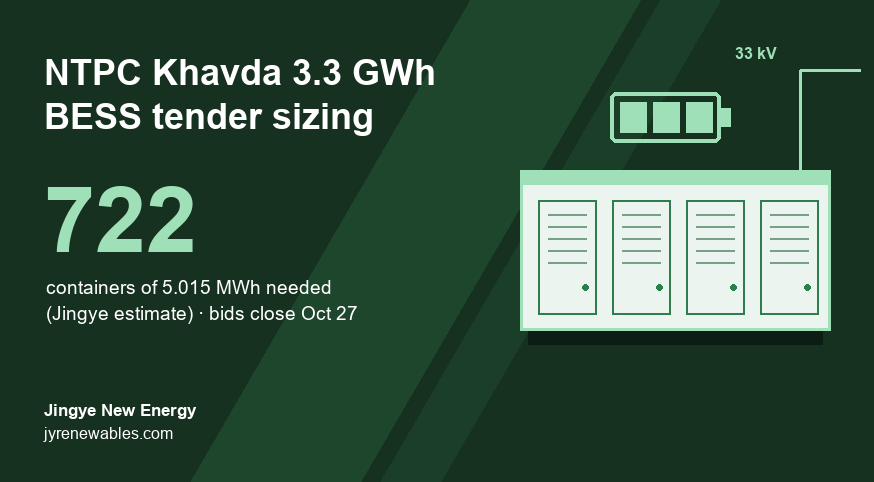
NTPC Green Energy's 1,100 MW / 3,300 MWh Khavda battery tender closes on October 27, 2026. Because capacity is counted as AC energy at the grid point, we estimate it needs about 722 containers of 5.015 MWh, roughly 10% more installed battery than the headline figure.
Oct. 20, 2026
Battery Energy Storage System Architecture: Key Components Explained
A battery energy storage system architecture determines how safely and efficiently a BESS stores, controls, and delivers electricity. The main challenge for overseas buyers is choosing the right structure without creating avoidable cost, safety, or integration problems.
Oct. 19, 2026
Battery Capacity Fade in Commercial Energy Storage Systems
Battery capacity fade in commercial energy storage systems reduces the amount of energy a site can store and deliver. This battery degradation can increase demand charges, reduce backup time, and change the return on investment.
Let’s Get Started on Your New Energy Journey.