Sep 07, 2026
As energy storage projects become larger and more technically complex, battery buyers are paying greater attention to something that is rarely visible in a product brochure: traceability.
For EPC companies, project developers, system integrators, and international distributors, knowing where a battery component came from is no longer enough. Buyers increasingly need to understand how the component was inspected, processed, tested, assembled, and released.
This is turning battery traceability into an increasingly important procurement consideration.
Battery traceability refers to the ability to follow product information through different manufacturing stages.
A mature traceability system can connect information across:
Raw materials
Battery cells
Components
Battery modules
PACK assembly
Electrical testing
Thermal management
Final inspection
Shipment
The objective is to create a continuous product record rather than a collection of disconnected inspection reports.
A BESS project may operate for many years.
If a technical problem occurs after commissioning, the project owner needs to determine what happened and where the problem originated.
Without adequate traceability, troubleshooting may depend heavily on manual records.
With digital traceability, manufacturers can potentially identify:
Production batches
Component information
Inspection results
Process records
Testing data
Assembly information
This can make quality investigation more structured.
Jingye New Energy states that its intelligent production lines are coordinated with an MES system covering the manufacturing process, enabling traceability and control from materials through finished products.
One common mistake is to treat traceability as something relevant only to quality inspectors.
For large energy storage projects, it can affect several departments.
Procurement teams can use traceability information when evaluating supplier consistency.
Engineering teams can investigate production-related issues more efficiently.
Service engineers can use equipment records when troubleshooting.
Project teams can maintain clearer documentation during acceptance and handover.
Documented production and testing records can support quality and regulatory processes.
| Buyer Type | Main Traceability Concern | Procurement Priority |
|---|---|---|
| EPC contractor | Project documentation | Process records |
| Energy storage developer | Long-term reliability | Product history |
| Distributor | Warranty support | Batch information |
| System integrator | Component compatibility | Manufacturing data |
| Industrial end user | Maintenance | Equipment records |
Imagine that an energy storage project develops an abnormal performance issue several months after commissioning.
The service team needs to determine whether the issue is related to:
A specific component
A manufacturing batch
Assembly
Electrical connection
Thermal management
Operating conditions
A strong traceability system can help narrow the investigation.
Instead of checking the entire supply chain manually, engineers can use production records to identify the relevant batch and manufacturing information.
This does not eliminate equipment failures, but it can improve the speed and structure of root-cause analysis.
When auditing an energy storage manufacturer, buyers should ask for more than a quality certificate.
A useful traceability checklist includes:
Is raw-material inspection recorded?
Are component batches identifiable?
Are production processes digitally recorded?
Are test results linked to individual products or batches?
Can finished-product information be traced backward?
Are records retained after shipment?
Can after-sales teams access relevant production information?
These questions can reveal how mature a manufacturer's quality system really is.
For project owners, traceability usually becomes noticeable when something goes wrong.
During normal operation, users may never interact with manufacturing records.
However, when a problem occurs, the difference between a manufacturer with structured records and one relying on fragmented paperwork can become significant.
This is why traceability is increasingly viewed as part of long-term supplier value rather than simply a factory quality function.
Jingye New Energy combines automated manufacturing with an MES-based production management approach.
The company states that its production system supports full-process traceability from materials to finished products. Its testing laboratory also covers incoming raw-material inspection, in-process component testing, and finished-product testing.
This approach gives buyers an additional dimension for evaluating manufacturing maturity.
For EPCs, distributors, energy storage developers, and industrial users evaluating battery storage suppliers, Jingye New Energy can provide technical information, manufacturing details, and customized energy storage solutions.
Email: jyxny@jyrenewables.com
Email: allen.meng@jyrenewables.com
Website: www.jyrenewables.com
Oct. 22, 2026
EV Charger Preventive Maintenance: Key Practices for Long-Term Reliability
EV charger preventive maintenance helps charging operators protect uptime, safety, and revenue over many years. A planned service program is more reliable than waiting for a fault after a vehicle cannot charge. This guide explains DC fast charger maintenance, EV charging station inspection, and charging cable inspection in simple steps.
Oct. 20, 2026
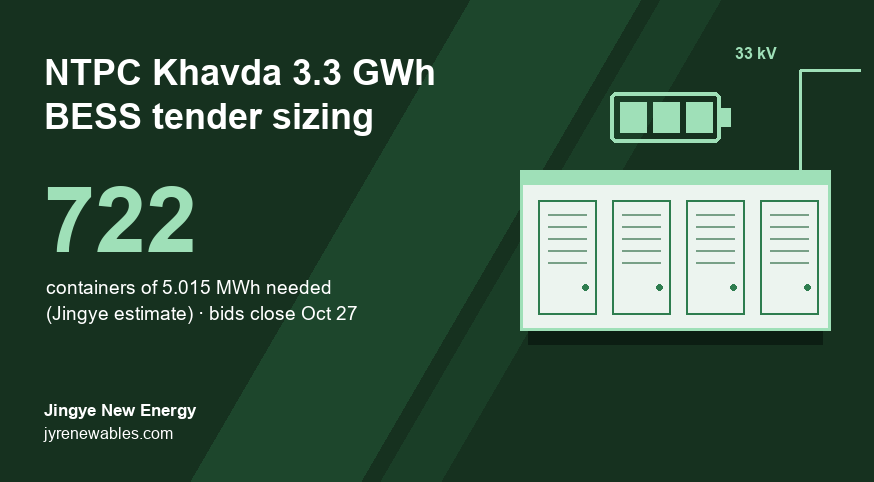
NTPC Khavda 3,300 MWh BESS Tender: How Many Containers You Really Need (2026)
NTPC Green Energy's 1,100 MW / 3,300 MWh Khavda battery tender closes on October 27, 2026. Because capacity is counted as AC energy at the grid point, we estimate it needs about 722 containers of 5.015 MWh, roughly 10% more installed battery than the headline figure.
Oct. 20, 2026
Battery Energy Storage System Architecture: Key Components Explained
A battery energy storage system architecture determines how safely and efficiently a BESS stores, controls, and delivers electricity. The main challenge for overseas buyers is choosing the right structure without creating avoidable cost, safety, or integration problems.
Let’s Get Started on Your New Energy Journey.