Oct 12, 2026
By Daniyal, Jingye New Energy. Published October 12, 2026.
Quick answer: In a BESS tolling agreement, a trader pays the battery owner a fixed fee and decides when the battery charges and discharges. Europe's largest public toll so far, signed by Statkraft and Greenvolt, covers 400 MW / 1.6 GWh in Poland for 10 years. For buyers, the toll turns availability (typically 97–99%) and capacity retention into the numbers that decide revenue. By our estimate, one 200 MW / 800 MWh 4-hour site needs 160–192 of Jingye's 5.015 MWh containers, depending on how much you overbuild.
On 29 September 2026, Statkraft and Greenvolt Power announced a 10-year tolling agreement for two operating battery projects in Poland, and Greenvolt called it the largest publicly communicated BESS tolling deal in the EU (Energy-Storage.news). Statkraft now decides when the batteries charge and discharge across energy and flexibility markets. Greenvolt receives a fixed payment on top of its capacity market income.
Why should equipment buyers care? Because contracted revenue changes how projects get financed. According to Claritas Investments, adding a toll or floor to a bare capacity market contract can lift debt from about a third of project cost to nearly two-thirds, and stretch loan tenors from under ten years to well over ten (Energy-Storage.news interview). More debt means more projects get built. But it also means lenders and offtakers will check whether the battery can actually deliver for a full decade. That is a hardware question.
A tolling agreement is a long-term contract where an offtaker pays a fixed fee for the right to control a battery's trading and dispatch. The owner keeps the asset, runs operations and maintenance, and earns a predictable income instead of trading risk.
It sits between two other common models. In Poland, Claritas describes floor deals, where the developer keeps around two-thirds of the upside above a guaranteed minimum, and fixed tolls, where the offtaker takes all market risk for a set annual fee (source). The table below summarises the trade-offs.
| Revenue model | Who controls dispatch | Owner's market upside | Typical debt share (Poland) |
|---|---|---|---|
| Capacity market contract only | Owner or its optimiser | All merchant upside, all merchant risk | About one-third of project cost |
| Capacity market + revenue floor | Owner's optimiser, with a guaranteed minimum | Often around two-thirds of upside above the floor | Close to two-thirds |
| Capacity market + fixed toll | Offtaker (e.g. Statkraft) | None; fixed fee instead | Close to two-thirds, highest certainty |
Sources: Claritas Investments via Energy-Storage.news, September 2026. Debt shares are indicative market ranges, not project data.
The deal covers two 4-hour projects of 200 MW / 800 MWh each: Turośń Kościelna, which started commercial operation in July 2026, and Ełk, targeted for Q4 2026 (Energy-Storage.news; SolarQuarter). Both hold capacity market contracts from Poland's 2023–2024 auction, so the toll is a second layer of contracted income.
It is not a one-off. R.Power signed a 10-year optimisation deal with a floor for its 1.2 GWh Dzięgielewo project with Axpo, and Claritas notes that Germany already has well over a gigawatt of storage under these kinds of offtake contracts (source; source). Poland itself has more than 11 GW of storage contracted in its capacity market, though only about 6–7 GW is expected to be built by 2030.
The direction is clear: in Europe's fastest-growing storage markets, more projects will be financed on 10-year contracted revenue. Similar logic drives fixed-tariff tenders in India, which we covered in our GEC-III buyer guide.
Because the owner is still responsible for keeping the battery available and at full capacity, but no longer controls how hard it is used. Under a physical toll, the owner typically passes the supplier's availability and performance guarantees through to the offtaker, and shortfall damages for missing them are a key negotiating point (Carbon Economist).
Availability is where a toll's money is won or lost. Contracts commonly require 97–99% system availability, at least 98% for the battery, and 99% for the PCS and auxiliary systems, with 1–2% planned maintenance usually exempt (Energy-Storage.news). The gap looks small, but falling from 98% to 97% raises downtime from about 175 to 263 hours a year. The same analysis cites Accure data showing nearly one in five BESS projects underperformed because of hardware failures, even after passing their commissioning tests.
In plain terms: under a toll, every hour your battery is offline, or every MWh it has lost to degradation, comes straight off a fixed fee you were counting on.
For a 200 MW / 800 MWh site like each half of the Polish deal, about 160 of our 5.015 MWh containers cover the nameplate energy, and 176–192 cover it with a typical overbuild. Here is our own sizing estimate.
| Design case | Target DC energy (MWh) | Containers per 200 MW site | Installed DC energy (MWh) | Power per container (MW) | Containers for full 400 MW / 1.6 GWh | Why |
|---|---|---|---|---|---|---|
| Nameplate only | 800 | 160 | 802.4 | 1.25 | 320 | No margin for losses or degradation |
| +10% overbuild (illustrative) | 880 | 176 | 882.6 | 1.14 | 352 | Covers conversion losses and usable depth of discharge |
| +20% overbuild (illustrative) | 960 | 192 | 962.9 | 1.04 | 384 | Also holds more capacity into later contract years |
Jingye New Energy estimates. Based on the 5.015 MWh, ≤2.5 MW rating listed on our container product page. The 10% and 20% overbuild figures are illustrative; a real design depends on the toll's capacity test rules, round-trip efficiency, auxiliary loads, grid-connection losses, degradation curve and augmentation plan.
Two things stand out. First, a 4-hour toll runs each container at about 1.0–1.25 MW, roughly half its 2.5 MW rating, which is a gentle duty for LFP cells over ten years. Second, the overbuild choice is commercial, not just technical: building more energy on day one costs more upfront, while planning later augmentation costs less now but needs space, grid capacity and a supplier who can deliver matching equipment years later.
Match your supply and service contracts to the toll, clause by clause. If the toll promises something for ten years, someone in your supply chain must stand behind it for ten years.
Many BESS problems start in integration and commissioning rather than in the cells, a point we covered in our BESS safety and EPRI buyer checklist.
Our 5.015 MWh BESS container is built for utility-scale projects like these. It uses 314Ah LFP cells in a 12×(1P104S×4) configuration at 1331.2 V DC, delivers up to 2.5 MW, and fits a standard 20-foot container. Safety and uptime features listed on the product page include:
Behind the product, Jingye New Energy runs a 15 GWh module/PACK production line with MES traceability from materials to finished product, a CNAS-accredited testing laboratory, ISO quality, environmental and occupational health and safety certification, and IATF 16949 for CCS (company profile).
We also run these systems ourselves. The Jiangsu Jingye Iron and Steel 50 MW / 100.32 MWh station uses 20 of our 5 MWh battery cabins with 10 sets of 5 MW PCS. At Huaxi Special Steel (15 MW / 30.09 MWh), Jingye New Energy designed, funded, built and operates the station, cycling twice a day. When you own the asset, availability stops being a contract clause and becomes your own income, which is exactly the position a tolled project owner is in. For smaller sites, see our C&I energy storage cabinets, and for the full range, our energy storage systems.
It is a long-term contract where an offtaker, usually a trader or utility, pays the battery owner a fixed fee for the right to decide when the battery charges and discharges. The owner keeps the asset and its operation and maintenance.
Recent European deals run around 10 years. The Statkraft and Greenvolt toll in Poland and the R.Power and Axpo floor deal for Dzięgielewo are both 10-year contracts.
Under a fixed toll the offtaker takes all market risk and the owner gives up merchant upside. Under a floor the owner gets a guaranteed minimum and, in Poland, often keeps around two-thirds of revenue above it.
Contracts commonly ask for 97–99% system availability, 98% for the battery itself and 99% for the PCS and auxiliary systems, with 1–2% planned maintenance usually exempt from penalties.
About 160 of Jingye's 5.015 MWh containers cover 800 MWh nameplate. With an illustrative 10–20% overbuild for losses and degradation, the estimate rises to 176–192 containers. A final number needs your toll's capacity test rules and degradation curve.
Yes. The 5.015 MWh container is rated at up to 2.5 MW, so a 4-hour design simply runs each container at about 1.0–1.25 MW, well inside its rating.
Send us your project size (MW / MWh), duration, expected cycles per day and the availability and capacity terms in your offtake term sheet. Our engineers will reply with a container count, layout and supply proposal.
Send your project requirementsHebei Jingye New Energy Technology Co., Ltd, part of Jingye Group, makes utility-scale BESS containers, C&I energy storage cabinets, CCS cell contact systems, commercial vehicle batteries and DC fast EV chargers.
Oct. 20, 2026
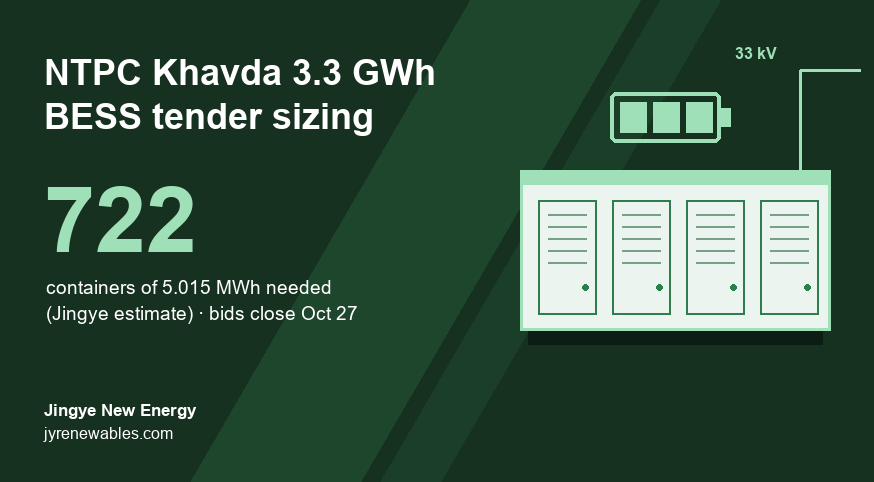
NTPC Khavda 3,300 MWh BESS Tender: How Many Containers You Really Need (2026)
NTPC Green Energy's 1,100 MW / 3,300 MWh Khavda battery tender closes on October 27, 2026. Because capacity is counted as AC energy at the grid point, we estimate it needs about 722 containers of 5.015 MWh, roughly 10% more installed battery than the headline figure.
Oct. 20, 2026
Battery Energy Storage System Architecture: Key Components Explained
A battery energy storage system architecture determines how safely and efficiently a BESS stores, controls, and delivers electricity. The main challenge for overseas buyers is choosing the right structure without creating avoidable cost, safety, or integration problems.
Oct. 19, 2026
Battery Capacity Fade in Commercial Energy Storage Systems
Battery capacity fade in commercial energy storage systems reduces the amount of energy a site can store and deliver. This battery degradation can increase demand charges, reduce backup time, and change the return on investment.
Related Products
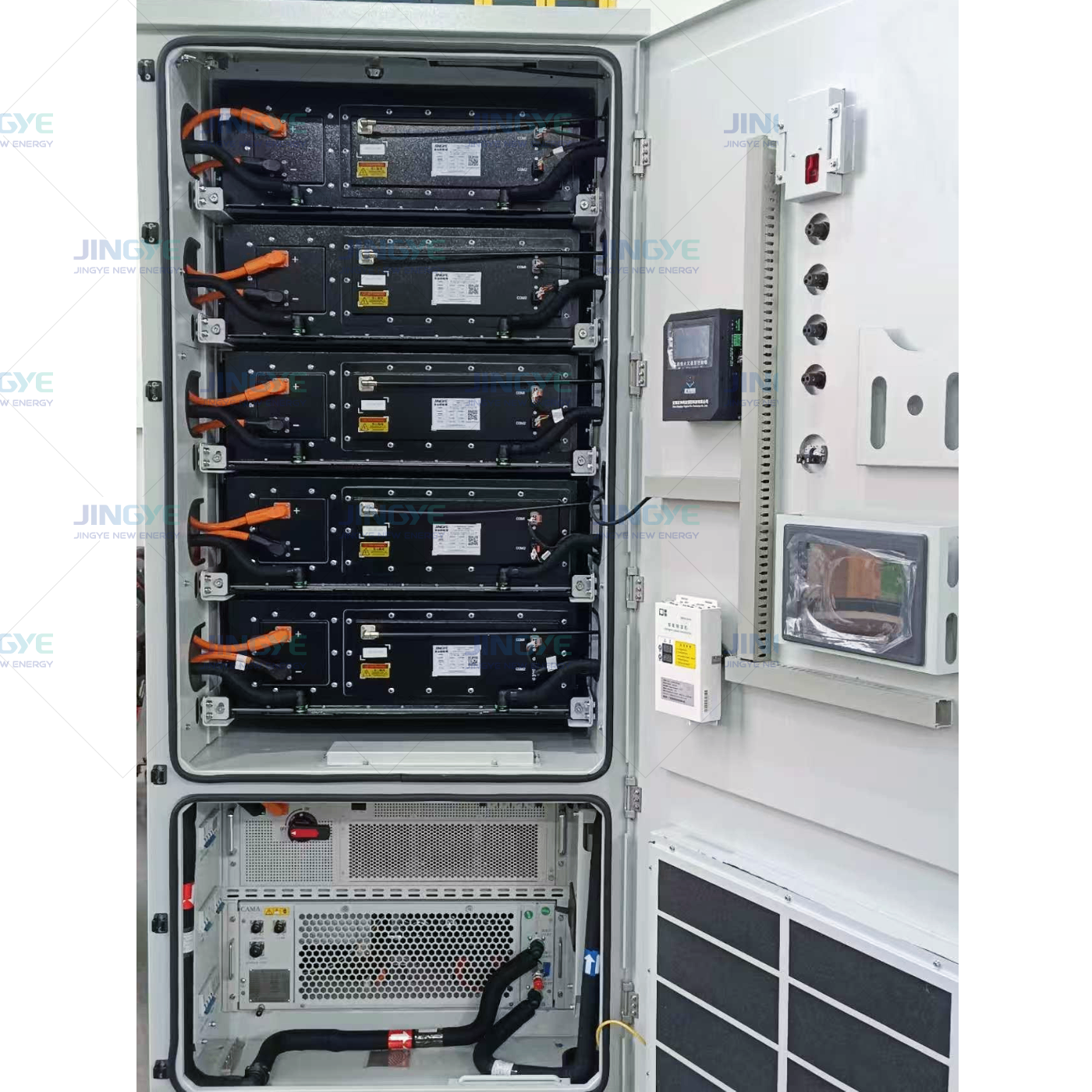
LFP-261kWh All-in-One Energy Storage Cabinet
The LFP-261kWh is an all-in-one commercial & industrial energy storage cabinet from Jingye New Energy, with a built-in 125kW inverter (PCS) — battery and inverter in one unit, no separate PCS needed. It delivers 261kWh using 314Ah LFP cells, liquid-cooled, >6,000 cycles, IP54, for peak shaving, load shifting, solar self-consumption, and backup power at small-to-medium sites. OEM/ODM available.
LFP-417kWh Energy Storage Cabinet
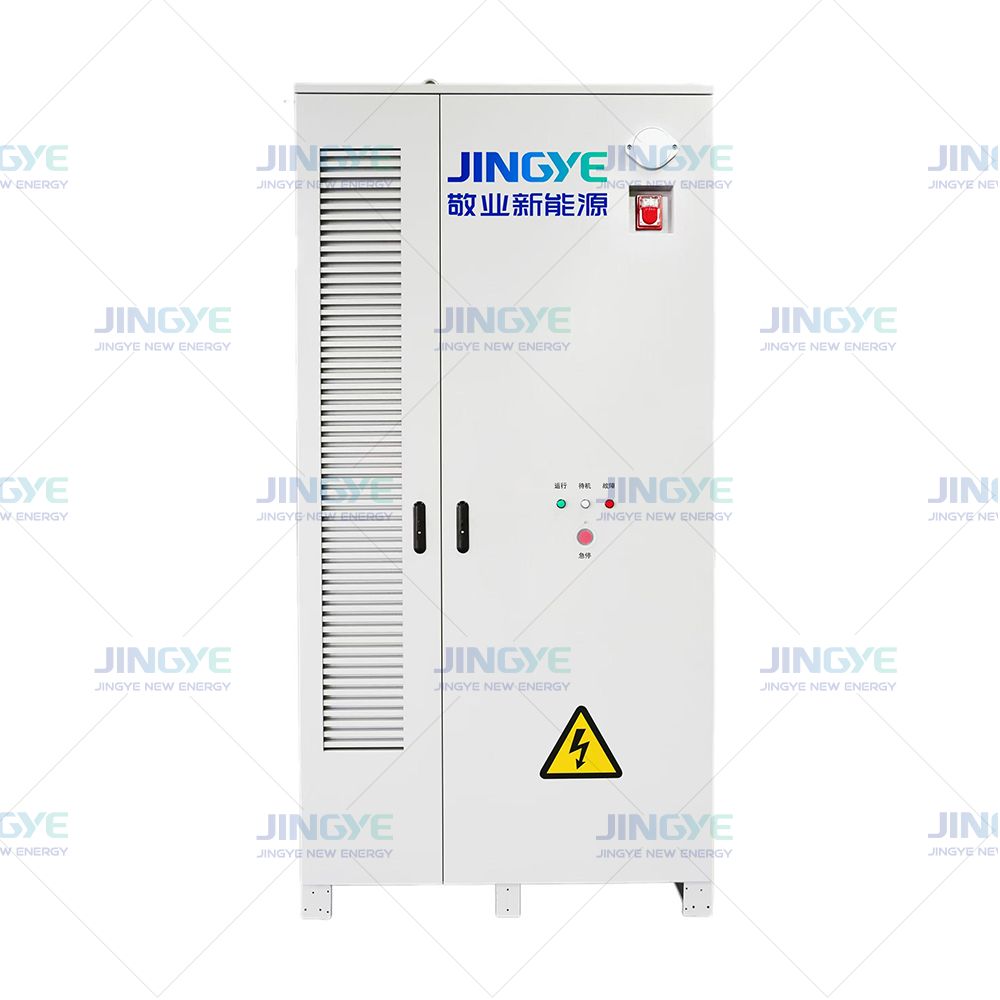
The LFP-417kWh is a high-capacity commercial & industrial energy storage cabinet from Jingye New Energy, built for large C&I sites that need maximum energy per footprint. It delivers 417kWh using 314Ah LFP cells on a 1331.2V platform, liquid-cooled, >8,000 cycles, IP55, and is series-scalable with an external PCS — for peak shaving, load management, and solar integration. OEM/ODM available.
5.015MWh Liquid-Cooled BESS Container (Containerized Energy Storage System)
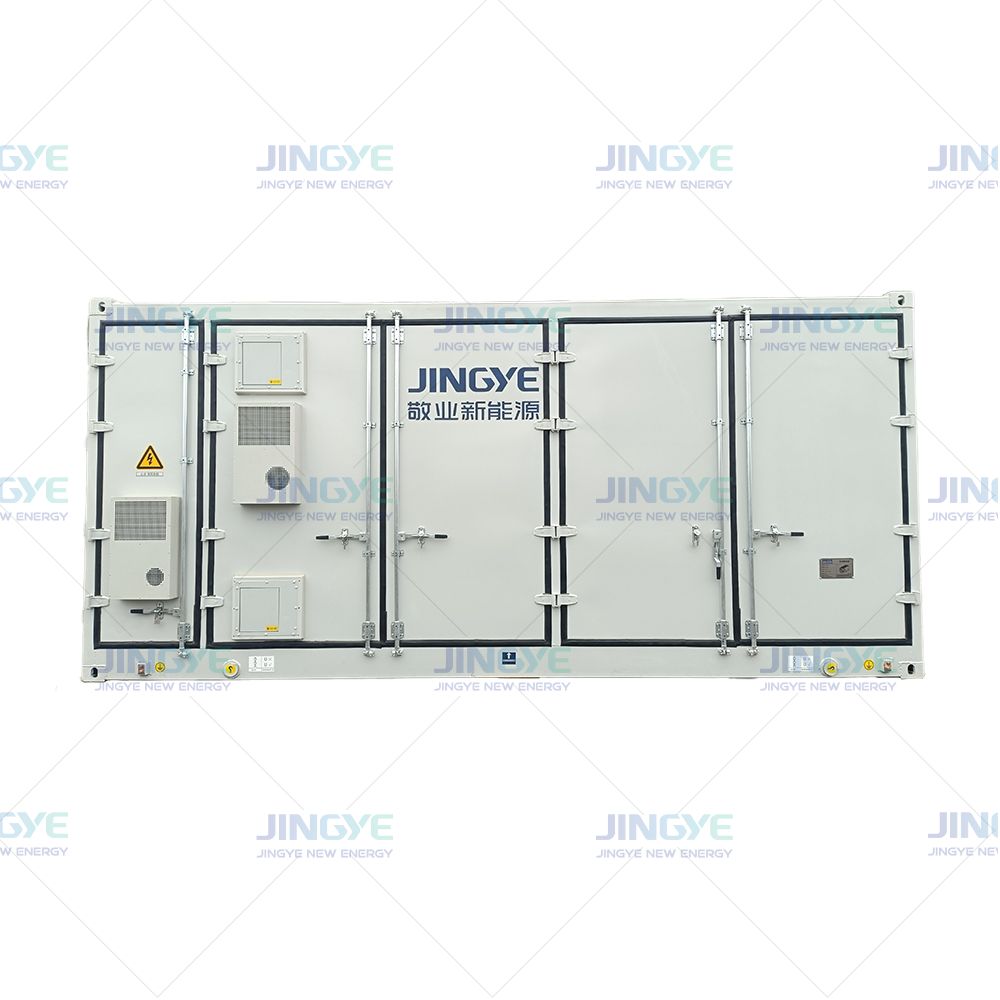
The 5.015MWh liquid-cooled BESS container from Jingye New Energy is a utility-scale containerized energy storage system built on 314Ah LFP cells. As a China-based BESS container manufacturer and supplier, we deliver 5,015 kWh of battery energy storage in a standard 20-foot container — up to 2.5 MW charge/discharge, liquid-cooled, with multi-level fire protection. OEM/ODM available; request a price today.
Let’s Get Started on Your New Energy Journey.