Nov 16, 2026
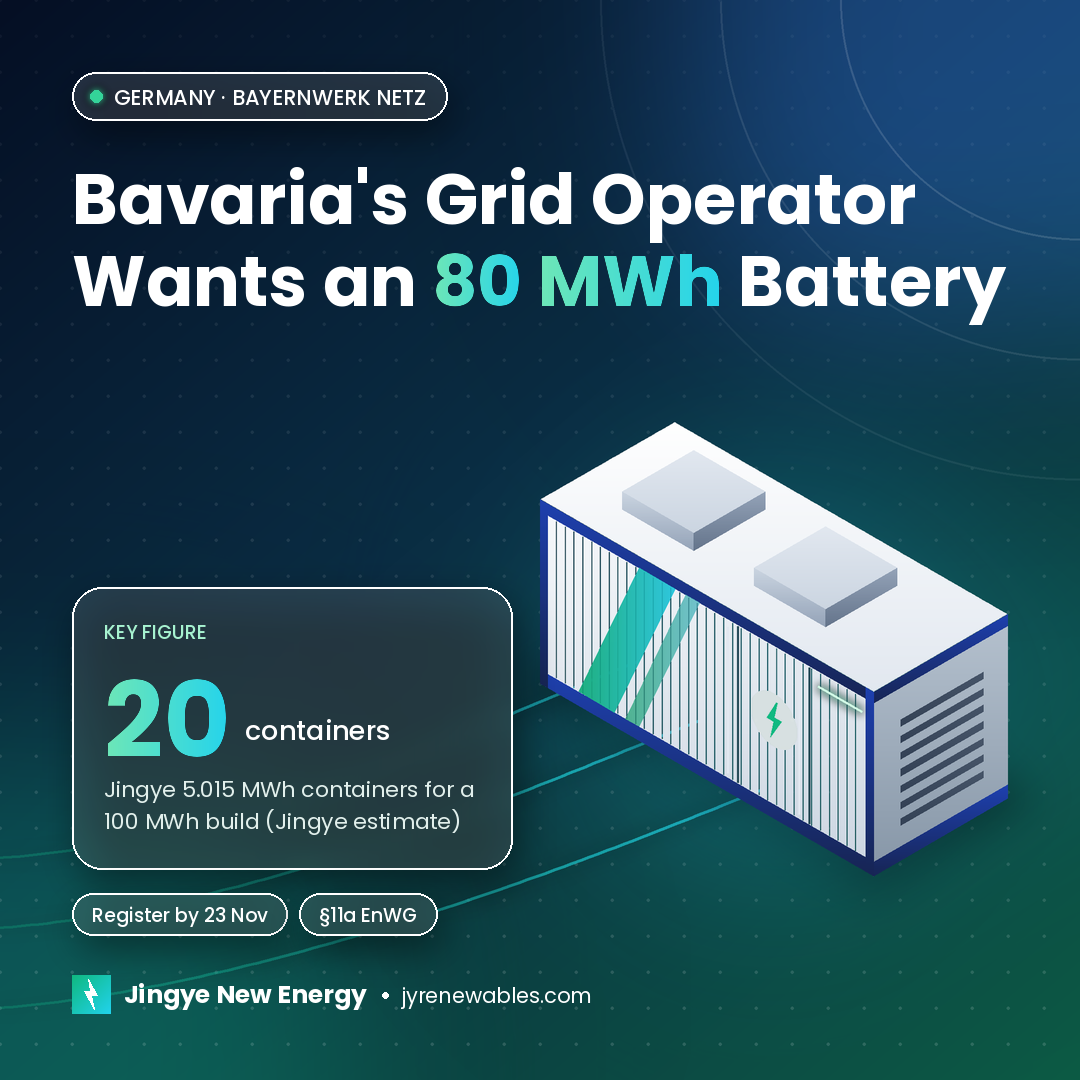
Bayernwerk Netz wants a battery of 20 MW and at least 80 MWh at its Speichersdorf substation in Bavaria. It will run for the grid, under §11a EnWG, in place of a conventional grid upgrade. Registration is open from 9 to 23 November 2026, and the target is commissioning by the end of 2027. With 5.015 MWh containers, 16 units just reach 80 MWh, and 20 units give about 100 MWh with a 25% margin.
Germany's grid operators have started buying batteries the way they used to buy cables and transformers. On 11 November 2026, regional distribution operator Bayernwerk Netz opened an expression of interest for a 20 MW / 80 MWh battery at its Speichersdorf substation in Bavaria. The battery is meant to replace a planned conventional grid upgrade and ease congestion caused by renewable power.
The window is short: registrations close on 23 November. This article explains how grid-serving storage works, how to size an 80 MWh bid, and what to check with your battery supplier before you register.
A battery of 20 MW and at least 80 MWh, connected directly to the Speichersdorf substation and operated to meet grid needs rather than market prices. That makes it a 4-hour system (80 MWh ÷ 20 MW).
| Item | Detail |
|---|---|
| Issuer | Bayernwerk Netz GmbH, regional distribution system operator (Bavaria) |
| Site | Speichersdorf substation, direct connection |
| Size | 20 MW power, at least 80 MWh energy (4 hours) |
| Purpose | Relieve congestion, integrate more renewables, replace a conventional grid upgrade |
| Legal basis | §11a Energiewirtschaftsgesetz (EnWG) |
| Storage ID | BAGE_S0007 |
| Registration | 9 to 23 November 2026, open to registered service providers |
| Target commissioning | End of 2027 |
Table 1. Key facts of the Speichersdorf expression of interest. Source: TaiyangNews, 11 Nov 2026.
A normal merchant battery chases price spreads. A grid-serving (netzdienlich) battery follows the grid operator's needs at one specific substation, and the operator pays for that service. Location matters: the battery only helps if it sits where the bottleneck is.
Bayernwerk's first project shows how the model works. For the 5 MW pilot at Wutzldorf, the grid operator signed a service contract with MaxSolar, which operates the battery. Bayernwerk sets the time-of-day and seasonal specifications, and the battery charges at high solar output and discharges at high demand. More than 100 bidders took part in that tender.
Rural substations are full of solar power for a few hours a day and almost empty the rest of the time. A battery at the substation soaks up the peak and releases it later, so the existing transformer can carry much more renewable power.
A Fraunhofer IEE study for the German Solar Association looked at 1,313 rural substations. It found that smart batteries could let about 150 GW of extra PV connect with average curtailment of around 1%. That would need roughly 60 GW / 240 GWh of storage. Spread evenly, that is about 46 MW / 183 MWh per substation (Jingye estimate), more than twice the size of the Speichersdorf battery.
The market is already moving fast. Germany installed 91% more new battery capacity in the first nine months of 2026 than a year earlier, about 8.2 GWh, and large battery parks made up roughly half of it. BSW-Solar is now calling for distribution grid tenders for batteries at substations, which is exactly what Bayernwerk is running.
Figure 1. Grid-serving battery tenders in Bavaria. Sources: Solarserver, Bayern Innovativ, TaiyangNews.
At least 16 containers of 5.015 MWh, which gives 80.24 MWh nameplate. Since the minimum is 80 MWh and every battery loses some capacity over its life, most bidders will add a margin. 20 containers (about 100 MWh) is the safer choice.
| Option | Containers | Nameplate energy | Margin over 80 MWh | Power per container at 20 MW | Container footprint |
|---|---|---|---|---|---|
| Minimum | 16 | 80.24 MWh | 0.3% | 1.25 MW | 236 m² |
| Moderate margin | 18 | 90.27 MWh | 12.8% | 1.11 MW | 266 m² |
| Recommended | 20 | 100.30 MWh | 25.4% | 1.00 MW | 295 m² |
Table 2. Speichersdorf sizing with Jingye 5.015 MWh containers (6,058 × 2,438 mm, ≤ 2.5 MW each). Footprint counts the containers only, without spacing, PCS or transformers. Jingye estimate.
Power is not the limit here. Each container is rated up to 2.5 MW, so even 16 units could deliver 40 MW, twice what the site needs. Running each container at 1.0 to 1.25 MW keeps the cells at a gentle rate, which helps temperature control and lifetime.
Figure 2. Container options compared with the tender minimum and the N-ERGIE Ansbach project (20 MW / 100 MWh). Sources: Bayern Innovativ; container options are a Jingye estimate.
The Ansbach project is a useful benchmark. N-ERGIE Netz asked for a 20 MW battery there too, and the winning project is being built at 20 MW / 100 MWh. A 20-container block lands in almost the same place.
The public notice says "at least 80 MWh" but does not say whether this means nameplate energy or energy delivered at the grid connection after losses and degradation. Clarify this with Bayernwerk Netz during registration. It decides whether 16 or 20 containers is the right answer.
Register first, then firm up the technical package. The registration window is only two weeks, so the battery data you need for the next round should be ready before you are asked for it.
When you speak to battery suppliers, these are the questions that matter for a grid-serving project:
German grid connection rules apply to the plant and its power conversion system. If you buy batteries and PCS from different suppliers, check early who provides the grid-code certificates. Our guide on all-in-one vs separate PCS systems explains the trade-offs.
Our 5.015 MWh liquid-cooled BESS container packs 314Ah LFP cells into a standard 20 ft container (6,058 × 2,438 × 2,896 mm) at 1,331.2 V DC, rated up to 2.5 MW. It has aerosol plus water fire protection at pack, cluster and compartment level, and the product page lists GB/T 36276, IEC/EN 62619, IEC/EN 62477, UN 38.3 and IEC/EN 63056. At the Jiangsu Jingye Iron and Steel 50 MW / 100.32 MWh station we installed 20 battery cabins of 5 MWh with 10 PCS cabins of 5 MW. That is the same energy block a 100 MWh Speichersdorf bid would use.
All products come from our own 15 GWh module and PACK line with MES traceability, and they are tested in our CNAS-accredited laboratory. The company holds ISO quality, environmental and occupational health and safety management system certificates. For grid-support duty, see also our article on black start capability in BESS, or browse the full energy storage system range.
It is a grid-serving battery that a distribution operator uses to relieve a specific part of its network. It charges and discharges according to the grid operator's rules rather than only market prices, and is paid under a service contract.
The expression of interest is open to registered service providers. Registration runs from 9 to 23 November 2026 under storage ID BAGE_S0007.
Section 11a of the German Energy Industry Act lets grid operators use storage as grid-serving equipment to avoid network expansion. In Bayernwerk's tenders so far, a third party builds and operates the battery under a service contract with the grid operator.
Four hours: 80 MWh at 20 MW. Bayernwerk's earlier site list required at least two hours, so this site asks for twice that.
Sixteen containers give 80.24 MWh nameplate. Twenty give 100.30 MWh, which leaves about 25% margin for losses and ageing (Jingye estimate).
Bayernwerk Netz targets commissioning by the end of 2027.
Send us the site size and the tender notes. We will return a container layout, energy-margin calculation and datasheet pack you can use in your submission.
Get a sizing proposalHebei Jingye New Energy Technology Co., Ltd, part of Jingye Group, makes battery energy storage systems, C&I storage cabinets, cell contact systems and commercial vehicle batteries, from cell integration to complete containerised systems.
Nov. 20, 2026
Gujarat's 550 MWh BESS Agreement: What EPCs Must Specify in 2026
NLC India has signed a 275 MW / 550 MWh battery energy storage agreement with Gujarat Urja Vikas Nigam Limited (GUVNL), strengthening India's growing grid-scale storage market. This article explains the key capacity, system design, safety and integration requirements that EPCs and project developers should evaluate when planning large-scale BESS projects.
Nov. 16, 2026
Bayernwerk 20 MW/80 MWh Grid-Serving Battery Tender: How to Size Your Bid (2026)
Bayernwerk Netz wants a 20 MW / 80 MWh grid-serving battery at its Speichersdorf substation, with registration closing on 23 November 2026. Sixteen 5.015 MWh containers just meet the minimum, while 20 containers give 100.3 MWh with a 25% margin.
Nov. 12, 2026
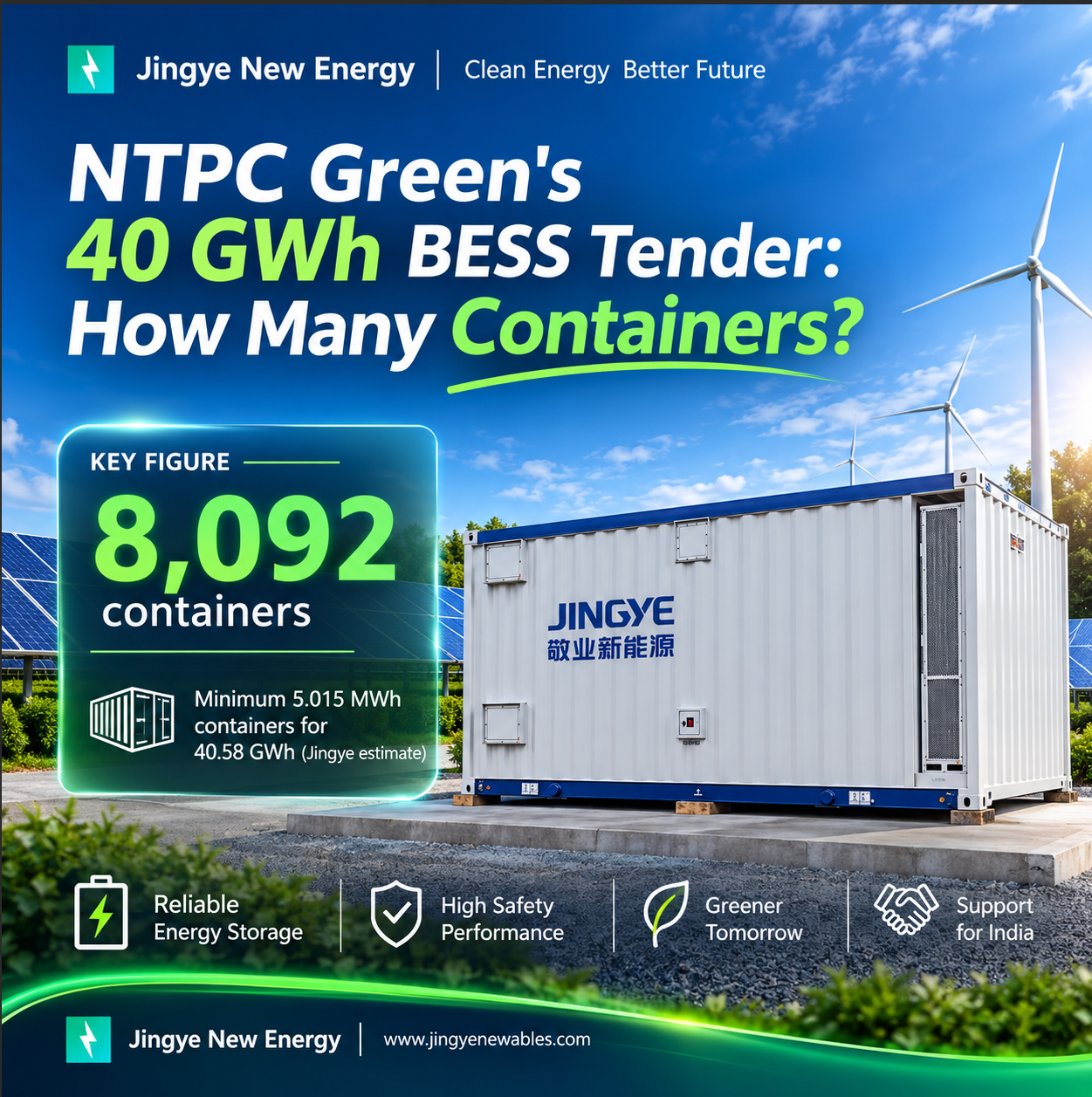
NGEL 40 GWh BESS Tender: Container Sizing, Qualification Rules and Bid Deadline (2026)
NTPC Green Energy's 10 GW / 40.58 GWh BESS tender closes on 8 December 2026 and needs at least 8,092 battery containers of 5.015 MWh. Here are the block sizes, qualification routes, turnover rules and bid steps.
Let’s Get Started on Your New Energy Journey.