Nov 06, 2026

Black start capability in battery energy storage systems allows a power network to restart after a total or partial outage without relying on the main grid. A black start battery system uses stored energy, power conversion equipment, and control software to energize a dead bus. This process supports grid forming, microgrid operation, and power system restoration. The system must also start its own battery management system, thermal controls, communication equipment, and auxiliary loads. These requirements make black start design more complex than normal backup power operation.
Many operators want a battery Energy Storage System that can restore critical loads within minutes. However, they must verify state of charge, inverter starting power, protection settings, and battery safety before approving the project.
A battery energy storage system has black start capability when it can start without grid power, energize a dead electrical bus, establish stable voltage and frequency, and supply selected loads or generation assets. A complete solution normally includes a grid forming inverter, a battery with enough state of charge, independent auxiliary power, suitable protection controls, and a tested restoration sequence. The system should be verified through factory tests, site tests, and operating simulations. Depending on system size and design, a black start battery system can begin voltage formation in seconds and restore selected loads in several minutes.
Black start is the ability to restore an electrical system after the local grid has lost power. Traditional power plants often require an external generator to start pumps, control systems, and fuel equipment. A battery energy storage system can provide this first source of power if it has the correct operating mode.
During a black start event, the battery system usually performs these functions:
A grid following inverter needs an existing voltage waveform from the grid or another source. It follows that waveform and injects current. A grid forming inverter can create the voltage waveform itself. This difference is central to black start operation.
| Feature | Grid following inverter | Grid forming inverter |
|---|---|---|
| Needs an existing grid voltage | Usually yes | No |
| Can energize a dead bus | Usually no | Yes, when designed and approved for the function |
| Controls | Follows voltage and frequency | Establishes voltage and frequency |
| Typical black start use | Limited | Suitable |
| Power quality responsibility | Shares responsibility with the grid | Must manage voltage, frequency, inrush, and load changes |
The battery must provide enough energy for the complete restoration sequence. The battery management system monitors cell voltage, temperature, current, state of charge, and state of health. It must permit black start operation only when safety limits are satisfied.
For example, a 10 MW battery system that operates for 30 minutes requires at least 5 MWh of usable energy before accounting for reserve, conversion losses, temperature limits, and auxiliary consumption. A project may reserve 15 to 30 percent of the installed energy for emergency operation. The exact value depends on the restoration plan.
The power conversion system establishes the initial AC voltage and frequency. It must control voltage during transformer energization and manage sudden changes in load. Common control methods include voltage source control, droop control, virtual synchronous machine control, and virtual oscillator control.
A grid forming inverter may have a response time in the millisecond range. The full black start sequence is longer because breakers, transformers, auxiliary systems, and loads must operate in a safe order.
The battery inverter cannot start if its own control panels, cooling pumps, battery racks, or communication systems have no power. The design may include a small uninterruptible power supply, a DC control battery, or a separate auxiliary generator.
Auxiliary loads often include HVAC equipment, fire detection, control cabinets, network switches, lighting, and protection relays. The project team should measure these loads rather than estimate them. A 10 MW container system may require tens of kilowatts for standby and cooling, depending on ambient temperature and operating mode.
Black start requires breakers and protection devices that can operate when the upstream grid is unavailable. Protection settings must support both islanded operation and grid connected operation. Incorrect settings can cause an unwanted trip when the battery energizes a transformer or starts a motor.
The energy management system controls dispatch, reserve, and operating limits. The power plant controller coordinates multiple inverters and manages the point of common coupling. The controller must contain a clear restoration state machine. Each state should have an entry condition, an operating limit, a timeout, and a safe failure response.
Black start controls need reliable communication between the battery management system, inverter, protection relays, switchgear, and supervisory control system. Redundant networks and accurate time stamps help operators understand the sequence after an event.
Connecting all loads at once can cause a large current surge. Motors may draw five to seven times their rated current during direct starting. Transformers can also produce magnetizing inrush that is several times the normal current. A controlled sequence reduces voltage depression and prevents inverter overload.
A practical sequence may begin with control systems below 10 percent of the available inverter rating. The operator can then add larger loads in blocks. The exact block size depends on short circuit strength, motor starting current, transformer data, and inverter overload capability.
| Design item | Typical engineering target | Why it matters |
|---|---|---|
| Initial voltage formation | Milliseconds for inverter control response | Creates the first stable waveform |
| System restoration time | Several minutes to tens of minutes | Depends on switching, transformer, and load procedures |
| Frequency control | Often 50 Hz or 60 Hz, based on the local grid | Keeps equipment within operating limits |
| Voltage control | Usually within the approved utility operating band | Protects loads and avoids nuisance trips |
| Battery reserve | Often 15 to 30 percent of usable energy, subject to the restoration plan | Provides margin for unexpected delays |
| Harmonic performance | Verified against the project power quality limit | Protects sensitive equipment and control systems |
| Protection response | Tested for islanded and grid connected modes | Prevents unsafe fault clearing |
The required battery capacity depends on power, time, efficiency, reserve, and auxiliary demand. A basic calculation is:
Required installed energy equals black start power multiplied by operating time, divided by total efficiency, plus reserve energy and auxiliary energy.
For a 5 MW critical load operating for 20 minutes, the load energy is 1.67 MWh. If the total conversion efficiency is 90 percent and the design includes 20 percent reserve, the installed usable energy should be higher than 2.0 MWh. The final design must also consider low temperature performance, battery degradation, minimum state of charge, and future capacity loss.
In island mode, a battery inverter usually supplies lower fault current than a traditional synchronous generator. This can affect protection coordination. The engineering team must confirm that relays can detect faults and trip the correct breaker.
Inverter fault current may be limited to about 1.1 to 2.0 times rated current for a short period, depending on the equipment design. A synchronous generator may provide a higher initial fault current. The protection system must be designed for the actual inverter data, not for generator assumptions.
Black start is a functional claim. It should be proven through documented testing. A design review alone cannot confirm that the system will restart a dead bus under real operating conditions.
Local utility rules, fire codes, electrical codes, and grid operator procedures also apply. The project should define the required standards before equipment procurement.
Factory acceptance testing can include:
Site tests should use the actual transformers, cables, switchgear, protection relays, and control network. The test team should record voltage, frequency, current, active power, reactive power, harmonic distortion, breaker status, and alarm time stamps.
A complete site test may verify that the battery system can:
| Challenge | Possible result | Engineering solution |
|---|---|---|
| Low battery state of charge | Restoration stops before critical loads are supplied | Set a minimum reserve and keep emergency energy unavailable for routine dispatch |
| No independent auxiliary power | Controls and cooling cannot start | Install a DC battery, UPS, or independent auxiliary source |
| Large motor starting current | Voltage drop or inverter overload | Use soft starters, variable frequency drives, or staged load pickup |
| Transformer inrush | Protection trip during energization | Use controlled switching and verify relay settings |
| Weak island fault current | Protection may fail to detect a fault | Use inverter aware protection coordination and fast communications |
| Control network failure | Sequence stops or equipment operates in the wrong order | Use redundant communication paths and local backup logic |
| Battery temperature outside limits | Power output is reduced or blocked | Maintain thermal control during standby and include temperature limits in the plan |
A battery can energize plant auxiliaries such as pumps, controls, lubrication systems, and communication equipment. This support can help a gas, hydro, or other generation facility return to service.
A battery can form a local island for hospitals, water facilities, factories, campuses, and emergency services. Loads are prioritized by safety and operational value.
Wind and solar plants need control power, communication, and medium voltage equipment before they can generate. A battery can start these systems and provide voltage support during reconnection.
Remote communities and industrial sites can use a black start battery system to reduce dependence on diesel generators. The battery may also provide frequency regulation and peak shaving during normal operation.
Data centers, transport systems, telecommunications sites, and water treatment plants can use battery storage for fast transfer and controlled island operation. The restoration sequence must match the facility emergency plan.
Jingye can support the planning and implementation of battery energy storage systems with a focus on system integration, equipment quality, and commissioning control. A black start project should be treated as a complete electrical system rather than as a battery container alone.
A project quality plan may include the following work:
For equipment inspection, measurable criteria should be defined before delivery. Examples include battery cell voltage deviation limits, enclosure protection ratings, insulation resistance values, torque records for power connections, relay setting records, and alarm response times. The final acceptance values must follow the equipment manufacturer instructions, approved drawings, and applicable standards.
Before selecting a system, project owners should ask these questions:
Black start capability in battery energy storage systems provides a fast and flexible way to restore selected electrical loads after a blackout. The core requirements are a grid forming inverter, adequate battery reserve, independent auxiliary power, coordinated protection, controlled load sequencing, and verified safety systems. Performance should be proven through factory testing, simulation, site commissioning, and regular operational drills. When these elements are designed as one system, a black start battery system can help utilities, microgrids, power plants, and critical facilities restore power in a controlled and measurable way.
Nov. 06, 2026
Black Start Capability in Battery Energy Storage Systems
Black start capability in battery energy storage systems allows a power network to restart after a total or partial outage without relying on the main grid. A black start battery system uses stored energy, power conversion equipment, and control software to energize a dead bus. This process supports grid forming, microgrid operation, and power system restoration. The system must also start its
Nov. 05, 2026
All-in-One vs Separate PCS Energy Storage Systems
Energy Storage Cabinets are no longer selected only by battery capacity. Buyers also need to evaluate power conversion, safety controls, thermal management, installation time, maintenance access, expansion options, and long-term operating cost. The central purchasing decision is whether to choose an All-in-One energy storage system or a Separate PCS architecture.
Nov. 05, 2026
AI Data Center Battery Storage: How to Size the BESS in 2026
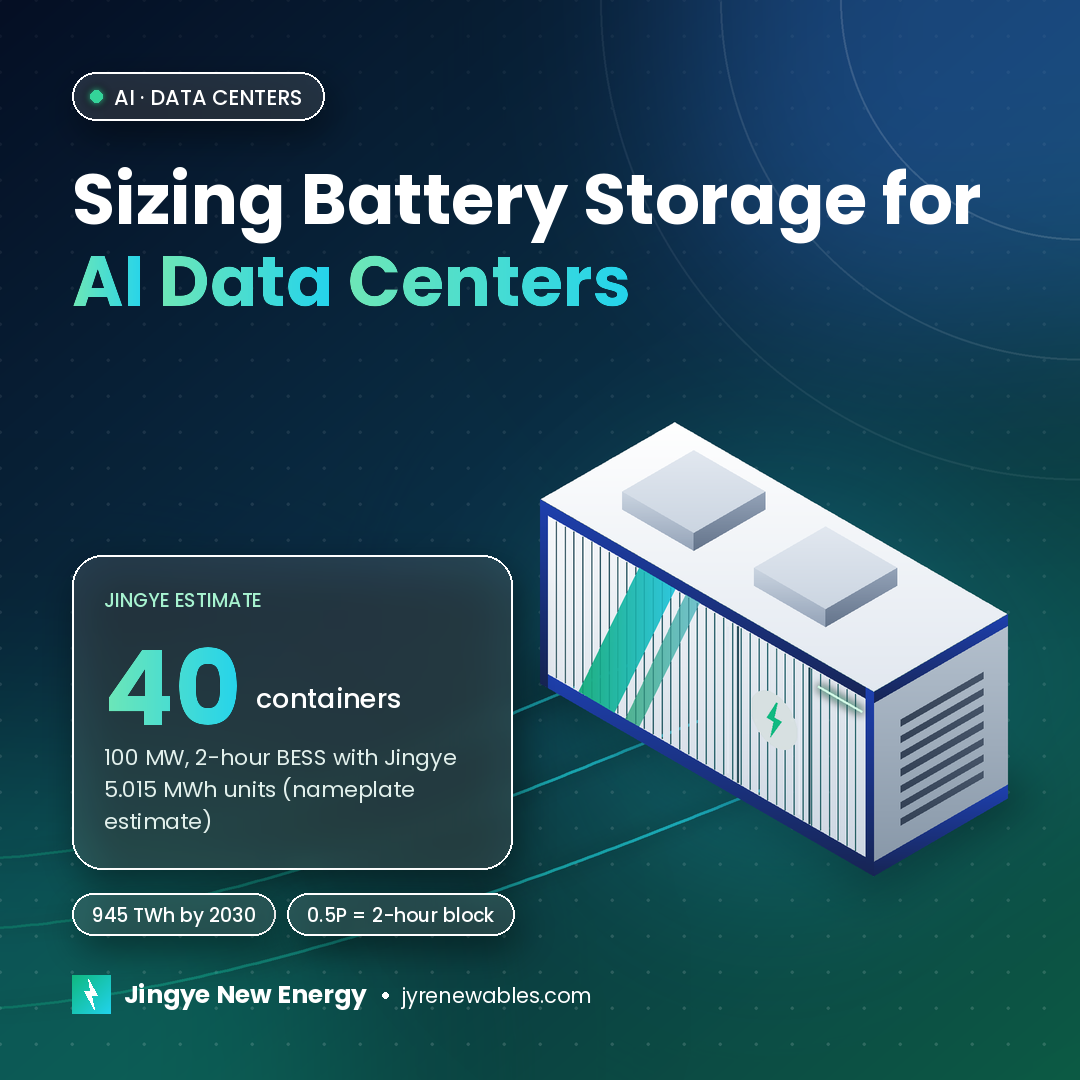
AI data centers use battery storage to smooth GPU load swings, ride through outages and manage grid limits. By our estimate, a 100 MW, 2-hour BESS needs 40 Jingye 5.015 MWh containers, and a 4-hour system needs 80.
Let’s Get Started on Your New Energy Journey.