Nov 23, 2026
NTPC Green Energy's tender buys LFP battery containers and grid-forming PCS for 40.58 GWh of storage. It is split into seven blocks of 4.56–6.80 GWh, and you have to bid for a whole block. Bids close on 8 December 2026. To qualify as a direct supplier you need 4,000 MWh of containerised batteries supplied in the last three years. Indian EPCs and developers can also qualify by teaming with a manufacturer that meets that bar.
On 9 November 2026, NTPC Green Energy Limited (NGEL) issued an international tender, NIT NGEL-CS-5853-004(BESS)-9. It covers containerised LFP battery systems and grid-forming power conversion systems (PCS) for a 10 GW / 40 GWh storage programme (IndianPSU). That's a big order for India. At the end of June 2026 the whole country had 9.3 GWh of battery storage installed, so this one tender is more than four times that.
This guide is for EPCs, developers and BESS integrators deciding whether to bid. It covers what the tender buys, who qualifies, what one block means in containers and money, and what to settle with your battery partner before the deadline.
NGEL is buying the core equipment, not complete plants. The supplier delivers LFP battery containers and grid-forming PCS. It supervises erection, installation and commissioning up to the PCS output terminals, then services and maintains the system for 15 years under a long-term service agreement (LTSA) (TaiyangNews).
10 GW against 40 GWh works out to about four hours of storage. A grid-forming PCS can set voltage and frequency itself instead of only following the grid, which is why it's becoming standard for large renewable-heavy grids.
There are seven blocks over three phases, and the smallest one you can bid for is 4.56 GWh. You can bid for one, several or all of them. Each bid has to cover the full block capacity (Energetica India).
Table 1 turns each block into the numbers a bidder has to plan for. We counted containers using our own 5.015 MWh container. We also applied the reported turnover rule (INR 69 lakh per MWh) to each block's capacity, on the assumption that it's measured against quoted capacity. Confirm that in the tender document.
| Phase / block | Capacity (GWh) | 5.015 MWh containers (min.) | Avg. turnover needed (INR crore) | Bid security (INR crore) |
|---|---|---|---|---|
| Phase 1, block 1 | 4.98 | 994 | 3,436 | 50 |
| Phase 1, block 2 | 6.60 | 1,317 | 4,554 | 100 |
| Phase 1, block 3 | 5.84 | 1,165 | 4,030 | 100 |
| Phase 2, block 1 | 4.56 | 910 | 3,146 | 50 |
| Phase 3, block 1 | 5.80 | 1,157 | 4,002 | 100 |
| Phase 3, block 2 | 6.80 | 1,356 | 4,692 | 100 |
| Phase 3, block 3 | 6.00 | 1,197 | 4,140 | 100 |
| All 7 blocks | 40.58 | 8,096 | n/a | 200 (above 10 GWh) |
Table 1. Block sizes and bid security from Energetica India. Container counts and turnover figures are Jingye estimates: containers = block MWh ÷ 5.015, rounded up; turnover = block MWh × INR 0.69 crore.
The tender talks about "deliverable" capacity. Usable energy at the PCS output is lower than battery nameplate once depth of discharge, conversion losses and 15 years of degradation are counted. So a real design needs more than 8,096 containers or an augmentation plan. Size against the guaranteed figure in the technical specification, not the headline GWh.
There are two paths. Experienced battery container makers can bid directly. Indian companies with energy or industrial project experience can bid if they team up with a qualified battery manufacturer (Energetica India).
The money rules are steep too. Reports list average annual turnover of at least INR 69 lakh per MWh over three years, plus net-worth tests: at least 25% of paid-up capital, and not eroded by more than 30% over the last three years (Energetica India). On the smallest block, that turnover rule works out to roughly INR 3,146 crore a year (Jingye estimate). For many EPCs, the partner they pick and the balance sheet behind the bid matter more than the price.
It's bigger than everything India has installed so far, put together. India added 8.2 GWh of battery storage in the first half of 2026, bringing installed capacity to 9.3 GWh by the end of June (Mercom India). This one procurement is about 4.4 times that installed base.
Figure 1. Tender capacity compared with India's battery storage base. Sources: Energetica India (tender), Mercom India (installed capacity and H1 2026 additions).
For suppliers, the message is that India's buyers are moving from single projects to equipment framework buys. The winners will need container factories, PCS supply and service teams that can stay in India for 15 years.
The window is short. Reported dates (IndianPSU, Energetica India):
Dates can change through corrigenda. Check the NTPC tender portal before you plan around any of them.
Under routes 2–4 you carry joint and several liability with your manufacturer for the whole contract. So check your partner as hard as the client will check you.
As a rough guide, a 4-hour design runs each container at about a quarter of its energy as power. Our 5.015 MWh container is rated up to 2.5 MW. At a 4-hour duration it works at about 1.25 MW, which is 5.015 MWh ÷ 4 h (Jingye estimate). That gives the PCS headroom and keeps cell stress low.
| Design input | What to ask for | Why it matters |
|---|---|---|
| Usable energy at PCS output | Guaranteed MWh at day 1 and in year 15 | Sets the true container count |
| Duration | 4 hours (10 GW / 40 GWh) | Sets the power per container and PCS sizing |
| Container energy | Nameplate MWh per 20 ft unit | Drives land, foundations and logistics |
| Cycling | Cycles per day from the specification | Drives degradation and the LTSA cost |
Table 2. Sizing inputs for a block bid. Jingye guidance; check every value against the NGEL technical specification.
Jingye New Energy makes a 5.015 MWh liquid-cooled BESS container: a standard 20 ft unit with 314Ah LFP cells, 1331.2 V DC nominal, up to 2.5 MW charge and discharge, and a three-level automatic fire suppression system. Our Jiangsu Jingye Iron and Steel 50 MW / 100.32 MWh project uses 20 sets of 5 MWh battery cabins and 10 sets of 5 MW PCS cabins. Before you name any manufacturer in an NGEL bid, including us, check its references against the 4,000 MWh rule. For India's other utility and C&I storage tenders, we're happy to share container specs and help you size the system. See more energy storage systems and project cases.
It is NGEL's international tender for LFP battery containers and grid-forming PCS for a 10 GW / 40 GWh storage programme. Total deliverable capacity is 40.58 GWh, and the supplier also provides 15 years of service and maintenance.
Yes, it's an international competitive bid. A direct supplier must have delivered at least 4,000 MWh of containerised battery systems in the last three years. Reports don't mention local-content rules, so check the tender document.
No. The minimum bid is one complete block, and partial-block bids will be rejected. Block sizes range from 4.56 GWh to 6.80 GWh.
Reports list INR 50 crore for up to 5 GWh quoted, INR 100 crore for 5–10 GWh, and INR 200 crore above 10 GWh.
A grid-forming PCS can set voltage and frequency itself, so it can support a weak grid instead of only following it. That matters as India adds more solar and wind.
With 5.015 MWh containers, it's about 910 for the 4.56 GWh block and 1,356 for the 6.80 GWh block on nameplate (Jingye estimate). Usable-energy guarantees and degradation push the real number higher.
Send us your block capacity, duration and usable-energy requirement, and we'll come back with a container configuration based on our 5.015 MWh unit.
Send your project requirementsHebei Jingye New Energy Technology Co., Ltd, part of Jingye Group, makes liquid-cooled BESS containers, C&I energy storage cabinets, cell contact systems, commercial vehicle batteries and DC fast EV chargers.
Nov. 23, 2026
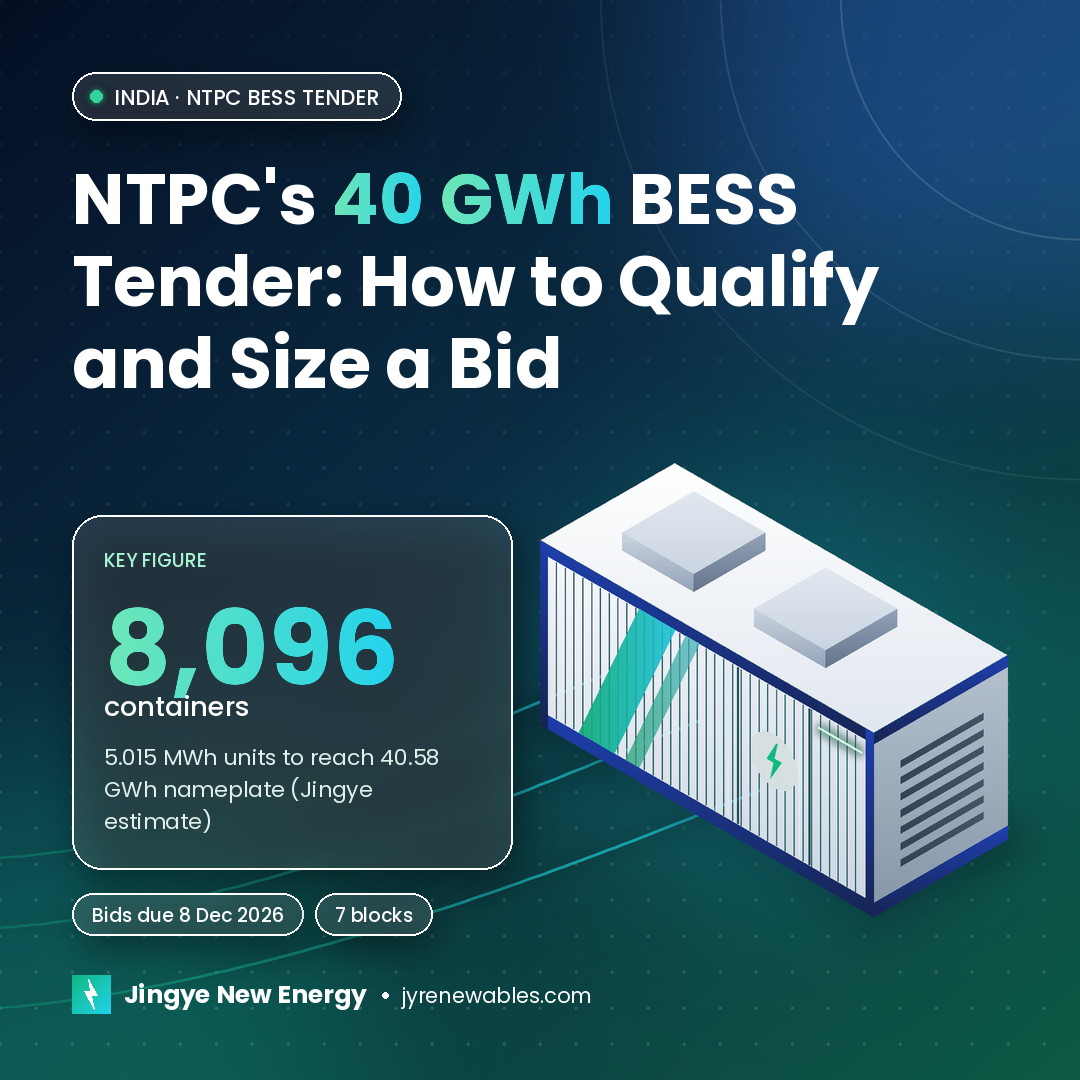
NTPC 40 GWh BESS Tender: How to Qualify and Size Your Block Bid (2026)
NTPC Green Energy's tender buys LFP battery containers and grid-forming PCS for 40.58 GWh in seven full blocks of 4.56–6.80 GWh, with bids due 8 December 2026. Direct suppliers need 4,000 MWh of containers delivered in the last three years.
Nov. 20, 2026
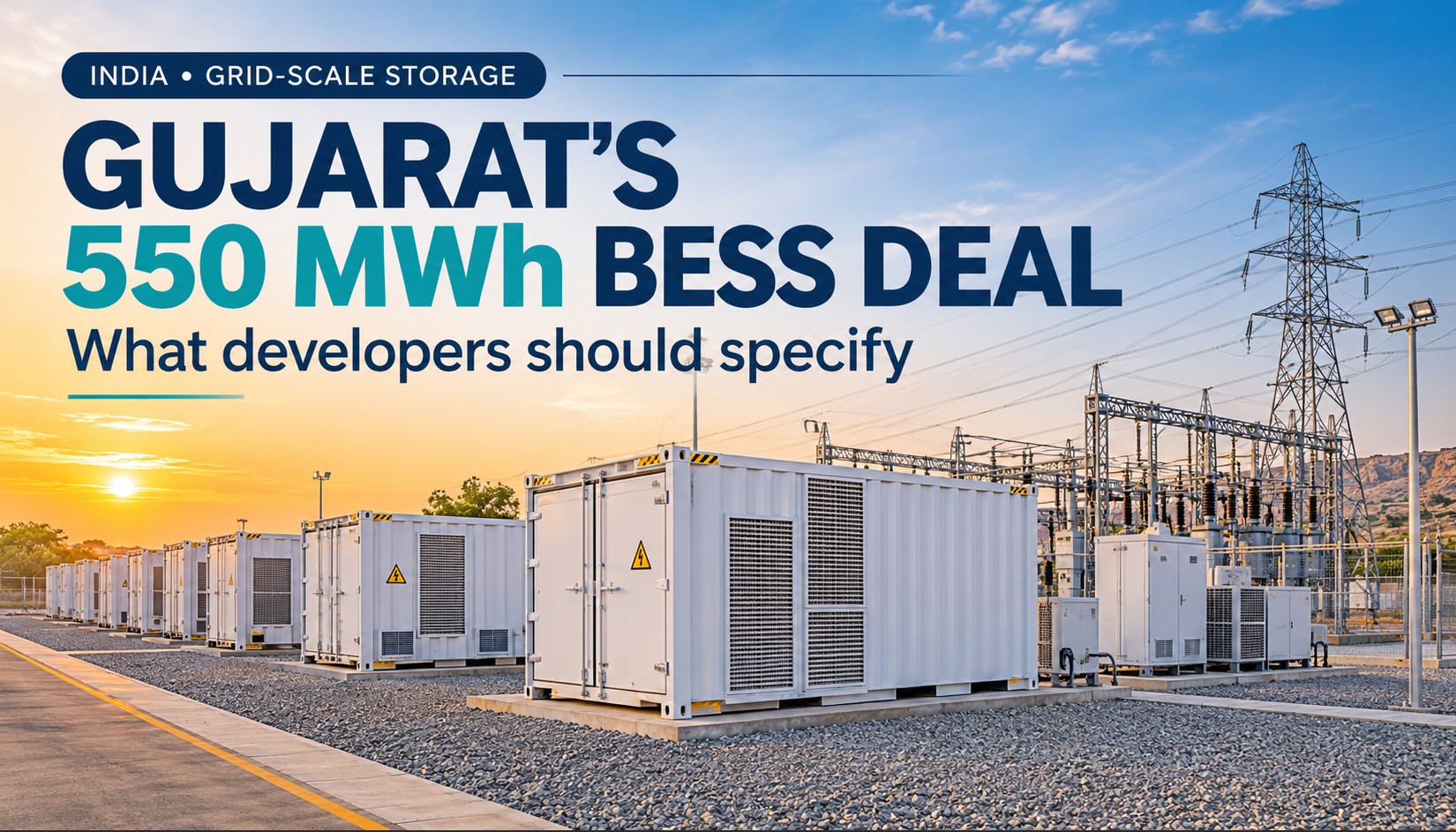
Gujarat's 550 MWh BESS Agreement: What EPCs Must Specify in 2026
NLC India has signed a 275 MW / 550 MWh battery energy storage agreement with Gujarat Urja Vikas Nigam Limited (GUVNL), strengthening India's growing grid-scale storage market. This article explains the key capacity, system design, safety and integration requirements that EPCs and project developers should evaluate when planning large-scale BESS projects.
Nov. 16, 2026
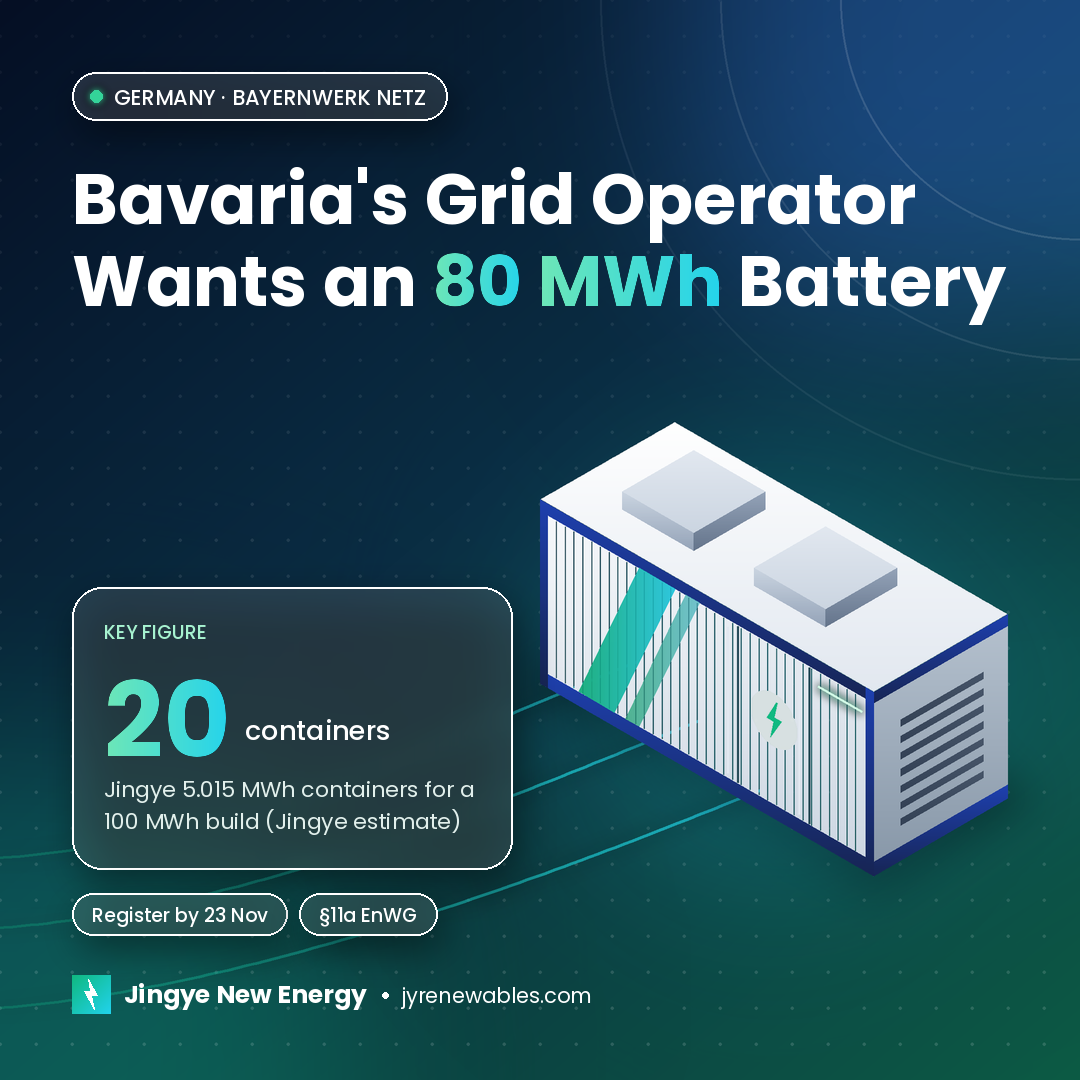
Bayernwerk 20 MW/80 MWh Grid-Serving Battery Tender: How to Size Your Bid (2026)
Bayernwerk Netz wants a 20 MW / 80 MWh grid-serving battery at its Speichersdorf substation, with registration closing on 23 November 2026. Sixteen 5.015 MWh containers just meet the minimum, while 20 containers give 100.3 MWh with a 25% margin.
Let’s Get Started on Your New Energy Journey.