Oct 26, 2026
By Daniyal, Jingye New Energy. Published 26 October 2026.
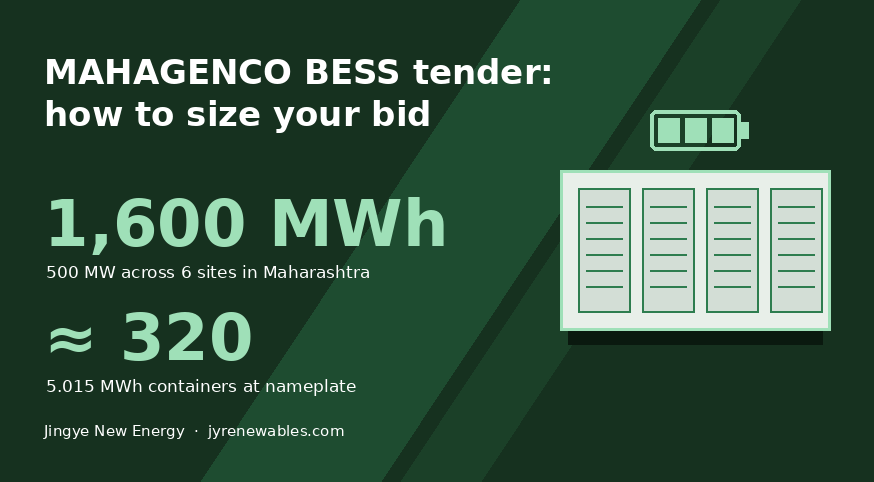
Quick answer: MAHAGENCO has tendered 500 MW / 1,600 MWh of battery storage at six sites in Maharashtra on a build-own-operate basis, with bids due in early November 2026. At nameplate, the whole tender equals about 320 containers of 5.015 MWh and 200 PCS skids of 2.5 MW. Bidders who size each site correctly for 2-hour and 4-hour duty will price more tightly than those who simply divide MWh by container size.
Maharashtra State Power Generation Company (MAHAGENCO) has invited bids for 500 MW / 1,600 MWh of battery energy storage at six of its power station sites, according to Renewable Watch. The plants will connect to MSETCL substations at 33 kV and above, and the winning developers will own the systems and run them for 15 years.
This is one of several large storage tenders in India this month. NTPC Green Energy has also tendered 3,300 MWh of BESS at its Khavda solar plant, with batteries rated for 25 years at one cycle per day (ESS News). For EPCs and developers, the question is no longer whether India will buy storage. It is how to size, source and price a bid that wins and still earns money for 15 years.
Six standalone battery storage plants at existing MAHAGENCO sites, built, owned and operated by the developer, totalling 500 MW / 1,600 MWh.
Three sites need four-hour storage (100 MW / 400 MWh each) and three need two-hour storage. Developers handle operation and maintenance for 15 years. Reported tender terms (Saur Energy, Mercom India):
At nameplate, about 320 containers of 5.015 MWh for the full 1,600 MWh, split 80 / 80 / 80 / 40 / 20 / 20 across the six sites.
We sized each site with the Jingye New Energy 5.015 MWh liquid-cooled container, which runs at 0.5P for two-hour duty (about 2.5 MW per container) or 0.25P for four-hour duty (about 1.25 MW per container). Because the container supports both rates, the energy count and the power count land on the same number at every site, so no capacity is wasted. Site capacities follow the Renewable Watch breakdown, whose figures add up to the 1,600 MWh total.
| Site | MW | MWh | Duration | 5.015 MWh containers | 2.5 MW PCS skids |
|---|---|---|---|---|---|
| Uran (Raigad) | 100 | 400 | 4 h | 80 | 40 |
| Koradi | 100 | 400 | 4 h | 80 | 40 |
| Nashik | 100 | 400 | 4 h | 80 | 40 |
| Khaperkheda | 100 | 200 | 2 h | 40 | 40 |
| Chandrapur (Lakhmapur) | 50 | 100 | 2 h | 20 | 20 |
| Parli | 50 | 100 | 2 h | 20 | 20 |
| Total | 500 | 1,600 | — | 320 | 200 |
Jingye New Energy estimate at nameplate capacity. Containers = MWh ÷ 5.015, rounded up; PCS skids = MW ÷ 2.5. Real bids add capacity for depth of discharge, round-trip losses and 15 years of degradation, as defined in the tender documents.
Two practical points come out of this table:
Under build-own-operate, the developer carries the battery risk for 15 years, so lifetime, safety and serviceability matter more than the first price per kWh.
Grid-scale BESS imports qualify for a concessional 10% basic customs duty, and storage batteries sold in India need BIS registration.
In October 2026 the Finance Ministry clarified that stationary, grid-scale and industrial lithium-ion BESS should not be treated as power banks, so they keep the concessional 10% basic customs duty; consumer power banks stay at 20% (Energetica India). Separately, storage batteries sold in India fall under the BIS Compulsory Registration Scheme, and foreign manufacturers apply through an Authorized Indian Representative (Agile Regulatory). Check with your Indian partner which registrations the full system needs for this tender.
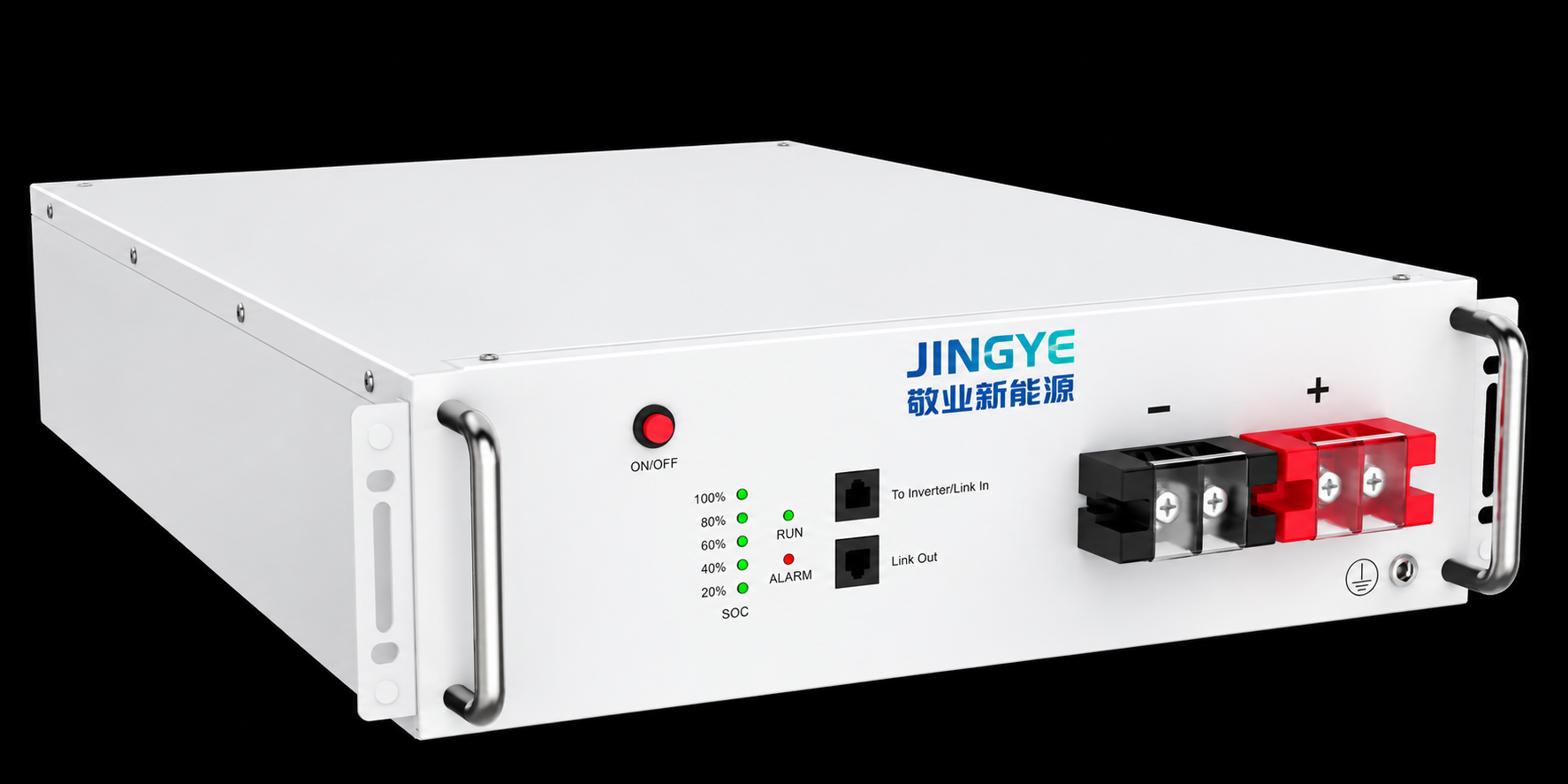
A 20-foot, 5.015 MWh liquid-cooled LFP container with three-level fire protection and a matching 2.5 MW PCS skid.
| Item | Jingye 5.015 MWh container |
|---|---|
| Energy | 5,015 kWh per container, LFP 314Ah cells |
| Configuration | 12 × (1P104S × 4) |
| DC voltage | 1,331.2 V (1,164.8–1,518.4 V) |
| Rate | 0.5P (2-hour) or 0.25P (4-hour) |
| Cooling | Liquid cooling; cell temperature spread ≤3°C in a pack, ≤5°C in the cabinet |
| Fire protection | Pack, string and compartment levels with perfluorohexanone (FK-5-1-12) |
| Protection and climate | IP55/IP54, salt-spray resistant, −20 to 55°C, up to 4,000 m |
| Standards listed | GB/T 36276, IEC/EN 62619, IEC/EN 62477, UN 38.3, IEC/EN 61000-6-2/4, IEC/EN 63056 |
| Matching AC block | 2,500 kW PCS and 2,500 kVA transformer skid |
Behind the product: Jingye New Energy holds ISO 9001, ISO 14001, ISO 45001 and IATF 16949 certificates, runs a CNAS-accredited test lab, and has 15 GWh a year of module and PACK capacity with MES traceability (company profile). Our containers already run at large industrial sites, including the 15 MW / 30 MWh storage plant at Tangshan Huaxi Special Steel (see our cases).
For smaller commercial and industrial sites, our C&I energy storage cabinets cover peak shaving and solar-plus-storage. You can find more buyer guides on the Jingye New Energy blog.
Start from the revenue per MW per month you need, then work back to the capital cost the storage can carry.
For reference, an earlier Maharashtra storage tender (MSEDCL, 2,000 MW / 4,000 MWh) was awarded at Rs 2,38,000 per MW per month to GK Energy for 150 MW / 300 MWh with viability gap funding, about Rs 42.84 crore a year for 15 years (Saur Energy). That is a two-hour project with VGF support, so it is not a direct benchmark for MAHAGENCO's four-hour sites, but it shows the tariff level winners are accepting in the state.
The cheapest way to stay competitive is to cut lifetime cost: fewer containers per MWh, lower auxiliary power, fewer site visits for maintenance, and a supplier that can quote the full DC and AC block on one schedule.
It covers 500 MW / 1,600 MWh of battery storage across six MAHAGENCO sites in Maharashtra, with a mix of two-hour and four-hour systems.
Build-own-operate. The winning developer builds and owns the storage plant and runs it, including operation and maintenance for 15 years.
Reports give 5 or 6 November 2026 for online bid submission. Check the final date on the MAHAGENCO tender portal.
About 320 containers of 5.015 MWh at nameplate, plus 200 PCS skids of 2.5 MW. Real bids need extra capacity for usable-energy and degradation guarantees, so treat 320 as the minimum.
The reported earnest money deposit is Rs 5 lakh per MW, so about Rs 5 crore for a 100 MW site and Rs 2.5 crore for a 50 MW site.
India's Finance Ministry has clarified that stationary, grid-scale and industrial lithium-ion BESS qualify for the concessional 10% basic customs duty; power banks stay at 20%.
Yes. Jingye New Energy offers the 5.015 MWh liquid-cooled container and a matching 2,500 kW PCS and transformer skid, so one supplier can quote the full DC and AC block.
Send us your site list and duration. We will return a container and PCS sizing for each site, a delivery schedule and a budget quotation before the bid deadline.
Request a sizing and quoteHebei Jingye New Energy Technology Co., Ltd, part of Jingye Group, makes containerized and C&I battery energy storage systems, cell contact systems (CCS), EV chargers and commercial vehicle batteries.
Oct. 27, 2026
AC Charging vs DC Fast Charging for Commercial Fleets
DC Fast EV Charger Manufacturer evaluations should begin with the fleet schedule, vehicle battery size, site power capacity, and total cost of ownership rather than charging speed alone. Commercial fleet managers want a practical comparison that explains which technology keeps vehicles available, controls operating costs, protects battery health, and scales as the fleet grows.
Oct. 26, 2026
MAHAGENCO 1,600 MWh BESS Tender: How to Size and Bid (2026)
MAHAGENCO has tendered 500 MW / 1,600 MWh of battery storage at six Maharashtra sites. At nameplate that is about 320 containers of 5.015 MWh and 200 PCS skids of 2.5 MW; here is how to size each site and what bidders should check.
Oct. 26, 2026
SCADA Systems for Utility-Scale Battery Energy Storage
A SCADA system for utility-scale battery energy storage gives operators one clear view of battery racks, the battery management system, the energy management system, and the power conversion system. It collects live data, sends control commands, and warns teams about unsafe conditions. For large battery energy storage systems, good SCADA design can reduce response time from minutes to seconds and
Let’s Get Started on Your New Energy Journey.