Oct. 19, 2026
Battery Capacity Fade in Commercial Energy Storage Systems
Battery capacity fade in commercial energy storage systems reduces the amount of energy a site can store and deliver. This battery degradation can increase demand charges, reduce backup time, and change the return on investment.
Oct. 16, 2026
ESCA Model BESS Contract: What Battery Buyers Must Check in 2026
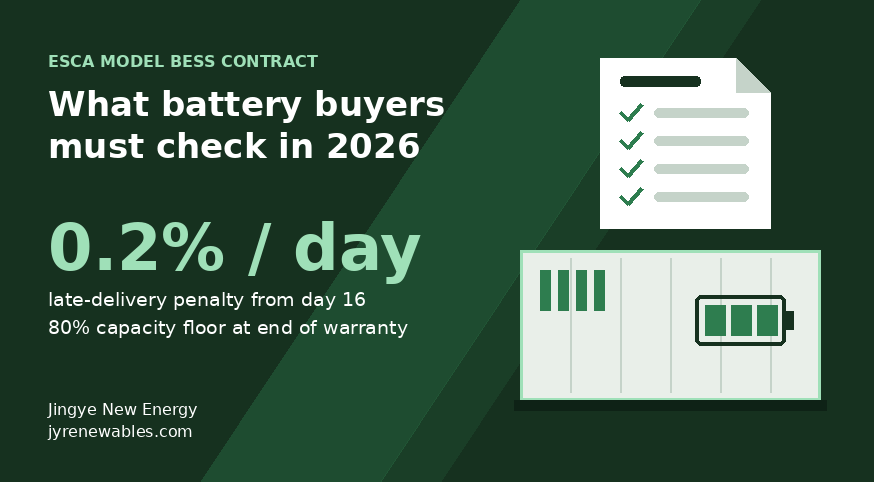
On 13 October 2026, buyers with more than 40 GWh of battery projects published the free ESCA model BESS contract. It sets 0.2% per day late-delivery penalties from day 16, 10% payment at factory test approval and an 80% capacity floor at end of warranty. Here is what buyers should check.
Oct. 16, 2026
Transformer Sizing for Commercial EV Charging Stations
Transformer sizing for commercial EV charging stations is a key task for every DC Fast EV Charger Manufacturer and site owner. DC fast charging, peak demand, and electrical capacity directly affect the cost and safety of a project. An undersized transformer can cause voltage drops, overheating, nuisance trips, and slow charging. An oversized unit increases equipment, installation, and standby
Oct. 15, 2026
Grid-Scale Battery Storage for Renewable Energy Integration
Grid-scale battery storage helps utilities use more solar and wind power without reducing reliability. A battery energy storage system supports renewable energy integration, while grid stability improves through fast control, peak shaving, and frequency regulation. These three functions answer the main concern of energy buyers: how to connect more clean power when generation and demand do not
Oct. 14, 2026
Energy Storage for Industrial Parks: System Design Considerations
Energy Storage Cabinets help industrial parks reduce energy costs, improve power quality, and use more renewable electricity. A battery energy storage system can store power when electricity prices are low and release it during high-price periods. Industrial park energy storage also helps factories manage demand charges and avoid short power interruptions. Solar power integration becomes more
Oct. 13, 2026
EV Charging Station Power Requirements and Grid Capacity
Planning an EV charging station requires more than selecting a charger model. You must calculate the EV charging load, check electrical service capacity, and complete utility interconnection before installation. The key conclusion is simple: a site with four 150 kW DC fast chargers may need a 600 kW charging load, but its grid connection often needs 750 kW or more after safety margin, auxiliary
Let’s Get Started on Your New Energy Journey.