Nov. 02, 2026
Battery Depth of Discharge and Its Impact on Energy Storage Life
Battery depth of discharge has a direct effect on energy storage life, safety, and operating cost. Thermal management helps control heat during charging and discharging. A commercial battery storage system may lose capacity faster when it operates at high discharge levels every day. Battery cycle life also depends on temperature, charging speed, operating voltage, and rest time. The battery
Oct. 30, 2026
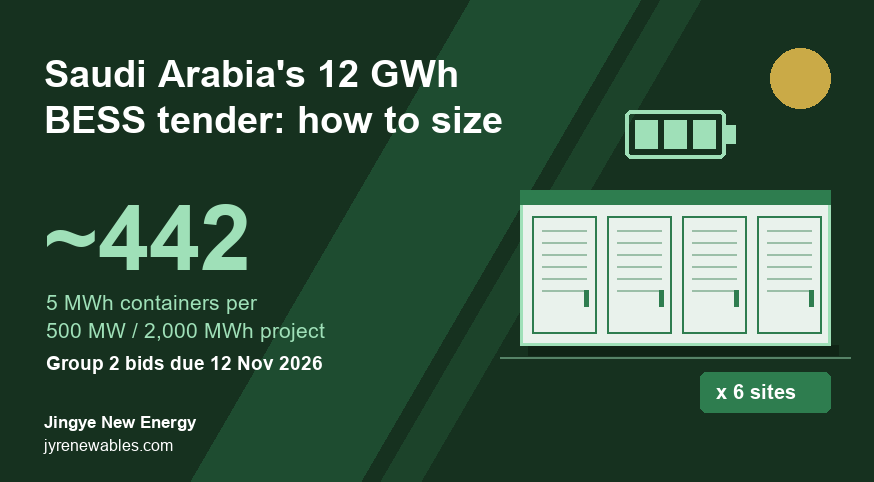
Saudi Arabia 12 GWh BESS Tender: How to Size Group 2 Bids (2026)
Saudi Arabia's Group 2 BESS tender (six 500 MW / 2,000 MWh sites, 12 GWh in total) now closes on 12 November 2026. By our estimate, each site needs about 442 of our 5.015 MWh containers to deliver 2,000 MWh at the grid, or up to 553 if 15-year degradation is built in upfront.
Oct. 30, 2026
How Many EV Chargers Does a Commercial Site Need?
If you are asking, “How Many EV Chargers Does a Commercial Site Need?”, I recommend using a five-step sizing method: measure parking demand, calculate daily energy consumption, estimate peak simultaneous charging, select AC or DC equipment, and verify electrical capacity. This approach helps businesses avoid underbuilding, reduce unnecessary capital expenditure, and create a scalable charging
Oct. 29, 2026
Transformer Requirements for Utility-Scale Battery Storage
Utility-scale battery storage depends on more than battery capacity. The battery energy storage system transformer must connect the battery racks and power conversion system to the utility grid safely. A complete design normally includes a medium voltage transformer, a step-up transformer, switchgear, protection, cooling, and monitoring. These parts control voltage, current, fault energy, and
Oct. 28, 2026
Battery C-Rate Explained for Commercial Energy Storage Systems
Battery C-rate determines how quickly a battery in commercial energy storage systems can charge or discharge. A high C-rate can deliver more power, but it may also increase heat, battery wear, and cooling needs. The correct C-rate supports peak shaving without reducing the service life of the battery energy storage system.
Oct. 27, 2026
AC Charging vs DC Fast Charging for Commercial Fleets
DC Fast EV Charger Manufacturer evaluations should begin with the fleet schedule, vehicle battery size, site power capacity, and total cost of ownership rather than charging speed alone. Commercial fleet managers want a practical comparison that explains which technology keeps vehicles available, controls operating costs, protects battery health, and scales as the fleet grows.
Let’s Get Started on Your New Energy Journey.