Nov 20, 2026
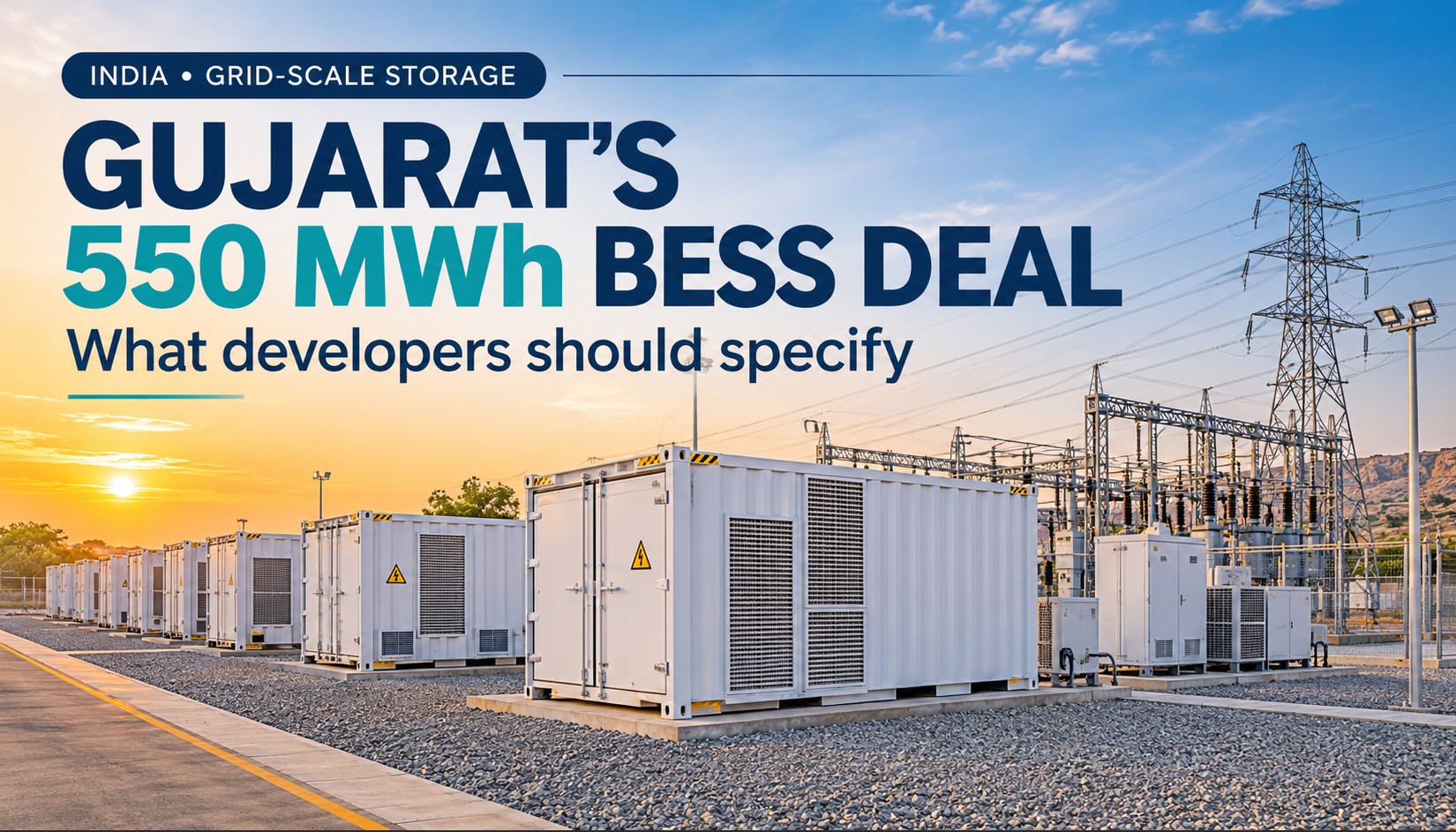
NLC India Renewables has signed a 275 MW / 550 MWh battery energy storage agreement with Gujarat Urja Vikas Nigam Limited. For EPCs and project developers, the project highlights the importance of matching power output, usable energy, battery configuration, grid connection and safety systems before selecting a containerized BESS supplier.
India's battery energy storage market is moving from individual project announcements toward a larger pipeline of utility-scale developments. One important recent development is the agreement between NLC India Renewables Limited (NIRL), a wholly owned subsidiary of NLC India Limited, and Gujarat Urja Vikas Nigam Limited (GUVNL).
The agreement covers 275 MW / 550 MWh of standalone battery energy storage capacity in Gujarat. It follows GUVNL's Phase IX procurement, which invited developers to establish 450 MW / 900 MWh of standalone BESS capacity through tariff-based competitive bidding. The agreement was disclosed by NLC India on November 18, 2026.
For battery manufacturers, EPC contractors, system integrators and project developers, the important question is not only how much battery capacity a project requires. It is how the complete system will deliver the contracted power and energy under actual site, grid and operating conditions.
The NLC India disclosure confirms that its renewable energy subsidiary has executed a Battery Energy Storage Purchase Agreement (BESPA) with GUVNL for a total of 275 MW / 550 MWh. The capacity is divided between two grid locations in Gujarat.
| Project location | Power capacity | Energy capacity | Energy-to-power ratio |
|---|---|---|---|
| Choraniya AIS Substation | 150 MW | 300 MWh | 2 hours |
| Virpore Substation | 125 MW | 250 MWh | 2 hours |
| Total | 275 MW | 550 MWh | 2 hours |
Table 1. Gujarat Phase IX project capacity. The two-hour figures are calculated by dividing energy capacity by power capacity. Source: NLC India's exchange disclosure, November 18, 2026.
The energy-to-power ratio is calculated using a simple formula:
Duration (hours) = Energy capacity (MWh) ÷ Power capacity (MW)
For this agreement: 550 MWh ÷ 275 MW = 2 hours.
This calculation describes the nominal energy-to-power ratio. It does not, by itself, confirm the usable energy at the grid connection point, the system's discharge efficiency or the actual dispatch schedule.
That distinction matters. A project may have a specified battery energy capacity, but the energy available to the grid can also depend on operating limits, auxiliary consumption, conversion losses, reserve requirements and battery degradation.
The Gujarat agreement is part of a much larger energy storage development pipeline. India's Central Electricity Authority (CEA), using data from the India Energy Storage Alliance (IESA), reported 195 BESS projects of at least 1 MWh in its September 30, 2026 assessment.
The report recorded approximately 198.44 GWh across operational, under-construction, awarded and tender-stage projects. This is a combined project pipeline, not a claim that all the capacity is already installed or operating.
| Project status | Number of projects | Energy capacity |
|---|---|---|
| In operation | 19 | 14.54 GWh |
| Under construction | 63 | 78.96 GWh |
| Awarded | 28 | 28.91 GWh |
| In tender stage | 85 | 76.02 GWh |
| Total | 195 | 198.44 GWh |
Table 2. India's BESS project status as of September 30, 2026. Values are converted from MWh to GWh and rounded to two decimal places. Source: Central Electricity Authority.
These figures show why developers should prepare for a market with projects at different stages. Some projects need immediate engineering and procurement. Others are still in tender preparation or evaluation.
For EPCs and procurement teams, this creates several practical priorities:
One important detail in the CEA report is that tender-stage projects can include renewable projects whose final storage capacity has not yet been determined. Developers should therefore distinguish confirmed project capacity from proposed or estimated pipeline figures.
The first step is to understand the difference between MW and MWh. MW describes the rate at which a battery system can charge or discharge. MWh describes the amount of energy it can store or deliver over time.
For example, a 100 MW / 200 MWh system has a two-hour nominal energy-to-power ratio. A 100 MW / 400 MWh system has a four-hour ratio. Both have the same power rating, but the second system has twice the energy capacity.
For project developers, this affects battery quantity, inverter selection, site layout, cooling requirements, cable sizing and overall system design.
These steps should be completed before a supplier quotation is treated as a final project design. A battery container's nameplate capacity is not automatically equal to the energy that can be delivered at the grid connection point.
Jingye New Energy lists a 5.015 MWh liquid-cooled containerized energy storage system. Using that published nominal energy capacity, a simple energy-only comparison can be made against the 550 MWh Gujarat agreement.
550 MWh ÷ 5.015 MWh per container = approximately 109.67 container-equivalents.
Rounding up gives 110 containers, with a combined nominal energy capacity of 551.65 MWh.
This is an illustrative energy comparison, not a proposed bill of quantities for the NLC project. It does not establish that Jingye equipment is selected for the project or that 110 containers would meet its technical requirements.
Actual project sizing must account for the AC or DC measurement boundary, usable state-of-charge window, conversion losses, auxiliary consumption, degradation allowance, operating reserve, availability guarantees and the contracted performance test.
For this reason, EPCs should request a complete system-level design rather than selecting equipment based only on the MWh number printed on a product datasheet.
A utility-scale BESS is more than a group of battery containers. It is an integrated electrical and control system. The technical specification should define how every major component works together.
The buyer should also define the exact system boundary for performance guarantees. For example, does the guaranteed energy refer to the battery DC terminals, PCS AC terminals or the grid connection point? These are different measurement locations and can produce different results.
Battery temperature affects operating performance, safety and long-term battery health. A suitable thermal management system helps control temperature differences between battery cells and supports stable operation.
Fire safety must also be considered at multiple levels. Buyers should review battery-level monitoring, early warning, automatic shutdown, gas or smoke detection, fire suppression, emergency response procedures and separation between equipment areas.
For a large project, the supplier should explain how the battery container's protection systems connect with the site's overall fire safety and emergency management plan. A feature listed on a product brochure should never replace a project-specific safety review.
Choosing a manufacturer based only on the lowest equipment price can create problems later. A reliable supplier should be able to explain its production process, testing procedures, system configuration and after-sales support.
Before placing an order, EPCs and project developers should request the following information:
Buyers should also check whether the supplier has experience with similar project sizes and operating environments. A supplier that can provide battery modules may not necessarily have the same responsibilities as a supplier delivering an integrated containerized system.
Clear responsibility between the battery manufacturer, PCS supplier, EPC and system integrator is important. The contract should identify who is responsible for system integration, commissioning, grid testing and performance verification.
Jingye New Energy provides battery energy storage solutions for utility-scale and commercial and industrial applications. Its product portfolio includes containerized BESS systems and liquid-cooled LFP energy storage cabinets.
For utility-scale applications, Jingye lists a 5.015 MWh liquid-cooled energy storage container. The published configuration uses 314Ah LFP cells, a nominal DC voltage of 1331.2V and a standard 20-foot container. The product page also lists rated power of up to 2.5 MW.
The container integrates thermal management, battery monitoring and multi-level fire protection. Buyers should review the complete datasheet and confirm the project-specific AC/DC boundary, usable capacity, operating conditions and integration requirements before selecting a configuration.
For commercial and industrial applications, Jingye also offers:
These cabinets are designed for applications such as peak shaving, load shifting, solar self-consumption and backup power. They serve a different project scale from a multi-container utility BESS.
Learn more about the 5.015 MWh containerized BESS and 261 kWh and 417 kWh C&I cabinets.
For project background, see the Huaxi Special Steel 15 MW / 30.09 MWh energy storage case study and how Jingye applies energy storage in heavy industry.
A clear project inquiry helps the supplier understand the required system and reduces unnecessary revisions. EPCs and developers should prepare a basic project information package before requesting a technical and commercial proposal.
Figure 1. Practical information flow for preparing a utility-scale BESS inquiry.
Where available, buyers should also provide the single-line diagram, site layout, grid connection information, performance requirements and tender technical specification.
These documents allow the manufacturer and system integrator to evaluate the required configuration more accurately. They also help identify technical gaps before the project reaches procurement or installation.
NLC India Renewables signed an agreement for 275 MW / 550 MWh of standalone battery energy storage capacity with GUVNL. The project is divided between the Choraniya and Virpore substations.
The nominal energy-to-power ratio is two hours, calculated by dividing 550 MWh by 275 MW. Actual delivered duration depends on usable energy, operating limits and system losses.
MW measures power output or input, while MWh measures stored energy. Both values are required to understand a battery system's power rating and storage duration.
A simple nameplate calculation gives 110 containers of 5 MWh each. However, final quantities depend on the actual container rating, usable energy, AC/DC conversion, degradation allowance and project performance requirements.
EPCs should review battery specifications, factory quality control, product certificates, system integration, cooling, fire protection, performance guarantees, warranty terms and after-sales support.
Utility-scale BESS systems are designed for grid-connected projects and larger power and energy requirements. C&I systems are generally used by factories, commercial buildings and industrial facilities for applications such as peak shaving, load shifting and backup power.
Buyers should prepare the required MW and MWh, discharge duration, project location, grid requirements, operating profile, applicable standards and expected project schedule.
Share your required MW, MWh, project location and technical specification with Jingye New Energy. Our team can review your project requirements and discuss suitable battery energy storage configurations.
Discuss Your BESS ProjectHebei Jingye New Energy Technology Co., Ltd, part of Jingye Group, makes utility-scale battery energy storage systems, commercial and industrial energy storage cabinets, and other new energy products for industrial and renewable energy applications.
Nov. 20, 2026
Gujarat's 550 MWh BESS Agreement: What EPCs Must Specify in 2026
NLC India has signed a 275 MW / 550 MWh battery energy storage agreement with Gujarat Urja Vikas Nigam Limited (GUVNL), strengthening India's growing grid-scale storage market. This article explains the key capacity, system design, safety and integration requirements that EPCs and project developers should evaluate when planning large-scale BESS projects.
Nov. 16, 2026
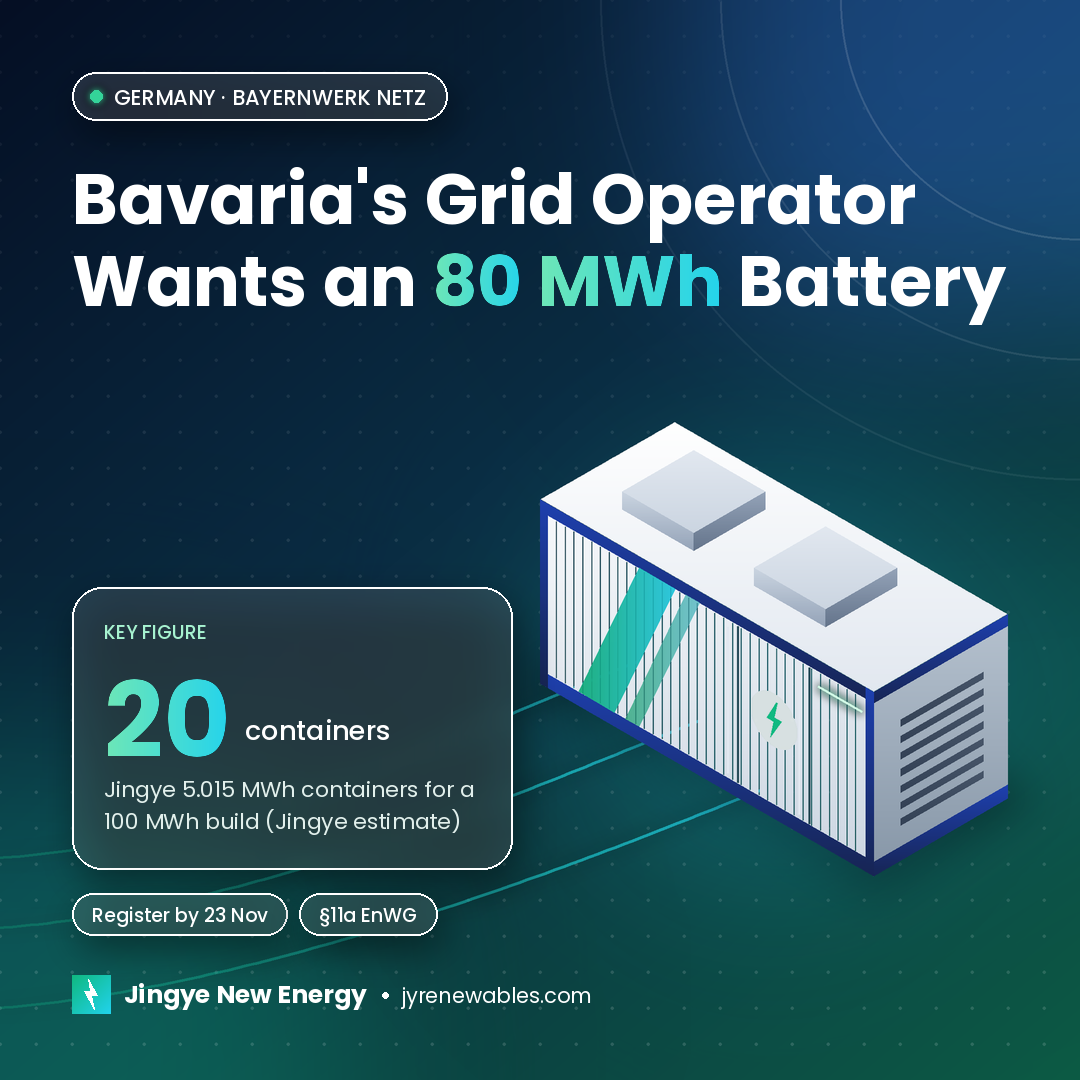
Bayernwerk 20 MW/80 MWh Grid-Serving Battery Tender: How to Size Your Bid (2026)
Bayernwerk Netz wants a 20 MW / 80 MWh grid-serving battery at its Speichersdorf substation, with registration closing on 23 November 2026. Sixteen 5.015 MWh containers just meet the minimum, while 20 containers give 100.3 MWh with a 25% margin.
Nov. 12, 2026
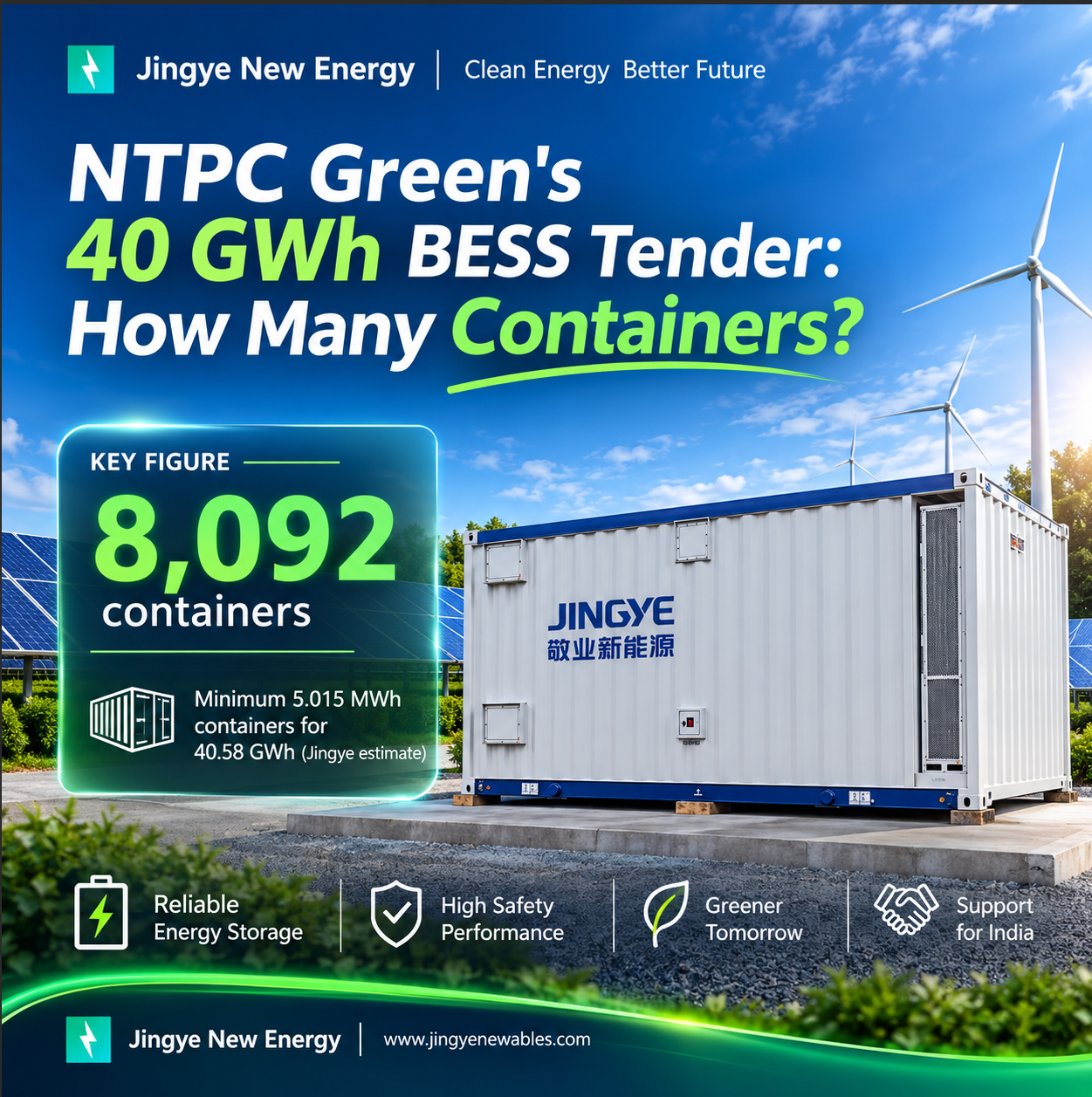
NGEL 40 GWh BESS Tender: Container Sizing, Qualification Rules and Bid Deadline (2026)
NTPC Green Energy's 10 GW / 40.58 GWh BESS tender closes on 8 December 2026 and needs at least 8,092 battery containers of 5.015 MWh. Here are the block sizes, qualification routes, turnover rules and bid steps.
Let’s Get Started on Your New Energy Journey.