Aug 24, 2026
Jingye New Energy | Reading time: 8 minutes
A commercial DC fast charger is a long-term infrastructure investment — for fleet depots, public charging networks, retail properties, and logistics hubs — and the specification that matters is not the kilowatt number on the datasheet. Charging speed, connector standard, cooling design, certification, and total cost of ownership over five years determine whether a station generates revenue or generates downtime. With commercial DC chargers ranging from 40kW to 240kW and beyond, and with the market shifting toward modular, OCPP-compliant, and future-proofed hardware, this guide covers the decisions that separate a profitable charging investment from a costly one.
DC fast chargers (also called Level 3 chargers) bypass the vehicle's onboard charger, converting AC to DC inside the charging unit and delivering power directly to the battery. A 120kW DC charger can add 200–300 km of range in 20–30 minutes, versus 4–12 hours for an AC charger. That speed is what makes DC charging commercially viable — but it also means higher equipment cost, more complex installation (480V three-phase service in North America, 400V in Europe), and higher ongoing maintenance expectations. The first decision is therefore not which charger, but whether the use case justifies DC at all: vehicles parked overnight favor AC; vehicles turning around between shifts, or serving the public, favor DC. For fleet depots, public charging hubs, highway service areas, and high-traffic retail, DC is the revenue-bearing choice.
Power output determines charging speed, equipment cost, and grid requirements. Matching power to the actual use case — not to the largest number available — is the core sizing rule:
|
Power class |
Typical application |
Charging speed |
|
40–60kW |
Hotels, shopping centers, municipal parking, small depots |
~100–150 km range in 30 min |
|
80–120kW |
Public charging stations, logistics fleets |
20–80% in 20–30 min |
|
120–180kW |
Busy urban hubs, commercial fleets |
Dual-gun models charge two vehicles |
|
180–240kW+ |
Highway service areas, high-traffic hubs, heavy-duty fleets |
80% in 10–20 min |
Two practical rules: match power to the vehicles you actually serve (their charging curves, not the charger's headline number), and plan for 20–30% headroom for fleet growth. A modular charger lets you add power modules later rather than replacing the unit — which is why modular design is now a standard procurement requirement.
The connector standard must match the vehicles and the network, and it varies by region: CCS1 (North America), CCS2 (Europe, Australia, Middle East), GB/T (China), CHAdeMO (Japan), with NACS adoption expanding in North America. Before issuing a purchase order, confirm which standard your target vehicles require, and consider dual-gun or multi-standard configurations for mixed fleets. Compatibility mistakes are the most expensive error in EV charging procurement — a charger with the wrong connector is a charger that cannot be used.
Operators who have run charging networks for years rarely talk about kilowatts — they talk about cooling, connectors, and environmental ratings:
Commercial DC chargers must meet regional safety and interoperability standards. For buyers sourcing from overseas manufacturers — where most high-power chargers are produced — the certification requirement is critical:
Purchase price is 25–40% of the real cost of a commercial DC charger. The five-year calculation includes installation, energy, maintenance, and software:
|
Cost category |
Typical range (per 120kW unit) |
|
Hardware |
$15,000–25,000 |
|
Installation (site prep, transformer, trenching) |
$8,000–20,000+ |
|
Energy over 5 years |
$30,000–60,000 |
|
Maintenance over 5 years |
$3,000–8,000 |
|
Software/CSMS over 5 years |
$2,000–6,000 |
A charger that is 10% cheaper at purchase but 3% less efficient and requires one extra service visit per year costs more over five years. The right vendor questions are not about the datasheet — they are about modular upgrades, firmware updates, remote diagnostics, spare parts lead time, and a service network that keeps stations online.
As grid capacity becomes a bottleneck in high-density areas, commercial charging is converging with energy storage. Pairing DC fast chargers with battery storage and solar (photo-storage-charge integration) lets sites charge during low-rate periods, discharge during peak demand, and avoid expensive grid upgrades. Jingye's energy storage systems — from C&I storage cabinets to containerized BESS — are designed for exactly this integration, allowing charging operators to build a complete energy infrastructure rather than a standalone charger. For the cost framework behind storage investment, see our battery energy storage system cost guide 2026.
Hebei Jingye New Energy Technology Co., Ltd (Jingye New Energy) is a new energy enterprise integrating R&D, manufacturing, sales, and operation, established in 2023 with a focus on one-stop energy storage and EV charging solutions. The company operates a 15 GWh module and PACK production line and produces commercial DC fast EV chargers across the 40–240kW range, alongside C&I energy storage cabinets, containerized BESS, commercial vehicle batteries, and cell contact systems. Jingye holds IATF 16949 certification, operates a CNAS-certified laboratory, and supports IEC/CE compliance for global export. Deployed projects include grid-scale storage plants and commercial and industrial energy storage systems, giving buyers a manufacturer with both product breadth and real installation track record.
Contact Jingye New Energy with your site type, target vehicles, power requirement, and grid conditions to receive a specification-matched quote and compliance documentation for commercial DC fast chargers.
Oct. 20, 2026
NTPC Khavda 3,300 MWh BESS Tender: How Many Containers You Really Need (2026)
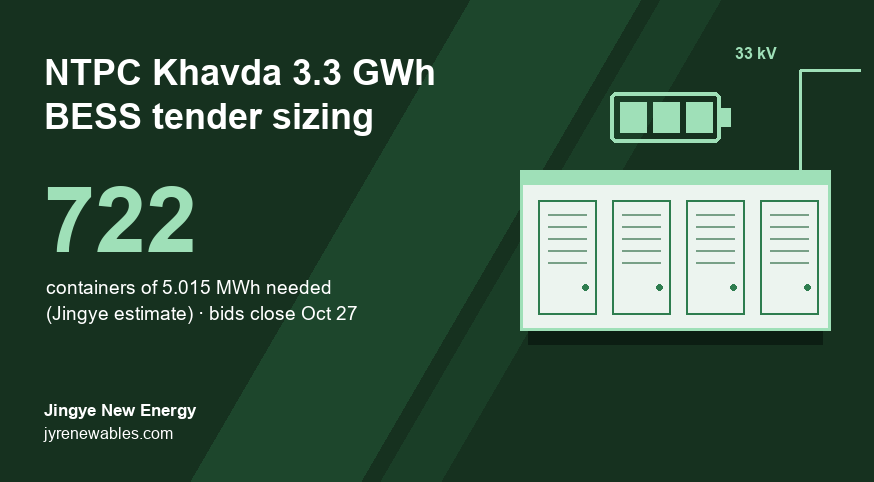
NTPC Green Energy's 1,100 MW / 3,300 MWh Khavda battery tender closes on October 27, 2026. Because capacity is counted as AC energy at the grid point, we estimate it needs about 722 containers of 5.015 MWh, roughly 10% more installed battery than the headline figure.
Oct. 20, 2026
Battery Energy Storage System Architecture: Key Components Explained
A battery energy storage system architecture determines how safely and efficiently a BESS stores, controls, and delivers electricity. The main challenge for overseas buyers is choosing the right structure without creating avoidable cost, safety, or integration problems.
Oct. 19, 2026
Battery Capacity Fade in Commercial Energy Storage Systems
Battery capacity fade in commercial energy storage systems reduces the amount of energy a site can store and deliver. This battery degradation can increase demand charges, reduce backup time, and change the return on investment.
Let’s Get Started on Your New Energy Journey.