Aug 03, 2026
In today’s energy-dependent world, efficient power storage solutions are more critical than ever. The emergence of the 261KWH Energy Storage System, particularly the C&L Energy Storage Cabinet, addresses the pressing need for robust and reliable energy management. Users often face scenarios of power shortages, soaring electricity bills, and unreliable energy sources—all of which can significantly affect daily living and operational efficiency. By integrating advanced energy storage technology, the C&L Energy Storage Cabinet provides an effective solution—offering a seamless way to store and manage energy for both residential and industrial applications.

The 261KWH Energy Storage System is designed to store electricity generated from renewable sources or from the grid, making it available for use during peak demand times or power outages. The core of this system lies in its ability to provide a buffer against fluctuations in energy supply and demand, enhancing reliability and efficiency.
It operates using lithium-ion battery technology, which has been shown to have a cycle life of up to 10,000 charges, translating to over 27 years of optimal performance under standard conditions. This remarkable lifespan is a defining feature for businesses and households that rely on consistent energy availability.
The versatility of the 261KWH Energy Storage System makes it suitable for a range of applications, including:
The 261KWH Energy Storage System offers several advantages:
To fully utilize your 261KWH Energy Storage System, consider reviewing the user manual that accompanies your C&L Energy Storage Cabinet. Familiarize yourself with proper installation techniques and energy management strategies specific to your energy needs. Additionally, it may be beneficial to explore user reviews and case studies online to understand how similar customers have optimized their systems.
1. How does the 261KWH Energy Storage System operate?
The system stores energy from various sources and discharges it as needed, balancing supply with demand effectively.
2. What are the major benefits of switching to this energy storage solution?
The primary benefits include reduced energy bills, improved energy reliability, and a lower carbon footprint.
3. Is the installation process difficult?
While most users can install it with basic tools following the user guide, professional installation is recommended for optimal performance.
Are you looking to enhance your energy management strategy? We recommend exploring the full capabilities of the C&L Energy Storage Cabinet by reviewing the official documentation or contacting Jingye for potential trials or installations. Engaging with expert guidance will help you navigate your energy storage needs effectively.
By embracing the 261KWH Energy Storage System, users not only address current energy challenges but also take a step toward more sustainable living and operational excellence. The time for innovative energy solutions is now; don't miss out on the opportunity to transform your energy experience.
Oct. 30, 2026
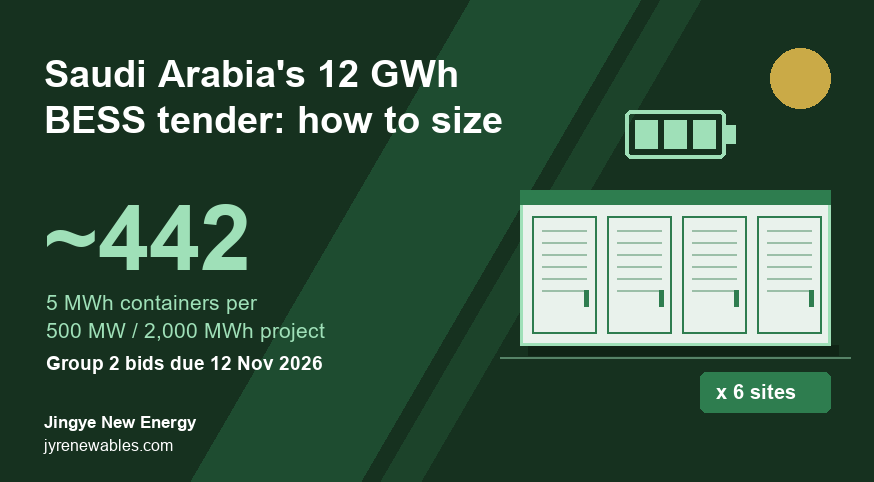
Saudi Arabia 12 GWh BESS Tender: How to Size Group 2 Bids (2026)
Saudi Arabia's Group 2 BESS tender (six 500 MW / 2,000 MWh sites, 12 GWh in total) now closes on 12 November 2026. By our estimate, each site needs about 442 of our 5.015 MWh containers to deliver 2,000 MWh at the grid, or up to 553 if 15-year degradation is built in upfront.
Oct. 30, 2026
How Many EV Chargers Does a Commercial Site Need?
If you are asking, “How Many EV Chargers Does a Commercial Site Need?”, I recommend using a five-step sizing method: measure parking demand, calculate daily energy consumption, estimate peak simultaneous charging, select AC or DC equipment, and verify electrical capacity. This approach helps businesses avoid underbuilding, reduce unnecessary capital expenditure, and create a scalable charging
Oct. 29, 2026
Transformer Requirements for Utility-Scale Battery Storage
Utility-scale battery storage depends on more than battery capacity. The battery energy storage system transformer must connect the battery racks and power conversion system to the utility grid safely. A complete design normally includes a medium voltage transformer, a step-up transformer, switchgear, protection, cooling, and monitoring. These parts control voltage, current, fault energy, and
Let’s Get Started on Your New Energy Journey.