Sep 20, 2026
For heavy trucks and commercial vehicles, a 24V LiFePO4 battery beats a traditional lead-acid battery on cycle life, cold-weather cranking, and weight, while a lead-acid unit still wins on upfront price — so choose LiFePO4 when you want years of maintenance-free starts, and lead-acid only when the lowest first cost is the sole priority. The market has already tilted toward lithium for fleet start-stop duty, and the reasons are practical, not promotional.
A commercial vehicle battery does two jobs: crank a big diesel or gas engine on cold mornings, and steady the low-voltage system while the truck idles, hotels, or runs auxiliary loads. When that battery fails, the truck does not move. Fleet operators feel this first as roadside callouts and then as lost shifts, so the buying question is really about total cost and reliability, not the sticker price.
The two chemistries diverge on the numbers that matter in daily fleet use.
Cycle life. A quality LiFePO4 battery delivers 2,000 to 4,000+ cycles; a lead-acid start battery is usually done well before 500 deep cycles and degrades fast if repeatedly discharged. Cranking power. Lithium holds its voltage under load, so it keeps cranking strongly even when partially drained. Lead-acid voltage sags as it weakens, and a weak unit may not start a cold engine. Weight. LiFePO4 is roughly half the weight of an equivalent lead-acid bank, which matters for payload and for roof- or chassis-mounted installs. Maintenance. Lead-acid needs watering, terminal cleaning, and venting for off-gassed hydrogen. LiFePO4 is sealed and needs none of that. Upfront cost. Lead-acid is cheaper to buy; LiFePO4 costs more up front but spreads that cost over many more service years.
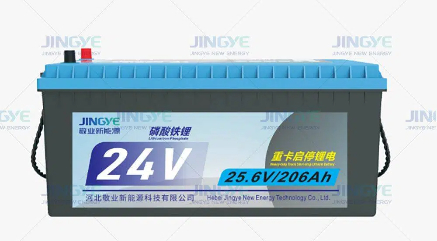
Cold is where the difference shows most. Lead-acid capacity falls sharply below freezing, and a marginal battery that started fine in September may not turn the engine in January. A purpose-built 24V LiFePO4 commercial vehicle battery such as Jingye New Energy's JY530 is engineered to operate down to -40°C and delivers a high starting current — the JY530 specifies 1,500A starting current at 25.6V / 206Ah (5.3kWh) — so it keeps cranking when temperatures drop. For fleets running northern routes or refrigerated trailers, that cold-start margin is the reason lithium wins.
A lighter battery helps payload and reduces strain on mounts and wiring. The bigger saving is labour: no watering, no terminal corrosion calls, no seasonal replacement. Over a three-to-five-year horizon, a LiFePO4 unit that outlasts three or four lead-acid replacements usually costs less per started year, even before you count the avoided breakdowns. That is the total-cost case fleet buyers actually underwrite.
Jingye New Energy's JY530 is a 24V LiFePO4 commercial vehicle battery built as a direct lead-acid replacement for heavy trucks and commercial vehicles. Beyond the -40°C rating and 1,500A starting current, it adds app, Bluetooth, and cloud monitoring so a fleet manager can see state-of-charge and health remotely — something a flooded lead-acid unit simply cannot do. It is OEM/ODM available, IEC/CE certified, and backed by Jingye's CNAS-accredited testing lab, the same quality system behind the company's 15GWh module PACK line.
For buyers comparing options, the practical rule is simple: if the truck must start reliably for years with zero maintenance and you value payload and remote monitoring, choose the JY530-class LiFePO4; if the only constraint is the lowest possible purchase price and the vehicle turns over quickly, a lead-acid unit still fills the gap.
LiFePO4 vs lead-acid for commercial vehicles is a total-cost and reliability decision, not a price tag. LiFePO4 wins on cycle life, cold-start power, weight, and maintenance-free service; lead-acid wins only on cheapest first cost. Jingye New Energy's JY530 24V LiFePO4 brings 1,500A starting current, -40°C operation, and cloud monitoring as a direct lead-acid replacement for heavy trucks.
Is LiFePO4 better than lead-acid for commercial vehicles?
For most fleet start-stop duties, yes. LiFePO4 lasts far longer (2,000–4,000+ cycles vs under 500 for lead-acid), cranks strongly under load, weighs about half as much, and needs no watering or terminal maintenance. Lead-acid only beats it on lowest upfront price.
How cold can a 24V LiFePO4 truck battery operate?
A purpose-built unit such as Jingye New Energy's JY530 is rated to operate down to -40°C and delivers 1,500A starting current, so it keeps cranking in winter when a weak lead-acid battery may fail.
What is the best battery for heavy truck engine starting?
For reliable cold-weather starts and a long service life, a 24V LiFePO4 commercial vehicle battery with a high starting current (1,500A class) and Bluetooth/cloud monitoring is the stronger choice. Lead-acid remains an option only when cheapest first cost is the sole priority.
Does a lithium commercial vehicle battery need maintenance?
No. A sealed LiFePO4 unit needs no watering, no terminal cleaning, and no venting, unlike flooded lead-acid. Jingye's JY530 adds app and cloud monitoring so health is checked remotely.
Can LiFePO4 replace lead-acid in my truck?
Yes, as a direct replacement if the voltage matches (24V for most heavy trucks) and the starting current meets the engine spec. The JY530 24V LiFePO4 is built exactly as a lead-acid replacement with 25.6V / 206Ah and 1,500A starting current.
Sep. 21, 2026
BESS Commissioning: Key Tests Before Commercial Operation
BESS commissioning confirms that a battery energy storage system is safe, reliable, and ready for commercial operation. A complete battery commissioning test checks the battery management system, power conversion system, and site controls before the asset serves the grid. Poor testing can cause failed grid connection tests, low round trip efficiency, unexpected shutdowns, or unsafe operating
Sep. 21, 2026
Energy Storage Capacity vs Power Rating in Utility-Scale BESS
Utility buyers often ask why a 100 MW battery can deliver less energy than expected, or why a 200 MWh system may fail to provide enough instantaneous power. The answer lies in utility-scale BESS energy storage capacity vs power rating: capacity determines duration, while power rating determines output speed. This guide explains how to size a battery energy storage system for grid services,
Sep. 20, 2026
LiFePO4 vs Lead-Acid Commercial Vehicle Battery: Which to Choose for Your Trucks?
A commercial vehicle battery does two jobs: crank a big diesel or gas engine on cold mornings, and steady the low-voltage system while the truck idles, hotels, or runs auxiliary loads.
Let’s Get Started on Your New Energy Journey.