Aug 04, 2026
A Battery Management System (BMS) monitors and manages the performance of a battery system. It ensures safety, longevity, and efficiency by controlling charge and discharge cycles and protecting against over-voltage, under-voltage, over-current, and temperature extremes.
The BMS continuously monitors the voltage and temperature of each cell within the 261kWh LFP battery system. It compares the data against pre-set safe operating limits.
Cell balancing is performed to ensure all cells are charged and discharged evenly. The BMS redistributes charge from more charged cells to less charged ones, extending battery life.
The BMS activates protective measures like disconnecting the battery from the load or charger if dangerous conditions are detected (e.g., over-voltage or over-temperature).
The BMS communicates with external systems such as inverters or energy management systems, sharing critical data and receiving commands for optimal performance.
The BMS logs operational data and performance metrics, which are essential for diagnosing issues and improving system efficiency over time.
In summary, the Battery Management System is crucial for the effective operation of a 261kWh LFP battery system. By understanding its functions, tools required, and potential pitfalls, you can ensure optimal performance and longevity. At Jingye, we prioritize providing comprehensive solutions to maximize your energy storage systems.
The BMS is one of the core parts of the 261kWh LFP battery energy storage system.
Oct. 30, 2026
Saudi Arabia 12 GWh BESS Tender: How to Size Group 2 Bids (2026)
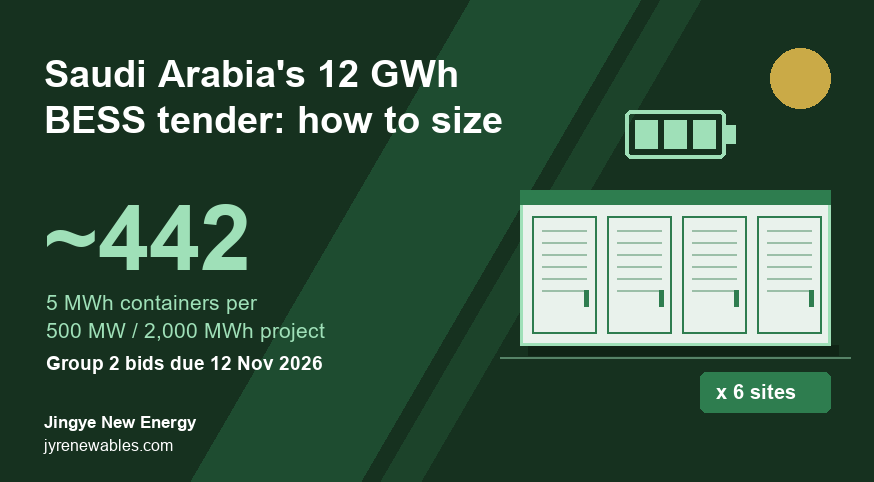
Saudi Arabia's Group 2 BESS tender (six 500 MW / 2,000 MWh sites, 12 GWh in total) now closes on 12 November 2026. By our estimate, each site needs about 442 of our 5.015 MWh containers to deliver 2,000 MWh at the grid, or up to 553 if 15-year degradation is built in upfront.
Oct. 30, 2026
How Many EV Chargers Does a Commercial Site Need?
If you are asking, “How Many EV Chargers Does a Commercial Site Need?”, I recommend using a five-step sizing method: measure parking demand, calculate daily energy consumption, estimate peak simultaneous charging, select AC or DC equipment, and verify electrical capacity. This approach helps businesses avoid underbuilding, reduce unnecessary capital expenditure, and create a scalable charging
Oct. 29, 2026
Transformer Requirements for Utility-Scale Battery Storage
Utility-scale battery storage depends on more than battery capacity. The battery energy storage system transformer must connect the battery racks and power conversion system to the utility grid safely. A complete design normally includes a medium voltage transformer, a step-up transformer, switchgear, protection, cooling, and monitoring. These parts control voltage, current, fault energy, and
Let’s Get Started on Your New Energy Journey.