Sep 07, 2026
When an energy storage project is evaluated, buyers often focus on capacity, efficiency, cycle life, price, and system configuration.
But another question deserves equal attention:
How was the equipment actually validated before delivery?
Laboratory testing provides an important bridge between product development and field deployment.
For energy storage manufacturers, a professional testing laboratory can help identify problems before products reach customers. For buyers, it provides an additional way to evaluate manufacturing and engineering maturity.
An energy storage system is a combination of electrical, chemical, thermal, mechanical, and control technologies.
A battery system can therefore require multiple types of validation.
Typical testing areas include:
Electrical performance
Electrochemical performance
Safety
Reliability
Environmental adaptability
Dimensional accuracy
Appearance inspection
Thermal management
Component performance
A single final inspection cannot fully represent this entire product lifecycle.
A mature testing system should not begin only after the product is assembled.
Jingye New Energy's testing laboratory describes a full-lifecycle approach covering incoming raw-material inspection, in-process component testing, and end-product type testing.
This creates three major checkpoints.
The objective is to prevent unsuitable materials from entering production.
Manufacturing processes and component quality are checked during production.
The completed product undergoes performance and safety-related validation.
This layered approach can reduce the possibility of defects moving from one stage to the next.
Energy storage systems are not always installed in ideal indoor environments.
Projects can operate in locations with:
High temperatures
Low temperatures
High humidity
Dust
Mechanical stress
Variable operating conditions
Therefore, environmental adaptability can become an important part of product validation.
A system that performs well under laboratory conditions still needs to be considered in relation to its intended operating environment.
| Application | Testing Priority | Buyer Concern |
|---|---|---|
| C&I storage | Electrical and thermal performance | Daily operating stability |
| Utility BESS | System reliability | Long-term operation |
| EV battery PACK | Mechanical and electrical validation | Vehicle integration |
| CCS components | Dimensional and electrical testing | Assembly consistency |
| Export projects | Compliance and documentation | Market access |
Consider a battery system containing hundreds or thousands of components.
If a problem is discovered only during final system testing, identifying the source can become complicated.
By testing components earlier, manufacturers can potentially detect issues before system integration.
For example, dimensional inspection of precision components can identify manufacturing deviations before assembly.
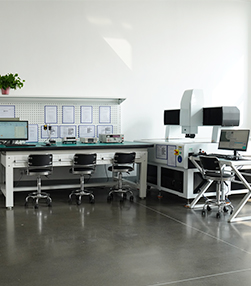
Jingye's laboratory uses more than 100 sets of professional testing equipment and includes automated optical measurement capabilities for precision dimensional control.
When evaluating a battery manufacturer, buyers should ask to see the manufacturer's testing structure rather than simply asking whether the company has a laboratory.
Important questions include:
What products are tested?
At which manufacturing stages?
Which parameters are measured?
Is testing performed internally?
Are test records retained?
Are environmental tests available?
How are failed products handled?
Can testing support customized designs?
The answers can provide a better picture of actual quality-control capability.
A laboratory should not function only as a final inspection department.
Its value increases when test results feed back into engineering and product development.
For customized energy storage systems, this becomes particularly important.
When a customer requests a different:
Capacity
Voltage platform
Communication protocol
Structural configuration
Thermal design
the manufacturer needs engineering validation before mass production.
Jingye New Energy's customization process includes engineering design, manufacturing, system integration testing, safety testing, communication testing, customer acceptance, and after-sales support.
Customers rarely see the testing process directly.
They usually experience its results through:
Product consistency
Fewer commissioning problems
Stable operation
Faster troubleshooting
More complete documentation
This is why laboratory capability should be considered as part of the supplier's overall reliability rather than as a standalone factory feature.
Jingye New Energy operates a CNAS-accredited testing laboratory supporting its energy storage, power battery, and CCS product lines.
The laboratory covers physical and chemical analysis, electrochemical performance, safety and reliability, environmental adaptability, and precision dimensional inspection.
For international buyers, this testing infrastructure can provide additional confidence when evaluating customized battery products and energy storage systems.
If you are evaluating an energy storage manufacturer and need information about testing, product validation, or customized system development, contact Jingye New Energy.
Email: jyxny@jyrenewables.com
Email: allen.meng@jyrenewables.com
Website: www.jyrenewables.com
Oct. 22, 2026
EV Charger Preventive Maintenance: Key Practices for Long-Term Reliability
EV charger preventive maintenance helps charging operators protect uptime, safety, and revenue over many years. A planned service program is more reliable than waiting for a fault after a vehicle cannot charge. This guide explains DC fast charger maintenance, EV charging station inspection, and charging cable inspection in simple steps.
Oct. 20, 2026
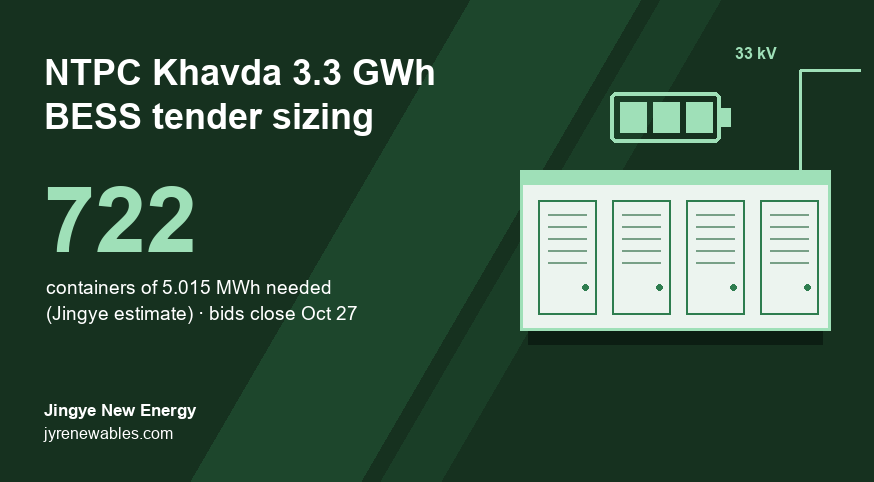
NTPC Khavda 3,300 MWh BESS Tender: How Many Containers You Really Need (2026)
NTPC Green Energy's 1,100 MW / 3,300 MWh Khavda battery tender closes on October 27, 2026. Because capacity is counted as AC energy at the grid point, we estimate it needs about 722 containers of 5.015 MWh, roughly 10% more installed battery than the headline figure.
Oct. 20, 2026
Battery Energy Storage System Architecture: Key Components Explained
A battery energy storage system architecture determines how safely and efficiently a BESS stores, controls, and delivers electricity. The main challenge for overseas buyers is choosing the right structure without creating avoidable cost, safety, or integration problems.
Let’s Get Started on Your New Energy Journey.