Nov 04, 2026
DC fast charging helps electric vehicle drivers add useful range during a short stop, but charging speed can affect battery temperature, charging behavior, and long-term capacity. Understanding how DC fast charging affects EV battery health, choosing the best DC fast charger for battery longevity, and managing DC fast charging battery degradation can help drivers save time without creating unnecessary battery stress. The goal is not to avoid fast charging completely. It is to use it at the right time, with the right power, and under suitable temperature conditions.
DC fast charging, also called DCFC, sends direct current from the charging station to the vehicle battery. Unlike AC charging, the vehicle does not need to convert the power from alternating current before storing it. This allows a higher charging rate and shorter charging sessions.
Charging power is measured in kilowatts, or kW. A 150 kW charger may deliver energy much faster than a 7 kW home AC charger, but the actual speed depends on several factors:
EV battery health describes how much energy the battery can store compared with its original usable capacity. A new 80 kWh battery may not always provide 80 kWh to the driver because manufacturers reserve a small buffer to protect the cells. Over time, normal chemical aging reduces available capacity.
Battery aging has two main forms:
High temperature, high charging power, long periods at a very high SOC, and deep discharge can increase battery stress. Modern EVs use software and thermal systems to control these risks, but charging habits still matter.
A responsible DC Fast EV Charger Manufacturer designs the charger to communicate with the vehicle’s BMS. The charger does not simply push its maximum rated power at all times. It follows the charging request sent by the vehicle.
The charging process normally has two stages:
At a lower or medium SOC, the vehicle may accept a relatively high current. The charger increases the battery’s energy level quickly while the BMS monitors voltage, temperature, and current.
As the battery approaches its upper voltage limit, the vehicle reduces current. This is why a vehicle may charge from 10% to 60% quickly but take much longer to move from 80% to 100%.
This gradual reduction is known as the charging taper. It protects the battery from excessive voltage and heat. For road trips, charging to approximately 70% or 80% is often more time-efficient than waiting for 100%, unless the extra range is necessary.
Jingye DC fast charging systems can be evaluated by the same technical criteria used across the industry:
These functions do not remove natural battery aging, but they help prevent unsafe charging conditions and unnecessary electrical stress.
Normal DC fast charging does not automatically damage an EV battery. Battery wear depends on the complete operating pattern, not only on whether DC charging is used.
A vehicle that uses DC fast charging once or twice a month for long-distance travel may experience a different aging pattern from a vehicle that receives multiple high-power charging sessions every day in hot weather. The key factors are temperature, charging frequency, power level, SOC, and the vehicle’s thermal management system.
Research and field data show that battery degradation varies by vehicle model and use pattern. Geotab’s analysis of more than 22,000 electric vehicles reported an average degradation rate of about 1.8% of battery health per year in its updated analysis. The report also found that climate, mileage, age, and charging behavior influence results.
In laboratory research, high temperature and high SOC can increase side reactions inside lithium-ion cells. These reactions may cause:
Most EVs reduce charging power when the battery becomes too hot or too cold. This may make the session slower, but it is an important protection method.
Drivers can reduce avoidable battery stress by following a simple charging routine.
DC fast charging is usually most effective when the battery is not close to full. Many vehicles charge quickly from around 10% to 60% or 70%, then reduce power as SOC rises.
For a road trip, two shorter charging stops may take less total time than one long stop to reach 100%. The correct target depends on the next station, weather, traffic, and the vehicle’s range.
Many EVs can precondition the battery before reaching a fast charger. The vehicle warms or cools the battery to a suitable operating range. This can improve charging speed and reduce stress caused by charging a very cold or very hot pack.
Drivers should enter the fast-charging station as the navigation destination when the vehicle supports automatic preconditioning.
Keeping a battery at a high SOC for many hours can increase chemical stress, especially in hot conditions. For daily use, follow the charging limit recommended by the vehicle manufacturer. Some vehicles recommend 80% for regular use, while others use different limits because of their battery chemistry and software design.
After towing, high-speed driving, or driving in high outdoor temperatures, the battery may already be hot. The BMS may lower charging power automatically. Waiting for the battery to cool, when practical, can improve the charging session.
The vehicle owner’s manual is the most reliable source for the recommended SOC limit, charging frequency, and battery care instructions. Lithium iron phosphate batteries, nickel-manganese-cobalt batteries, and other chemistries may use different charging guidance.
A damaged connector, loose contact, dirt, water intrusion, or overheated cable can create resistance and reduce charging performance. Stop the session if the connector becomes unusually hot, the charger shows a fault, or the cable has visible damage.
When comparing charging equipment, buyers should look beyond the maximum kW number. A reliable charger needs to provide controlled power and clear operating information.
| Feature | Why it matters |
|---|---|
| BMS communication | Allows the vehicle to request the correct current and voltage. |
| Dynamic power control | Adjusts output when the battery, connector, or grid reaches a limit. |
| Liquid or forced-air cooling | Controls heat in power modules and charging cables. |
| Temperature sensors | Detects abnormal heat at the connector and internal components. |
| Insulation monitoring | Helps identify electrical leakage before it becomes a safety hazard. |
| Remote diagnostics | Allows operators to identify faults and reduce charger downtime. |
| OCPP support | Enables communication between the charger and a management platform. |
A high-power charger is useful only when the vehicle, site electrical system, and charging cable can support the rated output. For example, a 240 kW charger cannot make a vehicle that accepts only 100 kW charge at 240 kW.
DC fast charging is used wherever drivers need more energy in less time. Common applications include:
Highway charging sites support long-distance travel. Drivers can add enough range for the next part of a trip while taking a short break.
In cities, fast chargers support drivers who do not have access to private parking or home charging. Retail centers, parking garages, and service areas can use charging hubs to increase customer dwell time.
Delivery vans, taxis, buses, and service vehicles may need several charging sessions during a working day. Fleet operators can use charging software to schedule vehicles, monitor energy use, and reduce peak electricity demand.
Office parks, hotels, apartment developments, and logistics facilities can combine AC chargers for longer stays with DC fast chargers for vehicles that need a quick turnaround.
Mobile charging units and high-power charging systems can support roadside assistance, temporary worksites, and locations where permanent charging infrastructure is not yet available.
Professional equipment can improve more than charging speed. It can support safety, uptime, service management, and predictable operating costs.
The correct charger should match the vehicle fleet, local electrical supply, expected daily sessions, climate, parking layout, and software requirements. Selecting a charger only because it has the highest power rating can increase installation costs without improving real-world charging time.
A practical installation plan should include the following steps.
For a commercial site, total cost of ownership is more useful than the purchase price alone. Include installation, electrical upgrades, network service, maintenance, payment fees, energy demand charges, and replacement parts.
Charging data can show whether a station is working as expected and whether charging behavior may be creating avoidable stress.
A single slow session does not prove that a battery is damaged. Cold weather, a high SOC, a busy site, a weak grid connection, or vehicle software can all reduce charging power. Operators should look for repeated patterns across many sessions.
For accurate battery and charging information, readers should review technical sources instead of relying only on advertising claims:
Battery behavior differs by model, chemistry, climate, software, and driving pattern. These sources provide useful industry context, but the vehicle owner’s manual and battery warranty remain the final references for a specific vehicle.
Some EVs are designed to support frequent DC fast charging, but daily high-power charging may create more heat and battery stress than slower AC charging. If home or workplace AC charging is available, it may be better for routine charging. Use DC fast charging when speed is important and follow the vehicle manufacturer’s limits.
Battery capacity naturally declines with time and use. Frequent high-power charging, high temperature, and long periods at a high SOC can contribute to faster aging in some conditions. The actual effect depends on battery chemistry, cooling design, software controls, climate, and charging behavior.
For many EVs, 10% to 80% is faster and more practical because charging power usually tapers near the upper SOC range. However, the best range depends on the trip and the vehicle’s charging curve. Charging to 100% is acceptable when the extra range is needed, but avoid leaving the vehicle fully charged for a long time unless the manufacturer recommends it.
Yes, but charging may be slower. Cold batteries have lower charging acceptance, so the vehicle may limit power to protect the cells. Battery preconditioning before arrival at the charger can improve the session.
Check the vehicle’s maximum DC charging rate and typical charging curve. A charger rated above the vehicle’s limit may still work, but the vehicle will not necessarily charge faster. For a fleet, choose power based on vehicle schedules, site capacity, and the number of sessions per day.
Modern EVs use a BMS to control voltage, current, and SOC. The charger communicates with the vehicle and stops or reduces output when the vehicle requests it. Drivers should still use certified equipment and stop a session if the system displays a fault or safety warning.
Many vehicles show a battery health estimate through the dashboard or mobile application. A dealer or qualified service center can perform a diagnostic test. Compare results over time instead of judging battery health from one charging session or one drop in driving range.
Review safety certifications, BMS communication, connector compatibility, cooling design, warranty coverage, OCPP or network support, service response time, spare-parts access, and field performance. Ask for installation requirements and real operating data rather than relying only on the maximum kW rating.
Start by checking your EV owner’s manual for the recommended daily SOC, maximum DC charging rate, and battery preconditioning instructions. Then compare charging stations by output stability, protection systems, maintenance support, and total cost of ownership. For homes, fleets, dealerships, and commercial sites, contact Jingye to discuss a DC fast charging solution matched to vehicle demand, site power, and operating conditions.
Used correctly, DC fast charging can reduce travel delays without making battery care complicated. Monitor temperature and SOC, charge only as fast as the vehicle can accept, avoid unnecessary time at 100%, and use professional equipment. These steps help drivers get the time-saving benefits of fast charging while supporting long-term EV battery health.
Nov. 05, 2026
All-in-One vs Separate PCS Energy Storage Systems
Energy Storage Cabinets are no longer selected only by battery capacity. Buyers also need to evaluate power conversion, safety controls, thermal management, installation time, maintenance access, expansion options, and long-term operating cost. The central purchasing decision is whether to choose an All-in-One energy storage system or a Separate PCS architecture.
Nov. 05, 2026
AI Data Center Battery Storage: How to Size the BESS in 2026
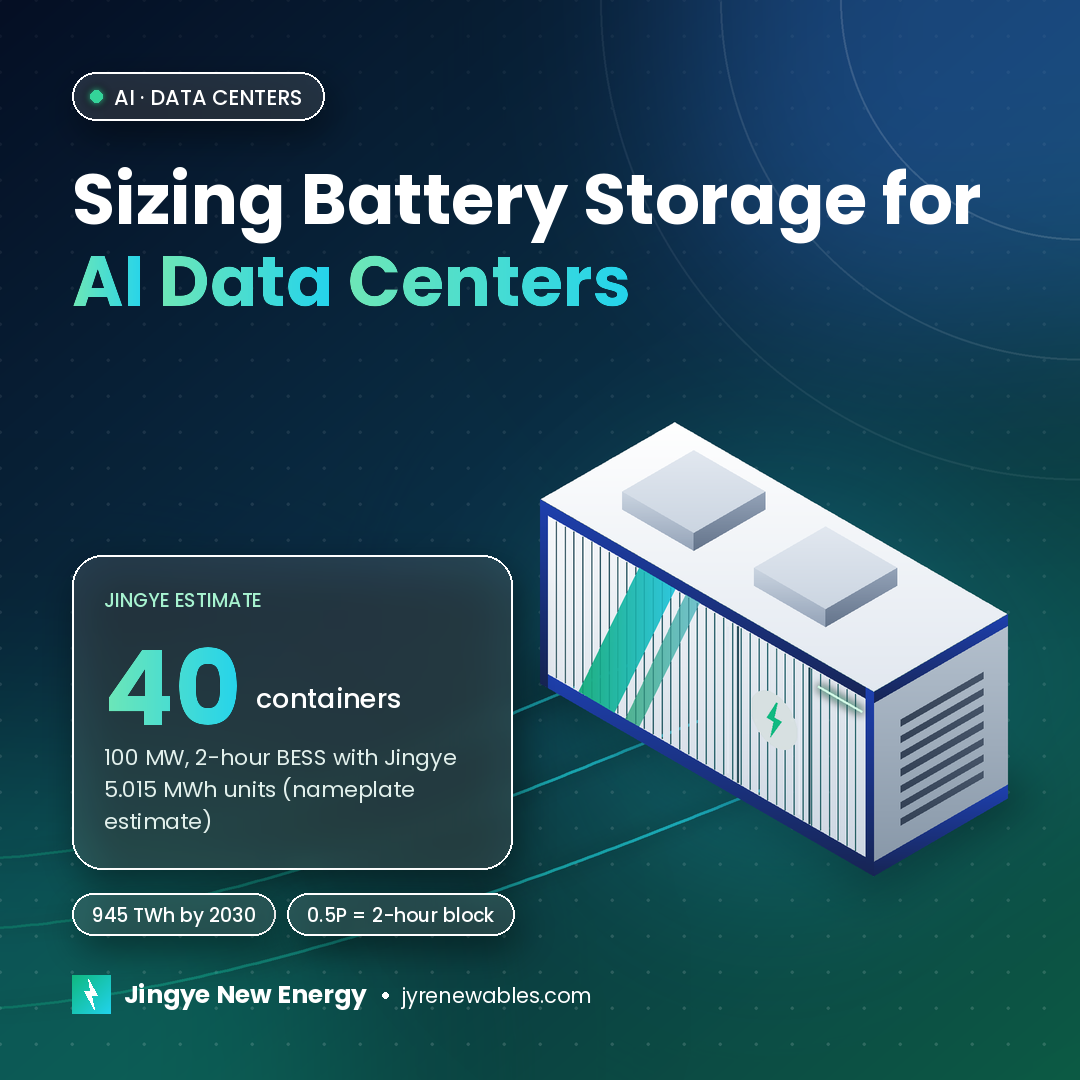
AI data centers use battery storage to smooth GPU load swings, ride through outages and manage grid limits. By our estimate, a 100 MW, 2-hour BESS needs 40 Jingye 5.015 MWh containers, and a 4-hour system needs 80.
Nov. 04, 2026
Brazil Battery Storage Auction LRCAP 2026: How to Size a 4-Hour Bid
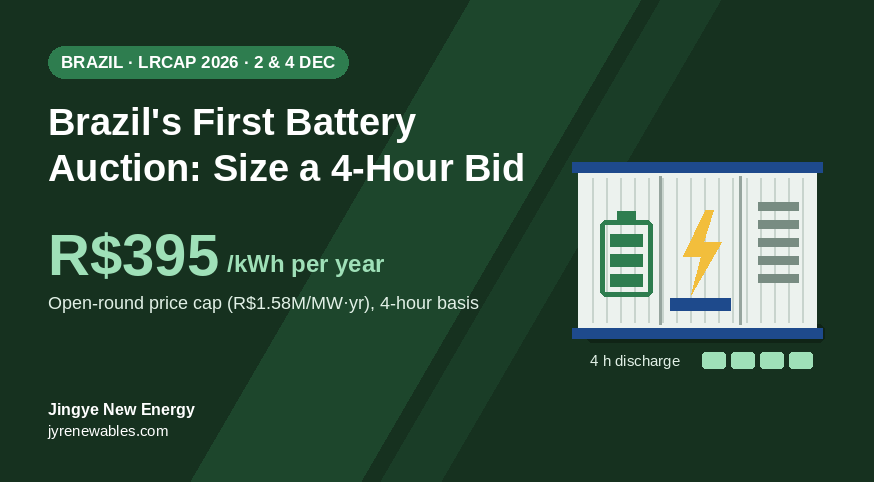
Brazil's first battery capacity auctions on 2 and 4 December 2026 cap prices at R$1.58–1.76 million per MW per year, about R$395–440 per kWh of 4-hour storage. By our estimate, a 100 MW bid needs 80–111 Jingye 5.015 MWh containers.
Let’s Get Started on Your New Energy Journey.