Oct 27, 2026
DC Fast EV Charger Manufacturer evaluations should begin with the fleet schedule, vehicle battery size, site power capacity, and total cost of ownership rather than charging speed alone. Commercial fleet managers want a practical comparison that explains which technology keeps vehicles available, controls operating costs, protects battery health, and scales as the fleet grows.
This guide brings together the main information fleet purchasing teams typically seek in leading search results: charging speed, installation requirements, daily operating experience, battery impact, reliability, financial performance, and suitability for different commercial applications.

The most important question is not whether AC or DC charging is technically better. The practical question is how long each vehicle remains at the depot, how far it travels each day, and whether it can charge during planned downtime.
A delivery van that returns to the depot for 10 hours does not necessarily benefit from a high-power DC charger. Conversely, a taxi, shuttle, bus, or regional delivery vehicle may lose revenue if it must remain parked for several hours after every route.
With AC charging, the charger supplies alternating current to the vehicle. The vehicle's onboard charger converts AC power into direct current before storing it in the battery. The output is therefore limited by the onboard charger's rating.
With DC fast charging, the conversion takes place inside the charging station. The station delivers controlled direct current to the battery through the vehicle's charging system. This enables substantially higher power, although the vehicle battery, thermal system, state of charge, and site power capacity still determine the actual charging rate.
| Parameter | AC charging | DC fast charging | Fleet purchasing implication |
|---|---|---|---|
| Typical output range | 7 kW to 22 kW for common commercial installations | 30 kW to 180 kW for many fleet depots, with higher ratings available | Higher DC output reduces parking time but increases infrastructure requirements |
| Power conversion location | Inside the vehicle onboard charger | Inside the charging station | Vehicle onboard charger rating is critical for AC, while station and battery limits are critical for DC |
| Typical charging duration | Several hours for a substantial battery refill | About 20 minutes to 2 hours depending on battery size, starting state of charge, power, and tapering | Use AC for predictable long dwell periods and DC for short operational windows |
| Installation complexity | Usually lower, particularly at moderate power | Usually higher because of electrical capacity, cooling, protection, and civil works | Confirm transformer capacity and utility requirements before selecting DC power |
| Equipment cost | Generally lower per charging port | Generally higher per charging port | Compare total site cost and vehicle productivity rather than charger purchase price alone |
| Site power demand | Lower for each port, but many ports can create a large combined load | High demand concentrated into fewer charging sessions | Load management and demand charge analysis are essential for both technologies |
| Best use case | Overnight depot charging, employee fleets, long-stay parking, and predictable schedules | High-utilization vehicles, short breaks, route recovery, and rapid turnaround operations | Select based on dwell time and revenue impact |
| Battery charging behavior | Lower power is often gentler during long charging periods | Higher thermal and electrical loads require effective battery and charger controls | Use charging limits and thermal management policies to support battery longevity |
| Scalability | Easy to add more ports if spare electrical capacity exists | May require staged expansion, additional transformers, or energy storage | Design the electrical system for the planned fleet size, not only the first deployment |
A 120 kW DC charger may not deliver 120 kW throughout the session. Charging power commonly declines as the battery approaches a high state of charge. The vehicle may also restrict power because of battery temperature, cell balancing, battery age, or software limits.
AC chargers generally require less power electronics and can be installed at a lower equipment cost. They may also use existing low-voltage electrical infrastructure when the site has adequate spare capacity. This makes AC attractive for fleets that can charge during long overnight or weekend parking periods.
DC fast charging requires greater investment, but faster energy delivery may increase vehicle utilization. A fleet should calculate the financial value of returning a vehicle to service earlier. For a revenue-generating vehicle, one additional route or shift may justify a higher charging investment.
The purchasing team should compare both options over the expected service life. The calculation should include electricity, demand charges, installation, maintenance, software, downtime, battery replacement risk, and the cost of vehicles waiting for energy.
In overnight depot use, AC charging can provide a consistent operating routine. Vehicles arrive, connect to assigned ports, charge during low-activity hours, and depart after a scheduled inspection. The lower charging rate can also simplify thermal management and reduce the likelihood of severe demand spikes.
However, AC becomes less practical when vehicles arrive with low battery levels and leave again shortly afterward. If several vehicles return late at the same time, the fleet may not have enough hours to recharge every vehicle before the next departure.
DC fast charging can help a fleet recover from unexpected energy shortages, extend vehicle operating hours, and support vehicles that cannot remain parked overnight. In daily operation, the main benefit is usually schedule flexibility rather than the fastest possible charging session.
Actual results depend on the vehicle and site. A vehicle may receive high power at a low state of charge and then taper as the battery fills. Drivers and dispatchers should therefore plan around the energy needed for the next route instead of waiting for a full charge whenever possible.
Battery degradation is influenced by temperature, average state of charge, depth of discharge, charging frequency, driving conditions, and battery management software. DC fast charging is not automatically harmful, but repeated high-power charging can increase thermal stress when the battery cooling system or operating policy is inadequate.
Charging stability affects fleet productivity more directly than peak power. A charger that delivers lower power consistently may be more valuable than a high-power unit that experiences frequent communication faults, overheating, payment errors, or connector interruptions.
During evaluation, request evidence about uptime, fault recovery, remote monitoring, firmware updates, connector durability, and service response time. A controlled site trial should measure successful sessions, interrupted sessions, average delivered energy, restart time, and support response.
Many fleet projects fail during planning because the charging equipment is selected before the site power assessment is complete. The electrical service must support charging together with buildings, refrigeration, lighting, heating, workshops, and other operating loads.
Smart charging can distribute energy across vehicles according to departure time, battery level, route priority, and electricity price. This is important for AC and DC installations because the combined load of several chargers can exceed the site's planned capacity.
Charging performance is affected by how easily drivers can reach the connector, park the vehicle, and complete the session. Poor cable placement, inadequate turning space, and blocked charging bays can create more delay than insufficient charger power.
AC charging is often the best starting point for passenger cars, light commercial vans, company vehicles, and municipal fleets that return to a depot for most of the night. It is also suitable when the project has a limited budget, moderate daily mileage, and sufficient parking time.
DC fast charging is more appropriate when vehicles must complete several routes per day or cannot remain parked long enough for AC charging. It can also provide resilience when schedules change and vehicles need additional energy between planned charging periods.
Many commercial fleets benefit from assigning AC chargers to vehicles with predictable overnight schedules and DC chargers to vehicles with high mileage or variable departure times. This approach can reduce the number of high-power chargers while preserving operational flexibility.
A practical hybrid design may include:
Purchasing teams should create a common specification that allows different suppliers to be compared fairly. The specification should describe the required operating result rather than only requesting a particular charger power.
The first 90 days should be treated as an operational validation period. Data from this period can show whether the selected mix of AC and DC charging reflects real fleet behavior.
Choose AC charging when vehicles regularly remain parked for six or more hours, daily energy use is moderate, and the fleet can be managed through scheduled charging. AC is usually the more economical foundation for overnight depot charging.
Choose DC fast charging when every hour of vehicle availability affects revenue, service coverage, labor utilization, or customer commitments. The higher investment is easier to justify when the fleet cannot wait for a long charging session.
A mixed network is often the most practical long-term solution. It combines affordable overnight charging with targeted fast charging for high-priority vehicles, unexpected route changes, and future operational growth.
For most purchasing groups, the correct decision is not AC versus DC in isolation. It is a power strategy that delivers the required energy at the lowest reliable lifecycle cost while protecting vehicle availability and battery performance. Jingye can support this evaluation as a DC Fast EV Charger Manufacturer
Oct. 27, 2026
AC Charging vs DC Fast Charging for Commercial Fleets
DC Fast EV Charger Manufacturer evaluations should begin with the fleet schedule, vehicle battery size, site power capacity, and total cost of ownership rather than charging speed alone. Commercial fleet managers want a practical comparison that explains which technology keeps vehicles available, controls operating costs, protects battery health, and scales as the fleet grows.
Oct. 26, 2026
MAHAGENCO 1,600 MWh BESS Tender: How to Size and Bid (2026)
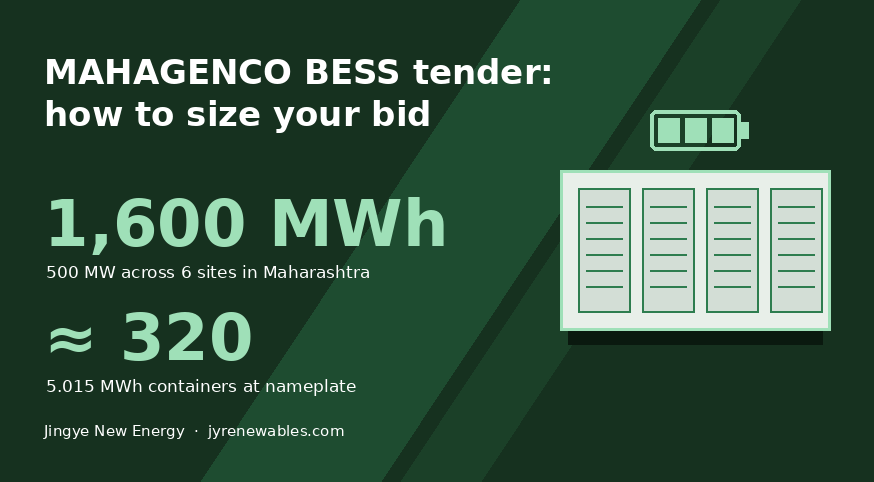
MAHAGENCO has tendered 500 MW / 1,600 MWh of battery storage at six Maharashtra sites. At nameplate that is about 320 containers of 5.015 MWh and 200 PCS skids of 2.5 MW; here is how to size each site and what bidders should check.
Oct. 26, 2026
SCADA Systems for Utility-Scale Battery Energy Storage
A SCADA system for utility-scale battery energy storage gives operators one clear view of battery racks, the battery management system, the energy management system, and the power conversion system. It collects live data, sends control commands, and warns teams about unsafe conditions. For large battery energy storage systems, good SCADA design can reduce response time from minutes to seconds and
Let’s Get Started on Your New Energy Journey.