Mar 20, 2026
After JINGYE designs a tailored energy storage system, the next step is solution approval, where we confirm that the proposed configuration meets your technical, operational, and budgetary requirements. This stage ensures the system is fully aligned with your project goals before moving into production.
JINGYE New Energy establishes a special business docking team to conduct multiple rounds of solution communication with customers, confirming technical details, quotation components, delivery arrangements, and other aspects one by one. It supports organizing technical review meetings according to customer needs, inviting enterprise technical experts and production supervisors to communicate face-to-face with the customer team, answering technical questions, and optimizing solution details (such as adjusting material configuration and optimizing delivery nodes).
Technical Review: Detailed evaluation of system specifications: capacity, voltage, modular configuration, and scalability. Verification of safety standards and compliance with local regulations.
Operational Validation: Assessment of integration with your existing energy infrastructure. Simulation of performance under expected load conditions.
Budget & Contract Confirmation: Finalization of cost, delivery schedule, and warranty terms. Formal approval from all stakeholders before signing the agreement.
Formal Solution Sign-Off: JINGYE provides a final solution document including system diagrams, configuration details, and operational guidance. Client confirmation triggers the transition to custom manufacturing.

Oct. 30, 2026
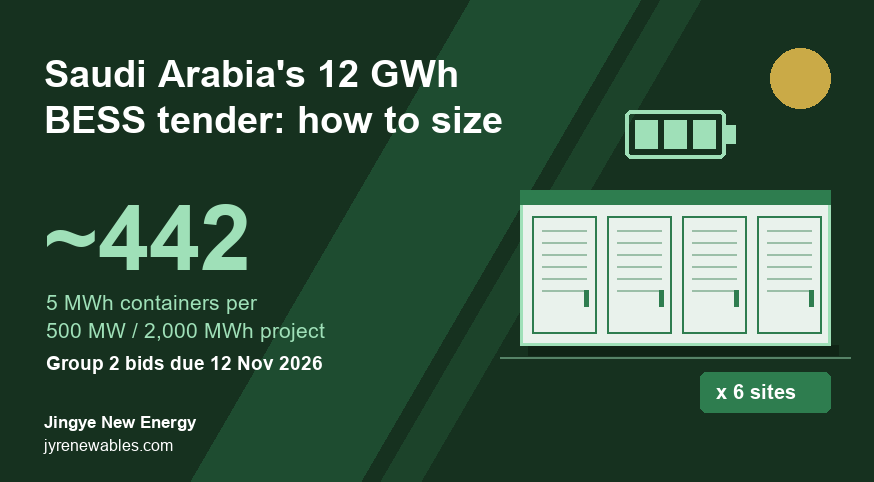
Saudi Arabia 12 GWh BESS Tender: How to Size Group 2 Bids (2026)
Saudi Arabia's Group 2 BESS tender (six 500 MW / 2,000 MWh sites, 12 GWh in total) now closes on 12 November 2026. By our estimate, each site needs about 442 of our 5.015 MWh containers to deliver 2,000 MWh at the grid, or up to 553 if 15-year degradation is built in upfront.
Oct. 30, 2026
How Many EV Chargers Does a Commercial Site Need?
If you are asking, “How Many EV Chargers Does a Commercial Site Need?”, I recommend using a five-step sizing method: measure parking demand, calculate daily energy consumption, estimate peak simultaneous charging, select AC or DC equipment, and verify electrical capacity. This approach helps businesses avoid underbuilding, reduce unnecessary capital expenditure, and create a scalable charging
Oct. 29, 2026
Transformer Requirements for Utility-Scale Battery Storage
Utility-scale battery storage depends on more than battery capacity. The battery energy storage system transformer must connect the battery racks and power conversion system to the utility grid safely. A complete design normally includes a medium voltage transformer, a step-up transformer, switchgear, protection, cooling, and monitoring. These parts control voltage, current, fault energy, and
Let’s Get Started on Your New Energy Journey.