Mar 20, 2026
Custom energy storage requirements involve tailoring battery capacity (KWH), power output (KW), chemistry, and thermal management to specific load profiles, safety codes (e.g., UL 9540, NEC 690/706), and operating environments. Key steps include analyzing consumption data, determining critical loads for backup, ensuring certification, and selecting components for longevity.
Sizing & Load Profiling: Determine capacity (KWH) based on daily consumption and power needs (KW) for critical loads. Size systems for 4-12 hour durations for optimal renewable integration.
Safety & Regulatory Compliance: Systems must meet local codes, requiring specific safety features like fire detection and proper siting.
Technology Selection:
LiFePO4 (LFP): Preferred for safety and high cycle life.
Flow Batteries: Suitable for long-duration, non-flammable, and high-cycle applications (up to 20000+ cycles).
System Components: A custom system typically integrates battery modules, a Battery Management System (BMS), and a Power Conversion System (PCS).
Thermal & Environmental Design: Outdoor systems require robust cooling and heating for varied climates, whereas indoor units must adhere to strict fire suppression guidelines.
Customer puts forward preliminary requirements (capacity, voltage level, application scenarios, size restrictions, communication protocols, etc.) The technical team preliminarily evaluates the feasibility and provides preliminary suggestions
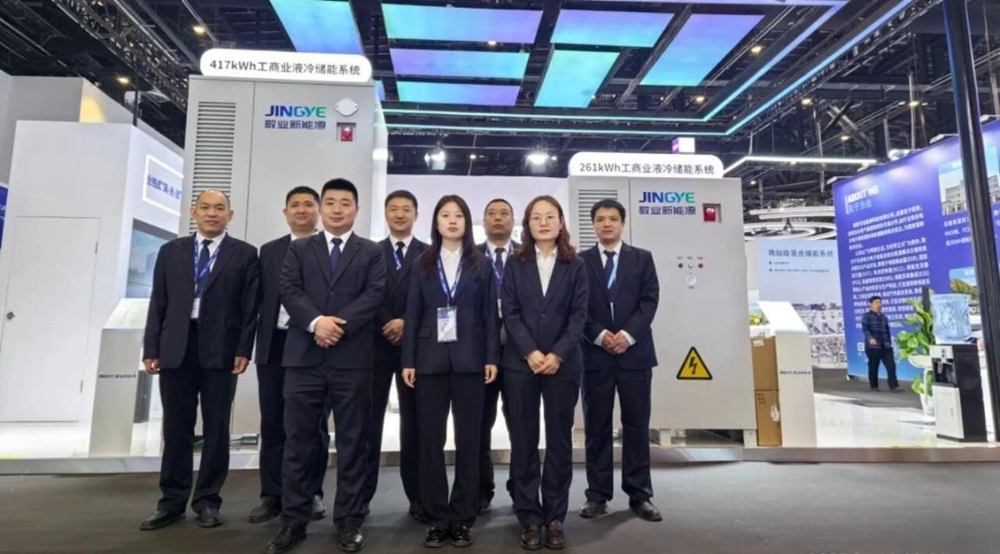
As a new energy enterprise with large-scale production capacity and a full industrial chain layout, JINGYE New Energy has established a service system combining standardization and personalization during the demand communication phase. Customers can express their core needs through multiple channels such as offline docking meetings, online platforms, and special project team connections.
JINGYE New Energy has set up a professional team to provide consulting and construction services for green and low-carbon development planning. It initiates a rapid evaluation mechanism to conduct research and analysis on high-energy-consuming parks, gaining a grasp of the park's industrial layout, energy consumption characteristics, and carbon emission status. Initial feedback is provided within 24 hours, and a preliminary communication report including technical feasibility conclusions, optimization suggestions (such as combination schemes based on existing mature modules, customized improvement directions for extreme scenarios), and references to similar industry cases is delivered within 48 hours. This ensures efficient matching between customer needs and the enterprise's technical reserves and production capacity. Meanwhile, a detailed survey is conducted on the distribution and developable potential of renewable energy in the region. The team formulates scientific carbon emission reduction goals and zero-carbon construction plans, clarifying energy transition and supporting energy storage facility construction schemes.
Sep. 22, 2026
Why EV Charger Efficiency Matters for Commercial Charging Operations
A commercial charging site can lose thousands of dollars each year through inefficiency long before an operator notices a hardware failure. When a DC fast EV charger converts grid electricity into battery power, energy is lost as heat, switching loss, cable loss, cooling demand, and standby consumption. A charger operating at 94% efficiency instead of 97% may appear to differ by only three
Sep. 22, 2026
EV Charging Infrastructure for Electric Bus Fleets
EV Charging Infrastructure for Electric Bus Fleets must deliver reliable power, safe operation, and predictable charging costs every day. An electric bus depot needs enough charging capacity to serve vehicles without delaying routes. Depot charging, battery management systems, and fleet scheduling are now central parts of daily bus operations. Electric bus fleets also require accurate energy
Sep. 21, 2026
BESS Commissioning: Key Tests Before Commercial Operation
BESS commissioning confirms that a battery energy storage system is safe, reliable, and ready for commercial operation. A complete battery commissioning test checks the battery management system, power conversion system, and site controls before the asset serves the grid. Poor testing can cause failed grid connection tests, low round trip efficiency, unexpected shutdowns, or unsafe operating
Let’s Get Started on Your New Energy Journey.