Mar 20, 2026
Before delivery, JINGYE New Energy communicates the acceptance plan with the customer in advance, provides an acceptance manual (including acceptance process, testing methods, and judgment standards), and supports customers in choosing on-site acceptance or remote acceptance mode. For on-site acceptance, technical engineers are dispatched to the customer's site to assist with product appearance inspection, quantity verification, and function testing (including no-load testing, load testing, and communication joint commissioning), and answer technical questions during the acceptance process. After the acceptance is passed, the delivery process is initiated. The packaging adopts a customized packaging scheme, where the packaging structure is designed according to the product size, weight, and transportation distance, and anti-collision, moisture-proof, and anti-static protection measures are equipped to ensure that the product is not damaged during transportation. In terms of transportation, long-term cooperative relationships have been established with large logistics enterprises, and transportation methods such as railway and sea transportation are selected according to the customer's location. The logistics information is tracked throughout the process, and the transportation progress is promptly fed back to the customer. Upon delivery, complete delivery documents are provided simultaneously, including user manuals (containing installation guides, operation procedures, and daily maintenance points), certificates of conformity, quality assurance documents, test reports, component lists, and technical drawings, ensuring that customers can quickly familiarize themselves with the product and put it into use.
Pre-Delivery Inspection: Verification of system quality, safety features, and compliance with approved design specifications. Functional testing of modules, battery management system, and overall performance.
Logistics & Delivery: Coordination of transportation to your site, including handling for large-scale containerized systems. Careful packaging and secure handling to prevent damage during transit.
On-Site Installation Support: Guidance from JINGYE engineers for correct installation, connection, and integration. Verification that the system aligns with local codes and project requirements.
Acceptance Testing & Commissioning: Comprehensive performance and safety tests on-site. Documentation of results and formal client approval to confirm system readiness.
Handover & Documentation: Delivery of all operational manuals, maintenance guides, and warranty documents. Final client sign-off completes the acceptance process and officially transfers the system for operational use.

Nov. 06, 2026
Black Start Capability in Battery Energy Storage Systems
Black start capability in battery energy storage systems allows a power network to restart after a total or partial outage without relying on the main grid. A black start battery system uses stored energy, power conversion equipment, and control software to energize a dead bus. This process supports grid forming, microgrid operation, and power system restoration. The system must also start its
Nov. 05, 2026
All-in-One vs Separate PCS Energy Storage Systems
Energy Storage Cabinets are no longer selected only by battery capacity. Buyers also need to evaluate power conversion, safety controls, thermal management, installation time, maintenance access, expansion options, and long-term operating cost. The central purchasing decision is whether to choose an All-in-One energy storage system or a Separate PCS architecture.
Nov. 05, 2026
AI Data Center Battery Storage: How to Size the BESS in 2026
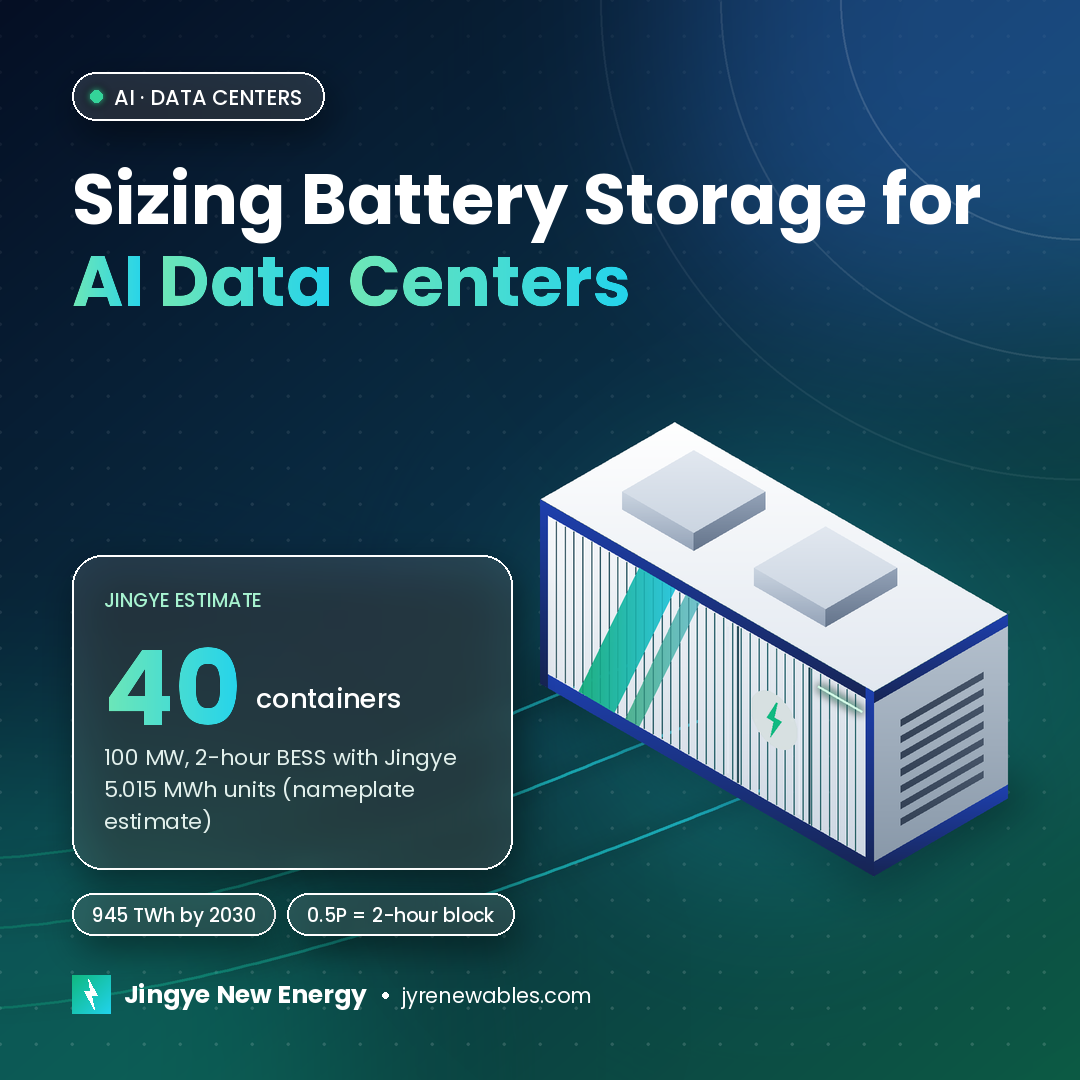
AI data centers use battery storage to smooth GPU load swings, ride through outages and manage grid limits. By our estimate, a 100 MW, 2-hour BESS needs 40 Jingye 5.015 MWh containers, and a 4-hour system needs 80.
Let’s Get Started on Your New Energy Journey.