Mar 20, 2026
JINGYE Providing installation guidance and commissioning support. Offer quick and free response and maintenance services to system fault within the warranty period.
Energy storage solutions after-sales services provide comprehensive lifecycle support, including 24/7 remote monitoring, diagnostics, on-site maintenance, and software upgrades to ensure peak system performance. Top providers offer tailored maintenance, spare parts, and training to minimize downtime. These services typically cover installation, troubleshooting, and warranty management to maximize asset ROI.
Remote Monitoring & Diagnostic (24/7): Use AI-driven, cloud-based platforms to detect potential technical issues and optimize performance in real-time.
Preventive & Corrective Maintenance: Regular, scheduled maintenance, keeps equipment in top condition, while on-site teams address routine wear and tear.
Technical Support & Training: Comprehensive support includes training for operators, rapid response to support tickets, and expert troubleshooting from firms.
Spare Parts & Repairs: Quick, on-site repairs and supply of spare parts ensure minimal operational disruption.
Warranty Management: Efficient processing of warranties to ensure long-term peace of mind.
System Upgrades & Optimization: Tailor-made solutions to update software and optimize efficiency over the life of the asset.
Responsible Disposal: Safe recycling and disposal of old battery storage systems to meet environmental goals.
Nov. 06, 2026
Black Start Capability in Battery Energy Storage Systems
Black start capability in battery energy storage systems allows a power network to restart after a total or partial outage without relying on the main grid. A black start battery system uses stored energy, power conversion equipment, and control software to energize a dead bus. This process supports grid forming, microgrid operation, and power system restoration. The system must also start its
Nov. 05, 2026
All-in-One vs Separate PCS Energy Storage Systems
Energy Storage Cabinets are no longer selected only by battery capacity. Buyers also need to evaluate power conversion, safety controls, thermal management, installation time, maintenance access, expansion options, and long-term operating cost. The central purchasing decision is whether to choose an All-in-One energy storage system or a Separate PCS architecture.
Nov. 05, 2026
AI Data Center Battery Storage: How to Size the BESS in 2026
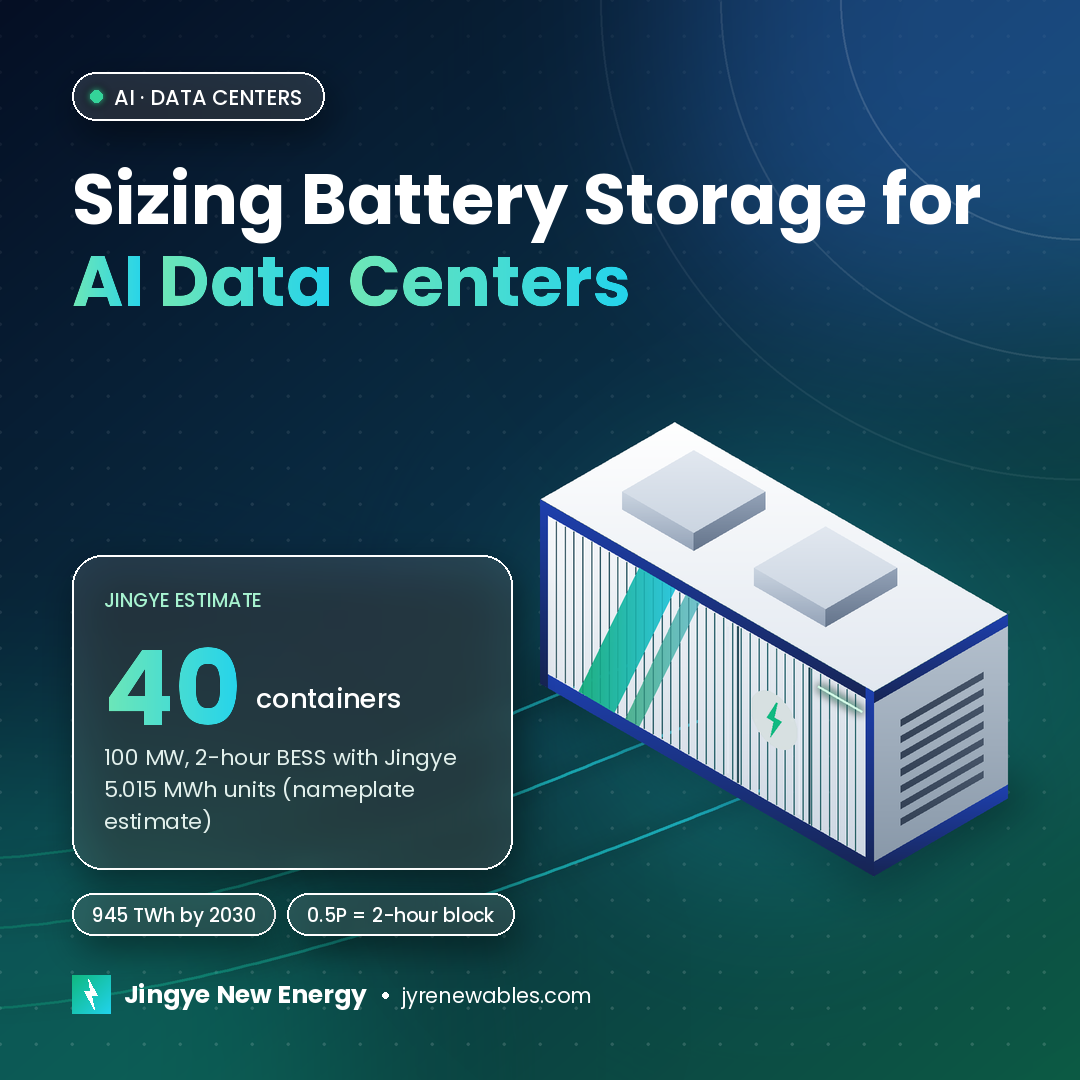
AI data centers use battery storage to smooth GPU load swings, ride through outages and manage grid limits. By our estimate, a 100 MW, 2-hour BESS needs 40 Jingye 5.015 MWh containers, and a 4-hour system needs 80.
Let’s Get Started on Your New Energy Journey.