Sep 10, 2026
The inverter is the brain of every solar system — it turns the DC power from your panels into the AC power your home or business actually uses, and decides how efficiently that happens. Choose the wrong one and you lose energy, flexibility and years of reliable service. This 2026 guide breaks down exactly how to pick the right solar inverter.
Solar panels produce direct current (DC). Your appliances, and the grid, run on alternating current (AC). The inverter converts DC to AC, manages the power flow, and (in hybrid models) decides when to charge a battery, power your loads, or export to the grid. It also monitors performance and protects the system.
Single-phase inverters suit most homes and small sites (typically up to ~6–10 kW). Three-phase inverters are for larger homes, commercial and industrial sites with heavier or three-phase loads. Match the inverter to your building's electrical supply — your installer can confirm which you have.
If storage is anywhere in your plans, a hybrid inverter saves you replacing hardware later.
Efficiency is how much solar energy survives the DC-to-AC conversion. Modern quality inverters reach 98–99%. A percentage point sounds small, but over 20+ years it's real money. Look for a max efficiency around 98.5% or higher for commercial and utility systems.
MPPTs (Maximum Power Point Trackers) let different groups of panels perform independently — important for roofs with multiple angles or partial shading. More MPPTs means more design flexibility. Small homes may need 2; large commercial inverters can have 10 or more.
As a rule of thumb, the inverter's power rating should roughly match your solar array size, often with a modest oversizing of the panels (a DC-to-AC ratio around 1.1–1.3) to maximise output. Undersize it and you clip production; oversize it and you waste money. Size it to your array and your load profile.
Can I add a battery to a normal string inverter? Usually you'd need a hybrid inverter or an AC-coupled battery. Planning ahead with a hybrid is simpler.
Is a more expensive inverter worth it? For efficiency, reliability and warranty over 20+ years, quality pays back. Don't buy on price alone.
How long do solar inverters last? Quality units run for many years; they're the component most likely to be serviced over a system's life, so reliability matters.
Jingye New Energy supplies a full range of solar inverters — single-phase residential units, three-phase commercial inverters, and utility-scale models up to 350 kW — matched with LFP storage for complete solar-plus-storage systems. Contact us for a recommendation or distributor pricing.
Oct. 27, 2026
AC Charging vs DC Fast Charging for Commercial Fleets
DC Fast EV Charger Manufacturer evaluations should begin with the fleet schedule, vehicle battery size, site power capacity, and total cost of ownership rather than charging speed alone. Commercial fleet managers want a practical comparison that explains which technology keeps vehicles available, controls operating costs, protects battery health, and scales as the fleet grows.
Oct. 26, 2026
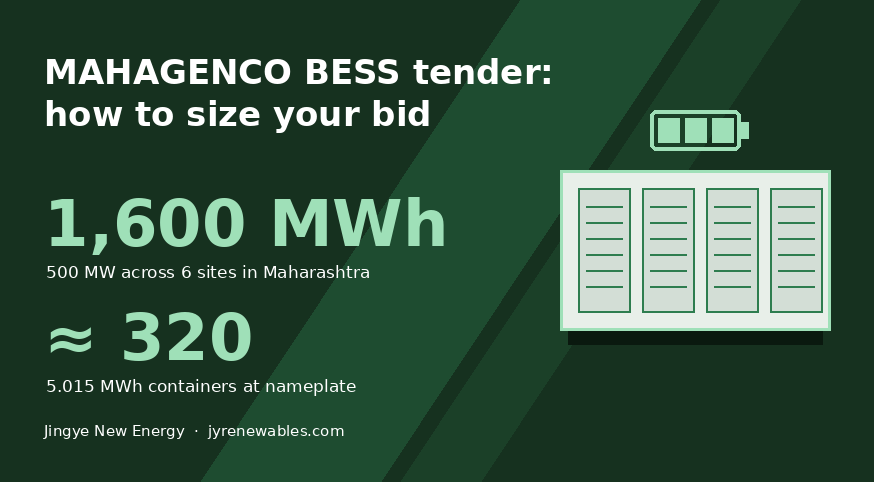
MAHAGENCO 1,600 MWh BESS Tender: How to Size and Bid (2026)
MAHAGENCO has tendered 500 MW / 1,600 MWh of battery storage at six Maharashtra sites. At nameplate that is about 320 containers of 5.015 MWh and 200 PCS skids of 2.5 MW; here is how to size each site and what bidders should check.
Oct. 26, 2026
SCADA Systems for Utility-Scale Battery Energy Storage
A SCADA system for utility-scale battery energy storage gives operators one clear view of battery racks, the battery management system, the energy management system, and the power conversion system. It collects live data, sends control commands, and warns teams about unsafe conditions. For large battery energy storage systems, good SCADA design can reduce response time from minutes to seconds and
Let’s Get Started on Your New Energy Journey.