Aug 31, 2026
Two battery energy storage systems can hold the exact same kilowatt-hours and still perform completely differently over ten years — and the reason is often how they are cooled. In 2026, the choice between liquid-cooled and air-cooled BESS is one of the most important decisions a buyer makes. This guide compares the two on the things that actually matter: temperature control, cycle life, safety, hot-climate performance, maintenance and cost.
Every battery generates heat when it charges and discharges, and heat is the number-one enemy of battery life. A cooling system removes that heat to keep the cells in their optimal temperature range. An air-cooled system uses fans to push air across the modules. A liquid-cooled system circulates a coolant through plates in direct contact with the cells, carrying heat away far more precisely.
Air cooling is simple and cheaper upfront: fans, vents and airflow. It works well for smaller systems, mild climates and light cycling. Its weakness is uniformity. Air struggles to cool every cell evenly, so some cells run hotter than others. In hot weather or under heavy daily cycling, that uneven heat accelerates ageing, forces the system to derate (reduce output to protect itself), and shortens overall life.
Liquid carries far more heat than air, and because the coolant contacts the cells directly, it holds every cell in a tight, uniform temperature band. The results are longer cycle life, more stable performance, higher usable energy density, quieter operation and better safety margins — especially in hot climates and high-throughput applications. The trade-off is a more complex system with a higher upfront cost.
Choose air cooling if the system is small, lightly cycled, in a mild climate, and upfront cost is the priority. Choose liquid cooling if the system is commercial, industrial or utility scale, cycles daily, operates in a hot climate, or needs the longest possible service life. For most C&I and utility projects in 2026 — and for anywhere with high ambient temperatures — liquid cooling is usually the better long-term investment.
As projects push toward daily cycling and longer warranties, the cost of premature degradation outweighs the upfront saving of air cooling. That is why liquid-cooled cabinets and containers now dominate new commercial and utility deployments. Jingye New Energy's 261 kWh and 417 kWh liquid-cooled cabinets and 5 MWh containerised systems are all liquid-cooled and IP55-rated, engineered for demanding, high-temperature and high-cycle environments.
Is liquid cooling worth the extra cost? For daily-cycled C&I and utility systems, and for hot climates, yes — the longer life and reduced derating typically outweigh the higher upfront price.
Is air cooling ever the right choice? Yes — for small, low-cycle systems in mild climates where upfront cost matters most.
Does liquid cooling need more maintenance? It has a coolant loop to service, but modern sealed systems are low-maintenance and the tighter thermal control reduces cell-level problems.
Which is safer? Both can be safe, but liquid cooling's uniform temperature control gives a wider safety margin against thermal runaway, especially in heat.
Jingye New Energy is the energy-storage arm of Jingye Group, a Fortune Global 500 company, with 15 GWh of annual LFP capacity. Our liquid-cooled 261 kWh and 417 kWh cabinets and 5 MWh containers are certified and export-ready. Contact us for a factory-direct quote.
Oct. 22, 2026
EV Charger Preventive Maintenance: Key Practices for Long-Term Reliability
EV charger preventive maintenance helps charging operators protect uptime, safety, and revenue over many years. A planned service program is more reliable than waiting for a fault after a vehicle cannot charge. This guide explains DC fast charger maintenance, EV charging station inspection, and charging cable inspection in simple steps.
Oct. 20, 2026
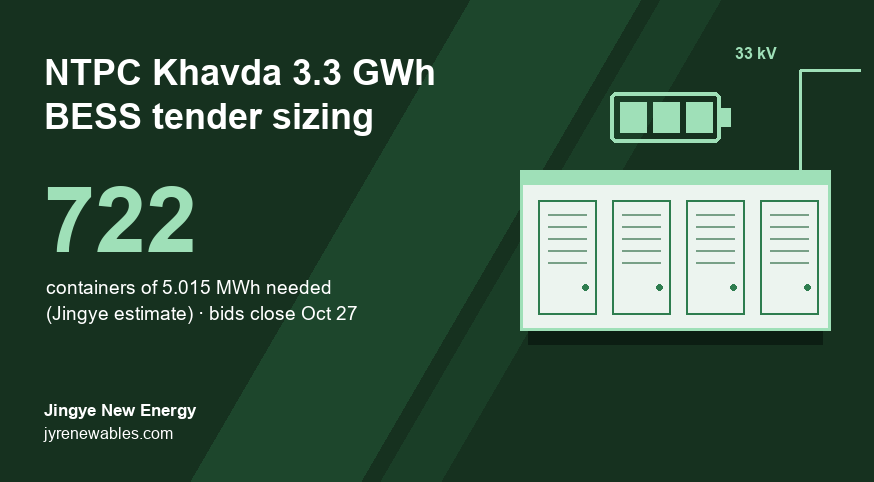
NTPC Khavda 3,300 MWh BESS Tender: How Many Containers You Really Need (2026)
NTPC Green Energy's 1,100 MW / 3,300 MWh Khavda battery tender closes on October 27, 2026. Because capacity is counted as AC energy at the grid point, we estimate it needs about 722 containers of 5.015 MWh, roughly 10% more installed battery than the headline figure.
Oct. 20, 2026
Battery Energy Storage System Architecture: Key Components Explained
A battery energy storage system architecture determines how safely and efficiently a BESS stores, controls, and delivers electricity. The main challenge for overseas buyers is choosing the right structure without creating avoidable cost, safety, or integration problems.
Let’s Get Started on Your New Energy Journey.