Aug 28, 2026
The United Arab Emirates is becoming one of the most active battery energy storage markets in the Middle East. With record solar capacity, ambitious clean-energy targets under Net Zero 2050, and cooling loads that push the grid hard every summer, battery energy storage systems (BESS) have moved from "nice to have" to core infrastructure. This 2026 guide walks commercial, industrial and utility buyers in the UAE through what to buy, what it costs, and how to choose a supplier you can trust.
Three forces are driving demand. First, the UAE is adding solar at scale, and solar needs storage to be useful after sunset and during peak evening demand. Second, the grid faces enormous air-conditioning loads, and storage shaves those peaks and stabilises supply. Third, national targets and corporate ESG goals are pushing developers and industrial users to replace diesel gensets with clean, dispatchable power. Together, these make BESS one of the fastest-growing energy investments in the country.
Almost all new projects use LFP (lithium iron phosphate) chemistry, which offers longer cycle life and better thermal safety than NMC — a real advantage in the Gulf climate.
Prices vary with scale, configuration and integration, but useful 2026 benchmarks are:
The biggest cost drivers are usable capacity, power rating (C-rate), cooling method, and the balance-of-system and installation work. Buying factory-direct from a manufacturer — rather than through a trading intermediary — typically removes a markup layer and improves after-sales support.
For safe import, deployment and financing, look for internationally recognised quality, safety and transport certifications. A credible manufacturer should be able to show documents such as IEC compliance, UN 38.3 (lithium battery transport), GB/T 36276, and quality-management certifications including ISO 9001, ISO 14001, ISO 45001 and IATF 16949. Local project approvals (for example, utility and authority sign-offs) sit on top of these product-level certifications.
Heat is the enemy of battery life and performance. In UAE conditions, prioritise liquid-cooled thermal management to keep cells in their optimal range, and an enclosure rated at least IP55 to resist dust and outdoor exposure. Good thermal design prevents capacity derating in summer and protects long-term cycle life — the difference between a system that lasts and one that fades early.
Is LFP or NMC better for the UAE? LFP is generally preferred for the Gulf climate thanks to its superior thermal stability and longer cycle life.
What size BESS do I need? It depends on your load profile and goal (peak shaving, backup, or solar shifting). A supplier should size the system from your energy data rather than guess.
Can I buy directly from a Chinese manufacturer? Yes. Buying factory-direct from a certified manufacturer is common for UAE projects and usually improves both price and support.
How long do these systems last? Quality LFP systems are designed for many thousands of cycles; proper thermal management is the key to reaching that life in a hot climate.
Jingye New Energy is the energy-storage arm of Jingye Group, a Fortune Global 500 company, with 15 GWh of annual LFP production. We supply 261 kWh and 417 kWh liquid-cooled cabinets and 5 MWh containerised systems, certified and export-ready for the UAE and wider GCC. Contact us for a factory-direct quote.
Oct. 22, 2026
EV Charger Preventive Maintenance: Key Practices for Long-Term Reliability
EV charger preventive maintenance helps charging operators protect uptime, safety, and revenue over many years. A planned service program is more reliable than waiting for a fault after a vehicle cannot charge. This guide explains DC fast charger maintenance, EV charging station inspection, and charging cable inspection in simple steps.
Oct. 20, 2026
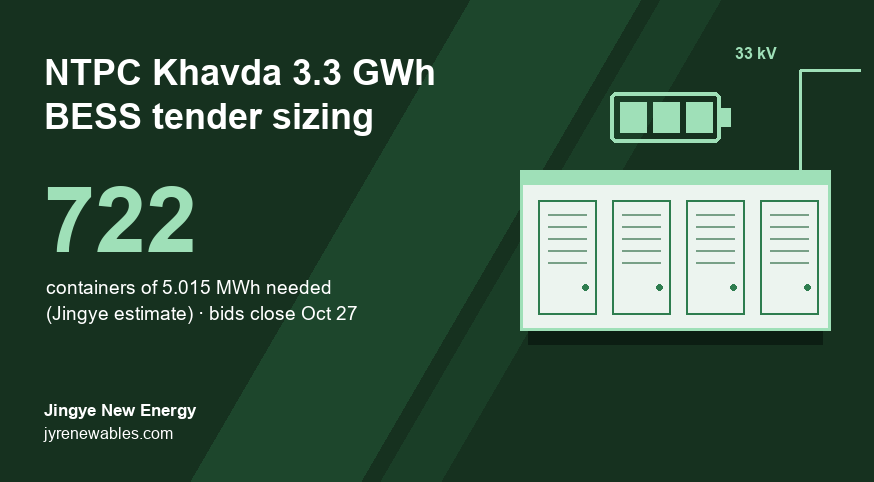
NTPC Khavda 3,300 MWh BESS Tender: How Many Containers You Really Need (2026)
NTPC Green Energy's 1,100 MW / 3,300 MWh Khavda battery tender closes on October 27, 2026. Because capacity is counted as AC energy at the grid point, we estimate it needs about 722 containers of 5.015 MWh, roughly 10% more installed battery than the headline figure.
Oct. 20, 2026
Battery Energy Storage System Architecture: Key Components Explained
A battery energy storage system architecture determines how safely and efficiently a BESS stores, controls, and delivers electricity. The main challenge for overseas buyers is choosing the right structure without creating avoidable cost, safety, or integration problems.
Let’s Get Started on Your New Energy Journey.