Oct 23, 2026
When buyers compare Energy Storage Cabinets with containerized battery energy storage systems, they are usually trying to answer a practical question: which format will deliver reliable power, acceptable operating costs, and a safe installation for the intended site? The right choice depends on capacity, available space, cooling conditions, fire protection requirements, maintenance resources, and the expected duty cycle.
This comparison explains how the two systems differ in design, battery life, stability, safety, installation, cost, and daily operation. It also provides a practical selection guide for commercial users, renewable energy developers, industrial facilities, and project purchasers working with Jingye or other energy storage suppliers.
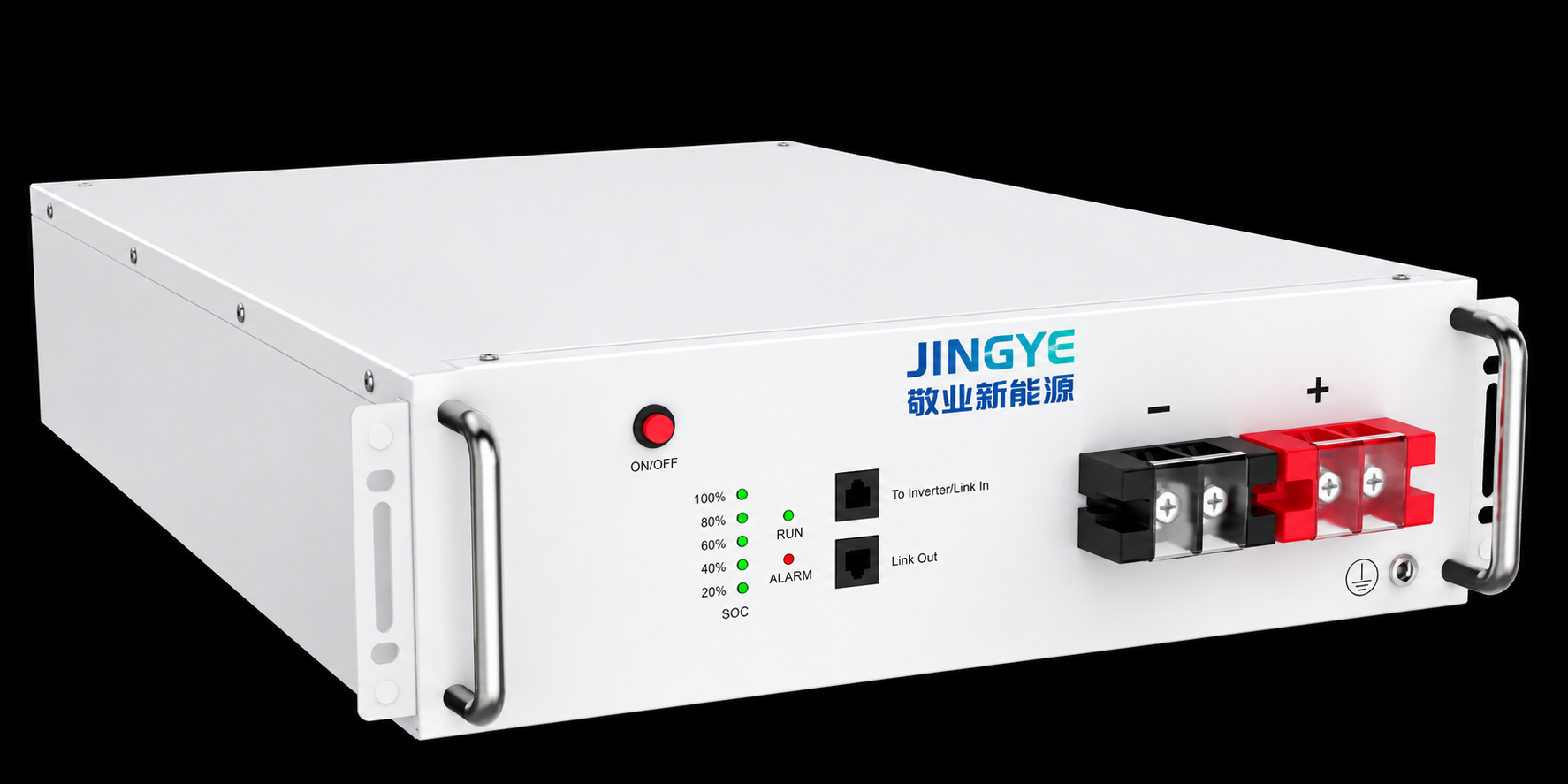
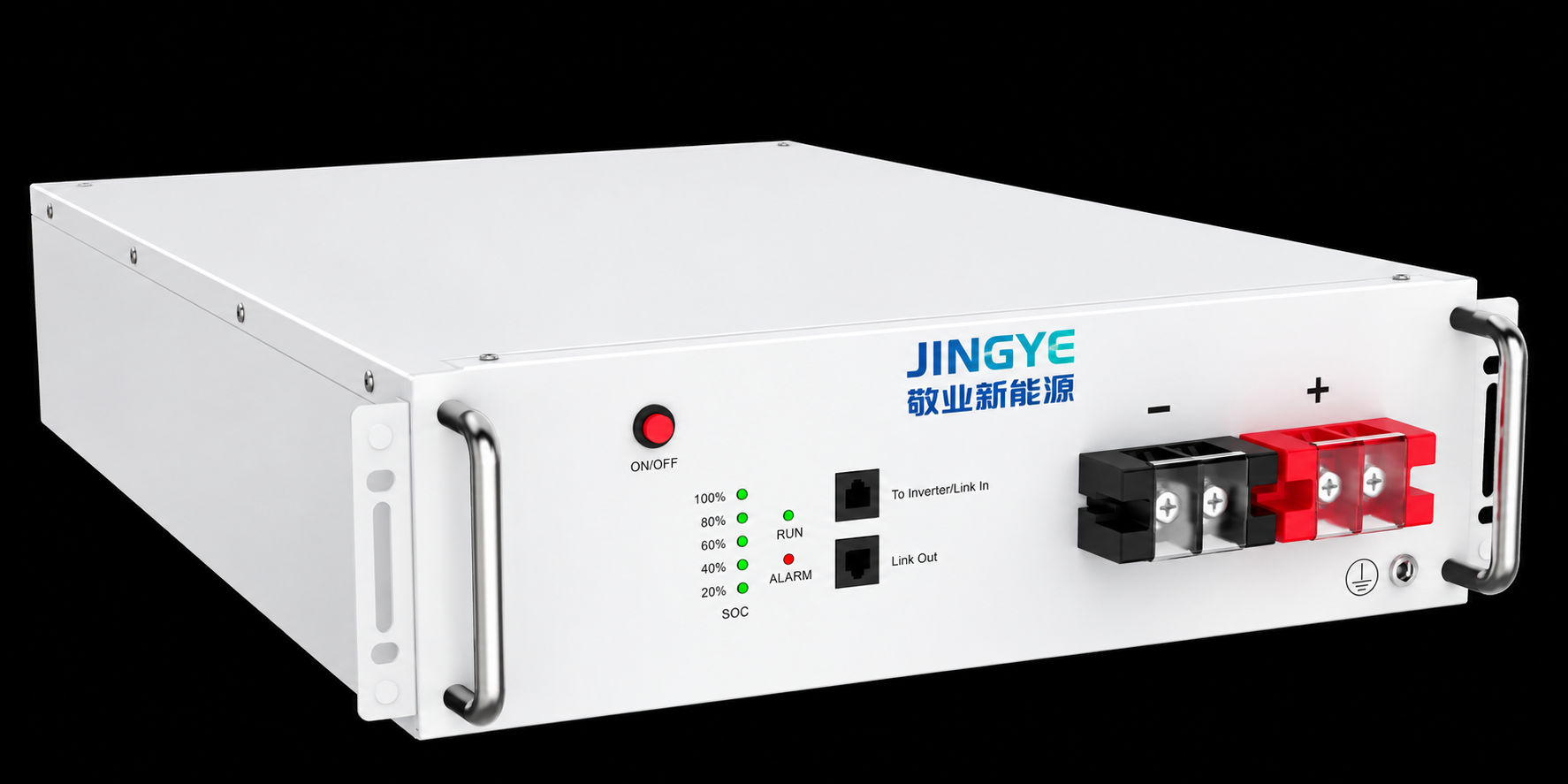
An Energy Storage Cabinet is a self-contained battery energy storage unit that normally integrates battery modules, a battery management system, power conversion equipment, thermal management, protection devices, and control software in one cabinet or a small group of cabinets.
Cabinet systems are commonly selected for projects that require moderate energy capacity, fast deployment, limited civil construction, or installation close to the electricity load. They are suitable for indoor and outdoor applications when the enclosure, cooling system, and protection rating match the site conditions.
A containerized BESS places battery racks, power conversion systems, thermal management equipment, fire suppression, monitoring systems, and auxiliary equipment inside a standard shipping container or a purpose-built container enclosure.
Containerized systems are commonly used for utility-scale renewable energy integration, grid frequency regulation, large industrial microgrids, energy arbitrage, and long-duration storage projects. The container format offers more internal space for battery racks and supporting equipment, but it also requires more planning for transportation, foundations, fire access, ventilation, and site layout.
Nominal energy capacity alone does not determine whether a system is suitable. Buyers should compare usable energy, continuous power, discharge duration, round-trip efficiency, battery chemistry, environmental range, protection rating, and the way the system will be expanded in the future.
| Parameter | Energy Storage Cabinet | Containerized BESS | Purchasing implication |
|---|---|---|---|
| Typical capacity | Approximately 50 kWh to 1 MWh per cabinet or cabinet group | Approximately 1 MWh to more than 10 MWh per container or container group | Cabinets suit distributed loads, while containers suit centralized large projects |
| Power range | Commonly tens of kW to several hundred kW per unit | Commonly several hundred kW to multiple MW per system | Compare both power rating and the required discharge duration |
| Battery chemistry | Most new systems use lithium iron phosphate batteries | Most new systems use lithium iron phosphate batteries, with other chemistries available for specific projects | Chemistry affects safety, cycle life, energy density, and cost |
| Usable depth of discharge | Often about 90 percent, depending on battery warranty and control settings | Often about 90 percent, depending on the same conditions | Usable capacity is more important than nameplate capacity |
| Round-trip efficiency | Commonly about 85 percent to 92 percent at system level | Commonly about 85 percent to 92 percent at system level | Actual efficiency depends on load level, temperature, auxiliary consumption, and PCS performance |
| Expected service life | Often 10 to 15 years with suitable operating conditions and planned component replacement | Often 10 to 15 years with suitable operating conditions and planned component replacement | Battery life depends more on cycling and temperature than on cabinet or container format |
| Cooling method | Air cooling or liquid cooling | Air cooling or liquid cooling, often with larger auxiliary systems | Cooling capacity must match local climate and the operating profile |
| Protection rating | Commonly IP54, IP55, or higher depending on the enclosure | Commonly designed for outdoor operation with reinforced weather protection | Verify the certified rating rather than relying on a general product description |
| Installation area | Small footprint and flexible placement | Larger footprint with access roads, spacing, and service areas | Land, fire separation, and maintenance access can affect total project cost |
| Expansion method | Add cabinets or battery modules in stages | Add containers, PCS units, transformers, and associated balance of plant | Cabinet expansion is often simpler for small growth, while containers are efficient for major capacity additions |
A system advertised as 1 MWh may provide less energy to the load after accounting for reserve capacity, conversion losses, auxiliary consumption, temperature limits, and battery management settings. Buyers should request the usable energy at the point of common coupling under the expected operating conditions.
The cabinet and container format does not by itself determine battery life. Battery degradation is mainly affected by cell chemistry, average state of charge, depth of discharge, charge and discharge current, ambient temperature, thermal uniformity, and the number of equivalent full cycles.
For many lithium iron phosphate systems, a properly controlled battery can support several thousand equivalent full cycles. However, the practical warranty result may be lower than the laboratory cycle rating because real installations experience partial cycles, standby time, high temperatures, auxiliary loads, and irregular power demand.
In a cabinet installation, technicians can usually isolate one unit while the remaining cabinets continue operating. This modular approach can reduce the effect of a single cabinet fault and make staged replacement easier.
A containerized system provides a more centralized design, which can simplify plant-level control and large-scale thermal planning. At the same time, a fault inside one container may affect a larger block of capacity. The impact depends on the electrical architecture, rack isolation, fire zoning, and the control system.
During actual operation, purchasers should evaluate the following stability indicators:
A cabinet system can divide a project into separate battery units. This allows the operator to isolate one cabinet for inspection, maintenance, or fault response. The result can be a smaller affected area when a problem occurs, provided that the cabinet has adequate internal separation and monitoring.
Important cabinet safety features may include:
A containerized BESS contains a larger quantity of battery material in one enclosure. This makes fire detection, thermal runaway response, gas management, fire separation, emergency access, and site spacing especially important.
Purchasers should not treat an integrated container as automatically safe. The complete project should be reviewed, including battery racks, container construction, ventilation, fire suppression, transformer placement, cable routes, emergency response procedures, and the distance between containers.
Cabinets are often delivered as factory-assembled units. After positioning, the installer typically connects the AC side, DC or battery connections where applicable, communications, grounding, and auxiliary power. This can reduce field assembly and shorten the commissioning period.
Cabinet installation still requires careful planning. The site must support the cabinet weight, provide adequate ventilation or cooling clearance, protect the equipment from flooding, and allow technicians to open doors and remove components safely.
A containerized BESS can reduce the need to construct multiple equipment rooms because the enclosure, battery racks, cooling, and protection systems are integrated before delivery. This is valuable for remote projects and large renewable energy sites.
However, the project may require heavy transport, crane lifting, reinforced foundations, wide access roads, and additional equipment such as transformers, switchgear, fire water systems, and fencing. Poor transport planning can cause delays even when the container itself is factory ready.
For a commercial facility that needs a few hundred kilowatt-hours or a moderate peak power rating, an Energy Storage Cabinet may avoid the cost of a large container foundation, heavy lifting, and extensive site infrastructure. Modular expansion can also prevent the buyer from paying for unused capacity at the beginning.
The main cost factors include:
For large projects, a containerized BESS may provide better cost efficiency because the battery racks, cooling equipment, monitoring, and enclosure are integrated into a repeatable block. Procurement, transportation, commissioning, and plant control can be standardized across many identical units.
Nevertheless, the total installed cost may increase because of:
Buyers should compare both formats using the same project assumptions. A lower equipment quotation may not be the lower-cost solution after installation, electricity losses, maintenance, degradation, and replacement are included.
The cabinet format is often the better choice when the project is close to the load, has limited space, or will grow in stages. It can also be more convenient when the owner wants to distribute storage across several buildings or electrical zones.
Advantages include:
Disadvantages include:
The container format is usually more attractive when the project needs megawatt-scale output, multiple hours of storage, or a centralized grid connection. It is particularly useful for renewable energy plants and large industrial sites with sufficient land and infrastructure.
Advantages include:
Disadvantages include:
Choose Energy Storage Cabinets when the main objective is to reduce peak demand, increase solar self-consumption, provide short-duration backup, or manage electricity use close to the point of consumption.
This format is especially suitable for:
Choose a containerized BESS when the project requires high power, several hours of discharge, a centralized medium voltage connection, or repeated operation across a large number of storage blocks.
This format is especially suitable for:
Some facilities benefit from using cabinets near sensitive loads and containers for centralized bulk storage. This arrangement can provide local backup, reduce feeder congestion, and support renewable energy integration at the same time.
A hybrid design should be considered only after reviewing:
Before selecting a supplier, request documentation that explains how the system performs in the actual climate, duty cycle, and grid environment. A generic product brochure is not enough for a bankable project decision.
A battery warranty may specify calendar years, equivalent full cycles, throughput energy, retained capacity, or a combination of these limits. The purchaser should confirm which condition ends the warranty first and whether the warranty includes augmentation or replacement.
Ask the supplier to clarify:
Purchasers should request operating data from comparable projects rather than relying only on stated cycle life. Useful evidence includes availability records, alarm frequency, temperature trends, capacity retention, response time, maintenance history, and the time required to replace failed components.
Questions for supplier interviews include:
Energy Storage Cabinets are generally the stronger option when the buyer values compact installation, staged expansion, localized backup, and direct integration with commercial or industrial loads. They are a practical solution for facilities that need moderate capacity without building a large centralized energy storage plant.
Containerized BESS is generally the stronger option when the buyer needs several megawatt-hours of capacity, high power output, long discharge duration, or a standardized design for a large renewable energy or grid service project. The buyer must be prepared for greater site, logistics, safety, and commissioning requirements.
Before making a final decision, compare both options using the same assumptions for usable energy, power, cycle count, temperature, efficiency, warranty, installation, and maintenance. The lowest upfront price may not provide the lowest cost per delivered kilowatt-hour or the highest long-term availability.
For many commercial users, Energy Storage Cabinets provide the best balance of flexibility, installation simplicity, and localized control. For utility-scale and large industrial applications, containerized BESS can provide more efficient centralized capacity and easier plant standardization. Jingye can help purchasers compare both configurations according to capacity, battery chemistry, cooling method, site conditions, and project objectives so that the selected Energy Storage Cabinets or containerized system delivers stable performance throughout its planned service life.
Oct. 23, 2026
Energy Storage Cabinet vs Containerized BESS: Key Differences
When buyers compare Energy Storage Cabinets with containerized battery energy storage systems, they are usually trying to answer a practical question: which format will deliver reliable power, acceptable operating costs, and a safe installation for the intended site? The right choice depends on capacity, available space, cooling conditions, fire protection requirements, maintenance resources, and
Oct. 22, 2026
EV Charger Preventive Maintenance: Key Practices for Long-Term Reliability
EV charger preventive maintenance helps charging operators protect uptime, safety, and revenue over many years. A planned service program is more reliable than waiting for a fault after a vehicle cannot charge. This guide explains DC fast charger maintenance, EV charging station inspection, and charging cable inspection in simple steps.
Oct. 20, 2026
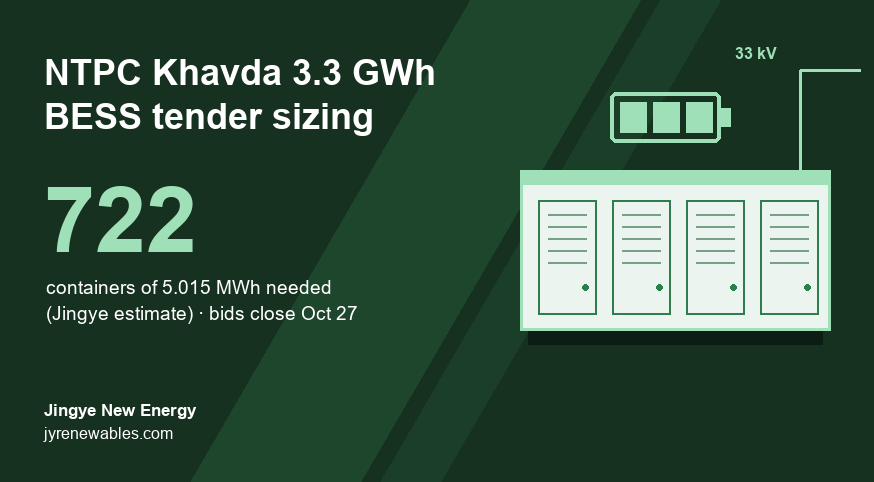
NTPC Khavda 3,300 MWh BESS Tender: How Many Containers You Really Need (2026)
NTPC Green Energy's 1,100 MW / 3,300 MWh Khavda battery tender closes on October 27, 2026. Because capacity is counted as AC energy at the grid point, we estimate it needs about 722 containers of 5.015 MWh, roughly 10% more installed battery than the headline figure.
Let’s Get Started on Your New Energy Journey.